
Based on extracts from his speeches throughout his life
Earlier installments are available for reading.
The 1970s: Vision of the Global Mission
Father and Mother moved to the United States and continued to lead the development of the global movement there and in Korea.
Part 96 [Final]
Liberation ceremony for the Moon tribe (August 5, 1973)
[Father’s prayer:]
I know that the Moon clan has not been blessed by You, Heavenly Father until now. They have experienced much suffering throughout history as a clan, to carry out the mission of building up a new nation. Even my own parents and brothers were sacrificed in that distant a place far away without any connection to the mission. Father, bless this time and liberate all our ancestors who had lived a good life so that wherever we go, we will have the privilege of being able to work freely. I am asking please open a new way for the Moon clan to uphold heavenly principles and carry out their mission as a good tribe in front of this people and the world. Heavenly Father…please permit us to make, in Your name, a new historic standard to substantially unite the spiritual and physical worlds.
As you can understand, I prayed for the liberation of my extended family in the Unification Church. Until now I have never prayed for my own family. I have never publicly prayed, “May God help my parents and ancestors in the spirit world.” But I am going to watch over our clan and tribe from now on. By doing this work, the Moon clan’s spiritual standard can open the door to the standard of liberation, and then a unified sphere of benefit is created in the spirit world. Through this connection, many clans and their relatives will be connected. Since our ancestors and their relatives are connected with other families through marriage, all people on the Korean peninsula are connected.
The forty-day workshop (Summer 1973)
When you hold a workshop, give a full set of Divine Principle lectures every three days. You have to give the lecture three times in ten days. You also have to give a course of lectures on overcoming communism every ten days. During the forty days, you have to give VOC lectures four times and Divine Principle nine times. This is the standard for you to practice throughout the world. If only one person is at the workshop, you should still do this. Why do people sometimes leave the church after becoming members? They are opposed by their family and by society, and because they don’t know the Divine Principle deeply. The final reason for falling away is the activities to raise money; even though they know the Divine Principle. Making money is not easy, so they may give up. Therefore, we need training in raising funds first, and then for engaging in mission work.
Sung-jin nim’s Blessing Ceremony (July 8, 1973)[1]
The second seven-year course is the children’s course. It is the course for the blessed children, the children of the Unification Church. This relationship has to be established in my family before the end of the second seven-year course. Therefore, I blessed Sung-jin. Three years in the seven-year course is equivalent to Jesus’ three years for the restoration of the spiritual world on the national level.
Japan, the Eve country, was to prepare a foundation of mother–son cooperation but failed to seize the chance to fulfill her responsibility. Therefore, I held Sung-jin’s Blessing Ceremony in Japan to restore that through indemnity….
He is put in a most disadvantageous position. Up to now, I’ve never taken him by the hand. I done this for the adopted sons. We are in a situation to restore the servant, the archangel, again. Won-pil Kim has been doing that job until now. Sung-jin could not call me “Dad” until he reached twenty-eight years of age. When he spoke to me he called me “Teacher.” This was for the sake of restoration through indemnity.
Sung-jin nim’s personality
When Sung-jin was to go to Japan [to study] on September 5, 1970, I told him that he should maintain his father’s dignity through his good behavior. The matter of prime importance is his attitude toward the church; the second is toward the nation, and third is the fact that he is my son….
Many rumors about Sung-jin arose, but during the thirty minutes when I met him everything was settled. Sung-jin, first of all, is a straightforward person. He is not stubborn when he is confronting what is right—as I am. If I had a son that lacked any sense of obligation, I would have to accept it. No matter what other people may say about him, I do not doubt him. That means I surely believe in him.
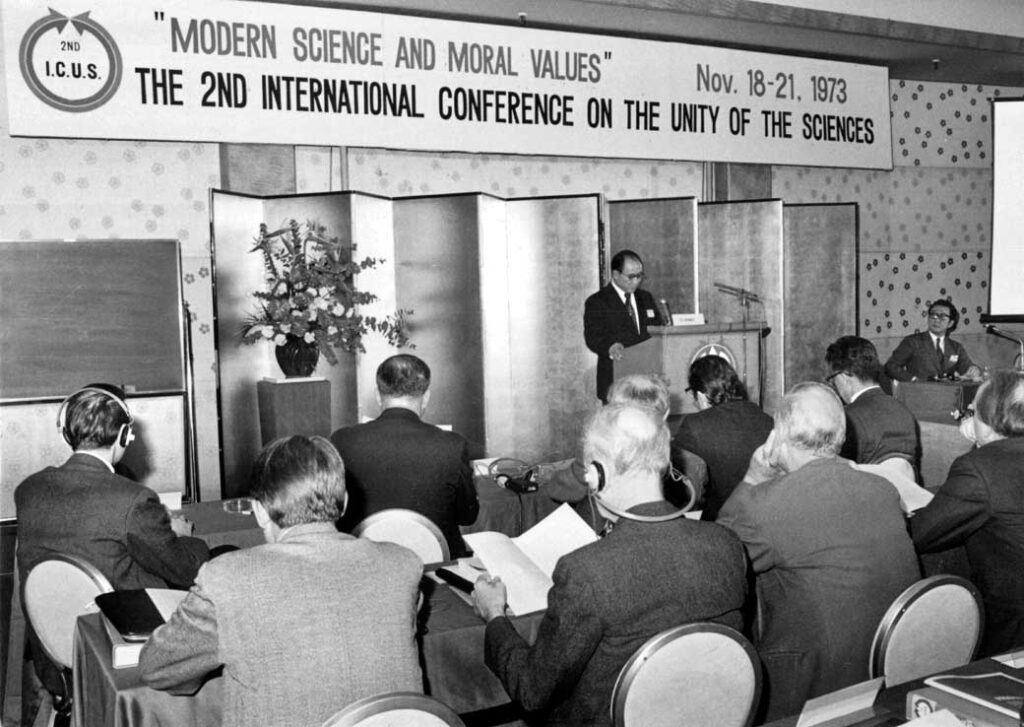
The Second ICUS (Tokyo, November 23–26, 1973)
I want you to know that ICUS (International Conference on the Unity of the Sciences) was created to establish the foundation through which we would influence the great scholars of the world. The second ICUS was held in Tokyo. Scholars from every corner of the world, including famous scholars from Tokyo University, came.
As the founder of the conference, I was prepared to give a speech. However, though it is only logical for the head of an organization to give an address, they eliminated my speech and greetings from the program. The conference was scheduled to take place the next day, and I arrived there and found that the organizers had caused this problem. So, through Mr. Kuboki, I informed them, “You can all go. This scientists’ conference is cancelled,” which was like a bolt out of the blue…. I turned everything upside down in that one evening. I told them, “You either make the correction on the programs, or you are dismissed.” Since I was paying for the entire conference, I had every right to do that. Isn’t that so? I was responsible for this. [Applause]
When this took place, they could only say “Oh, we are insulted.” They made light of Korean people and they had to make up for that. After I overturned everything, they stayed up all night to make the programs again. They didn’t really have a choice, did they? We had our own print shop, so they made haste to print my name clearly on the programs.
Twenty-one city lecture tour
(October 1, 1973–January 29, 1974)
We selected twenty-one cities and began a lecture tour in 1973. We finished it on January 28, 1974. In every city I visited in America, what do you imagine I did there? If there were any members of our church, I let them invite their parents to the speech. I told Bo-hi Pak and the president of the church in America to invite them to a big lunch or to dinner and to treat them to good food. I said that I would pay all the expenses. I let the parents come to the party with their children. I created an atmosphere in which the children spoke well of their parents. When their children spoke only of their parents’ excellence, the parents spoke about the praiseworthy character of their children, looking back on their school days. And they finally confessed, with tears of gratitude, that they had stubbornly opposed the church without knowing that their children were leading worthy lives through the church movement. Many parents hugged their children tightly with tears of remorse, saying that they had opposed them only out of ignorance.
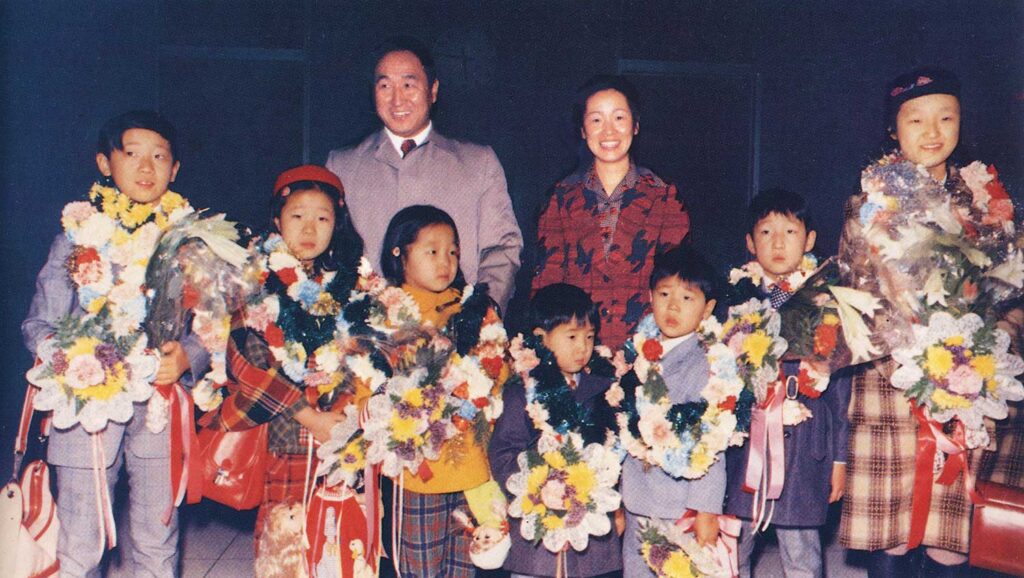
The True Children move to the United States (December 18, 1973)
The question is, If I were to leave my children here, would you be able to take responsibility for them and take care of them as I become more and more desperate? Not just Ye-jin, I have other children as well. Would you be able to take responsibility for them in a place overrun by communists no matter what? In this regard, it would be advantageous in many ways to have them under their parents’ care. You should know that this is why I am considering taking them to the United States. That does not mean that I am going to stay there for good. When I do return to Korea, it will be at a time when you can welcome me back with flags of victory raised high.
We are concluding this series with this installment. From the time of the Holy Wedding onward, Father spoke much less about his own life and family. True Parents and their family emigrated to the Unites States in the early 1970s, and the history of True Parents’ ministry is well recorded by the History Committee in the United States and in various media. We would like to thank the History Committee (as it is generally known) in Korea for contributing to our understanding of Father’s early life and the history of our church’s development in Korea, in support of our research for this series.
[1] Sung-jin nim is Father’s son by his first wife, Sun-gil Choi.