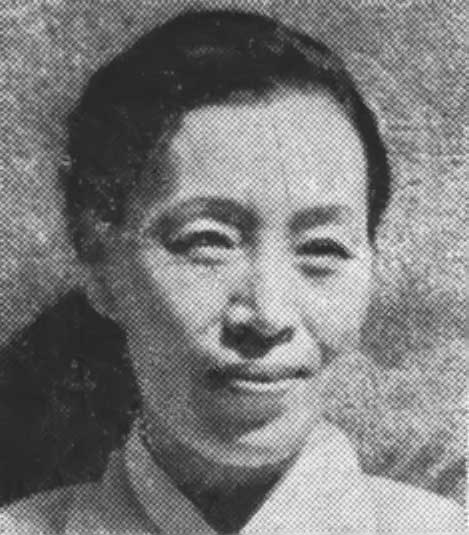
Mrs. Kang Sun-ae was born in Seoul in 1915. She graduated from Ewha College in 1937. She lived during a time when the role and value of women were changing in Korea. She had married and had children before she joined our church in 1958, without her husband. This is a testimony that evokes the Korea of a past time, and as such is a study of some of the values and sacrifices that characterized the spirit of the early period of our movement.
Part 5 (Click here to read Part 1 and Part 2 and Part 3 and Part 4)
Outreach and VOC work
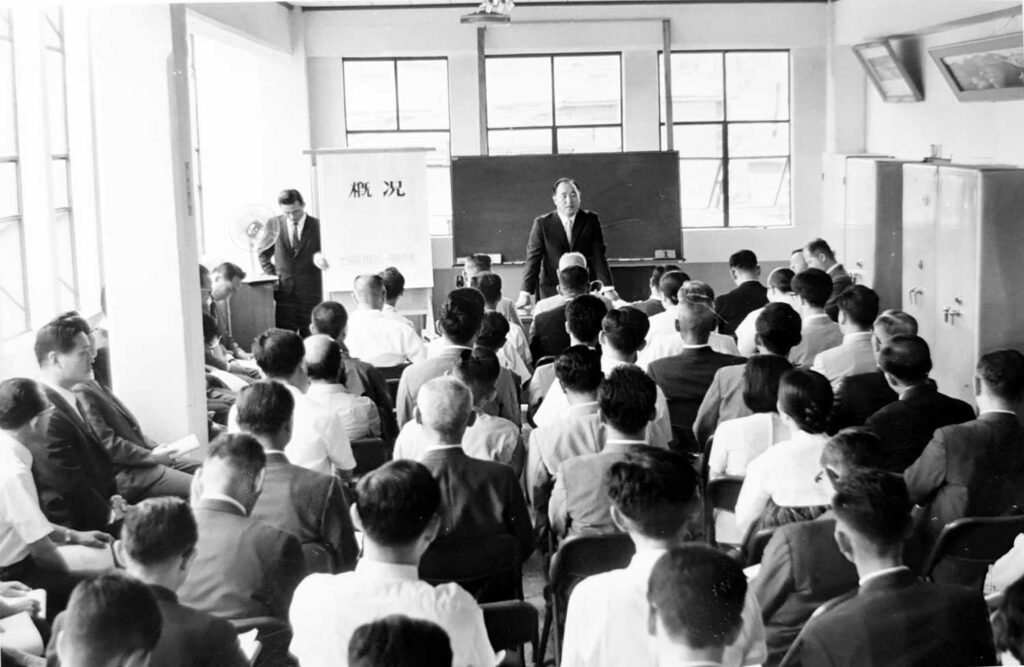
After the tour, I went back to the headquarters church. I had planned to finally take time to recuperate and begin taking medication, but Mrs. Ji Seng-ryeon came to look for me again. Once again, I had to visit our Gangwon District. We both paid a visit to the governor of Gangwon Province together with Mrs. Choi Jeong-sun.[1] After receiving the governor’s permission to give a lecture to the officers of the Gangwon provincial government, we invited Choi Chang-rim to give the lecture. The lecture received a great review, enabling us to give a lecture to even the public officers working in the city of Chuncheon. On this foundation, our activities developed by the day and we could convey our message to the chairman of the Promotion of Reconstruction Committee,[2] the director of the YMCA, pastors, universities and even broadcasting companies. We even visited the Army Second Corps, but could not meet the commander. So we went all the way to the Counterintelligence Division and asked to talk to the general in charge. An officer reprimanded us saying, “Do you know what this place is?”[3] We had lunch at a cafeteria for army officers. We also talked with the adviser on the troop information and education and the director of a broadcasting station.
Once, a Moral Re-Armament[4] (MRA) movement leader paid a visit to Gangwon and invited religious figures under the name of the provincial governor. I remember being the only woman invited.
After the governor’s skilled greetings and personal introductions, we listened to the motive and purpose of MRA. After the presentation, the governor then said, “I would like to welcome Mrs. Kang, being the only woman here today, to say a few words” and made me stand. I tried to press down my beating heart and thought, “This is the moment I should convey Father’s teachings.” I started by saying, “There cannot be a result without a cause. Hence, we can see a cause through its result.” All the participants on that day, including the governor, appeared quite surprised by my message. Many said they had difficulties comprehending such a highly philosophical lecture.
Since that event, the chairman of the Promotion of Reconstruction Committee[5] always comes to our church and give words of encouragement whenever the community leaders’ meeting was held. The entire Chuncheon area, starting from the governor to those working in the local government felt like members. However, I aimed for more, thinking, “How can I make all the people of Gangwon listen to the lecture?” So, I made another request to Governor Pak. According to him, the Home Affairs director, the Public Affairs chief, and the local section chief had to all agree on my proposal. He suggested that I meet them. I went to their offices at the provincial government building almost every day. With a heart that I had to accomplish this before Father returned to Korea from his world tour, all the prayers and dedications I invested paid off and I ended up persuading all those who opposed us.
One day, a local official, Lee Seok-bong, and I urged the Home Affairs senior director with earnest hearts. He gave in with a smile, saying, “No matter how hard I try, Mrs. Kang’s enthusiasm just outmatches mine.”
The next day, I met the local section chief and he quietly revealed to me about an internal problem and told me to talk with the chief secretary. Soon afterward, I went to the chief secretary. The chief secretary reported the matter to the governor and once he came back, he instantly summoned the Home Affairs director and the local section chief and told them right in front of me, “Why are you opposing what people are doing?[6] Tell everyone that if they don’t do it, it will be the same as committing hara-kiri.” He instructed that an official notice be sent immediately. I met the Public Affairs chief and raised my two hands up saying “I am a Unification Church member” and then put them down. He told me that I looked like an innocent child when I did that. I was certain that our pleas were conveyed to Heaven and that it was God who was helping us.
A few hours after this decision was passed, a dam collapsed, flooding the surrounding area. The flooding caused many problems. However, because the provincial government office had immediately written the official notification, it was conveyed to the church. God’s work and providence could have almost gone up in the air in one second. This enabled the community leaders to act as Victory Over Communism lecturers.
Father returns from the First World Tour
October 10, 1965, was the day Father returned to Korea. Over a thousand members came to welcome him home. As soon as he arrived, Father set off on a tour across the country and conducted ceremonies to connect the soil and stones he brought from forty holy grounds he had created around the world with Korea and the first place he went to was Gangwon Province.
The Chuncheon District had already readied a big room for Father to stay in. As for the preparation of furniture and equipment, they were divided among all the other zones and the room was well decorated.
Father arrived in Gangwon and went to the holy ground located on the hill behind the provincial government building. He spoke to all the members and gave a benediction prayer. On the day that Father had to leave, Mrs. Ji Seng-ryeon,[7] who had been waiting for the opportunity to receive a written or calligraphic message from Father, made an earnest request before Father left. Father readily accepted the request and wrote one calligraphic message for Choi Jeong-sun and her daughter Seng-ryeon and one for Pak Bong-ae’s daughter. As for me, he wrote only a single Chinese character “誠 (성 dedication);” the meaning of which was quite deep.
I could not recover to good health and stayed at the headquarters church. With Father’s permission, I went to Lee Sang-hun’s internal hospital in Daejon. I received treatment for about a month while staying in Lee Sok-jang’s place. I decided to rest and while I was taking oriental medicine, Father paid a visit to Daejon during one of his provincial tours. I pleaded with Father, “Please let me freely follow this path.” However, Father refused my request with a serious expression. I could not look straight at his serious expression and could not say anything back to Father. Father told me “to rest some more.”
After this, Father had an opportunity to come to Daejon again. Seeing me suffering from toothache, he then told me, “It is happening because of old age” and was quite saddened and concerned about my situation. Seeing Father being saddened by my suffering, I could feel the heart of a Father. Following this incident, I removed my top teeth and replaced them with dentures. They felt new and beautiful.
Staying close to Father and Mother
Early in September 1966, I set off for the factory in Sutaekri. While I was helping with the wiping of gunstocks, I followed Deok-ja, who was in charge of Father’s meals, and helped her take lunch to Father at Jangjamot Park. At night, we all huddled together and were talking when Father asked me, “Sun-ae, what is your wish?” I was quite weak and could not do much for God’s will and hence answered, “I wish I had good health.” Father replied, “If you stay here, you will recover. So please stay here.” It was so unexpected that I was taken aback. However, Mother also asked me to stay with them; I was quite sorry but did what they asked me to do. I then started to think about what I had to prepare. My mind was uncontrollably happy.
To be continued…
[1] The district director of the Red Cross
[2] After the Korean War, the nation was in ruins. Among other efforts citizens were encouraged to buy and plant trees to reforest the nation after aerial bombing had denuded the hills.
[3] He was probably implying that as an organization involved in the highly dangerous work of finding North Korean spies, their division is closed and protective for security reasons.
[4] A staunchly conservative revivalist movement founded by Frank N. D. Buchman (1878–1961)
[5] After the Korean War,
[6] Seemingly this was an issue of some people not wishing to support our movement’s VOC initiative.
[7] Wife of Lee Gi-seok, who was the church leader of the Gangwon District, a large rural province in the northeast corner of the country.