“Educating Children to Be the Best they Can Be” (Literally: Educating True Children)
Sermon by Rev. Kim Hong-deuk at Cheon Won Church, Korea
May 1, 2022
Dear Family members ~ it’s good to see you ~ how are you doing?
How was it to hear the Hyojeong Sharing of the Korean-Japanese family, Shin Seung-hwan and Hiroe Maeda? How many children have they had altogether? Five sons and six daughters, right? In fact it’s not easy to raise even one child, but to see a harmonious family growing up with eleven kids all with good manners—it’s like the model of the ideal family that God wants to achieve! Theirs must truly be the family that God is most pleased with, the family that God wants to bless the most. Let us all raise a big round of applause once more, wishing whole-heartedly the happiness of family of Shin Seung-hwan and Hiroe Maeda.
Thank you so much! Dear brothers & sisters! You may notice our Sunday worship service is changing a lot these days. It used to be called “Sunday Worship Service”; now it has changed to “Pyeonghwa Nuri,” meaning “Peaceful World.” In addition, we have “Hyojeong Sharing,” where blessed families who are working hard share about their lives; and a new feature called “Doing Hoon Dok” has been added to exemplify the family tradition of scripture reading.
Furthermore, starting today, we’ve even removed the podium as you see so as to communicate more naturally and openly like family members. How do you like it this way? I myself have been preaching by standing at the podium for quite some time, so it’s a bit awkward without one; but on the other hand, I like it because now I can feel closer together, family style. So do all you folks feel closer to me too? Yes? Thank you!
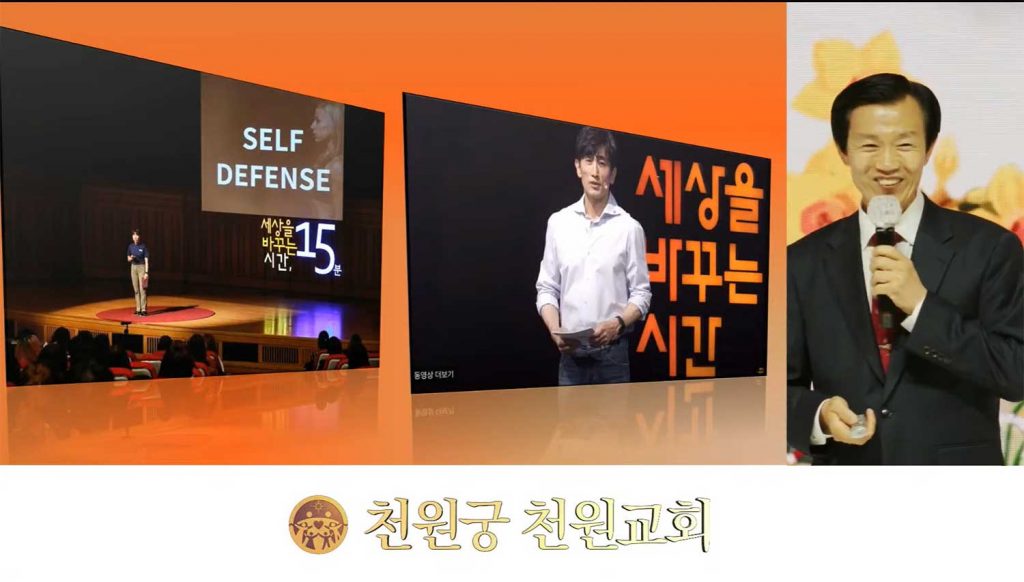
In fact, this form of giving a talk without using a podium is similar to a TV program called “Sae-ba-shi.” Sae-ba-shi is short for “A time dedicated to changing the world.” It’s a popular program evoking warm community spirit among a large audience by introducing success stories within a short 15 minutes. Let’s say a pastor gives a short 30-minute sermon every week and it helps change the lives of his congregation and strengthen their faith in God. I suppose we could put it this way: “Shim-ba-shi” could be an acronym for “A time dedicated to changing our hearts.”
So how are you folks doing today? Today starts the month of May by the Gregorian calendar. By what name do we usually call the month of May? That’s right: It’s known as the “Month of Family.” That’s because this month has the most days that [in Korea] relate to the centrality of family or reflect on the family—Children’s Day, Mother’s Day, Teachers Day, Coming-of-Age Day, and Couples Day.
Thus the main theme of sermons for this month of May revolve around “Happy Family”; and today is the first Sunday preceding Children’s Day, so I prepared my talk under the title “Educating True Children.” To start off, in Hoon Dok Hae we really read precious words on the importance of the family. Let’s read a passage from As a Peace-Loving Global Citizen:
“The most difficult aspect of family life is raising children properly. We give birth to them in love and raise them in love, but they don’t necessarily grow up the way their parents desire. What’s worse, today’s materialistic culture is destroying the innocent minds of young people. Young people should be growing up to be responsible adults capable of extraordinary things are being lost to drugs. Drug-induced states make people lose touch with their own spirit. Young people who have lost their spirit can only fall into crime and sexual immorality.”
You can’t imagine how difficult and trying it is to raise sons and daughters properly in such seductive surroundings. Every parent in the world hopes their children to be successful progeny they can be proud of. Of course parents want to attach the more strongly to them, giving them everything possible in hopes of raising their offspring to be outstanding citizens. Yet no matter how much parents labor to give birth and raise their brood with love, so often in spite of it all the kids go astray and don’t come out according to their parents’ wishes. As a parent, if you manage to land a decent spouse, have sons and daughters, make a happy family, and live life on the level—what more could you expect as a parent? But to just achieve that may be the most difficult undertaking in our lives.
The fact is, even we as parents may not know how to really be happy ourselves! Parents themselves have likely gone through plenty of trials, errors, and downright failures, and probably we’ll continue to experience setbacks throughout our lives. So the million-dollar question is how to educate our children so they will walk the straight and true path. Most parents, as they come of age, raise their own children the same way they were taught by their mothers and fathers. Yet no matter how parents do their best trying to raise their children properly, inevitably there are all sorts of ways and philosophies of discipline that mislead or deform their children’s personality, character, habits, and mentality.
Watching the TV show “Oh Eun-Young’s Golden Child”, a program with high viewer ratings, it reminds us that, in the main, children’s quirks and bad habits stem from their parents’ faulty parenting. Therefore, for proper guidance and growth of children, rather than discipline them according to the habits they themselves inherited, parents in this new age must first make effort to correct their attitude and mindset for parenthood. Going around to visit families in our community, I came to realize that often fathers don’t even take concern for their children’s upbringing and education. As a dad, I could use the excuse that I’m busy with my job or my mission, but the proof is in the pudding: The smoother relations between father and child and the better heart-to-heart sharing, the more emotionally stable both sons and daughters can mature.
Just for a breather, I came across this serendipitous poem on the internet. It’s well known—you might have already seen it. It’s a poem by a 2nd grader in elementary school:
Title: Why Dad?
It’s good to have a mom.
She makes me prim and pretty.
It’s fine to have a fridge.
Providing me with food.
A puppy’s best of all—
My fondest playful friend!
But who knows what Dads are for?
She’s got a point. So how about our dads on hearing this? Some might laugh, but it’s bittersweet, like a sadness of ennui seeping into one’s heart. How do you answer a child who doesn’t know what a father is there for? Shall a son or daughter boast, “My father works hard to make money so our family can eat.”? Maybe a better answer is, “I could be born thanks to my dad.” Perhaps the role of a father is more important and engaging, though it may seem elusive to children at home.
I'm going to show a video I once showed in a sermon two years back, but the content is touching and relevant, and many are here for the first time today, so I'll play it once more. It’s a movie that makes you think again about the existence of father for Family Month:
Translation of the VIDEO CONTENT (The video file accompanies this sermon file):

Choong-seon’s dad. Jin-young’s dad.
I’m feeling always sorry toward him.
[Young fathers of children under 40 months of age were subjected to hidden cameras in the name of studying fathers' role in children's learning and development.]

<Research Lab for Analysis of Impact on Learning & Development in Childhood & Adolescence>
“What is your child's favorite food?”
“Have you ever watched your child sleep?”
“In your car, on your phone, on your desk, in your wallet… How many pictures of your child do you have?”
“When was the last time you said I love you to your child?”

I gave the questionnaire again with the same questions; only this time the subjects were changed:

“When was the last time you told your child you love him or her?”
“When was the last time you told your father you loved him?”
“What is your dad's favorite food?”
“Have you hugged your dad recently?”
“Have you ever watched your father as he slept?”
“In your car, on your phone, on your desk, in your wallet… How many pictures of your father do you have?”

(TV) Choong-seong’s dad, Kim Yong-bong.
I’m Shim Hwang-cheong’s father, Shim Hyeon-gi.
I’m Kim Young-geun, the eldest son.
I’m Jo Young-woo—a guy who became a dad.
Jo Yoo-seok’s father.
Jin-hyung’s dad here.
Name’s Kim Seong-bok. I remember. This… son of mine. I only had daughters and finally I had a son, but I wondered what if it was a daughter again.
(fisherman) What shall I say to my mother, father, brothers and sisters ????
There are things I ought to do as a parent and it hurts me that I couldn't do it.
(glasses crying) Being a son is something no one can change.
I couldn't help my son much, but he grew up well.
Isn't it a parent's heart that's still lacking? Until the moment you die. I live with that mindset. I guess I'm still lacking.
(Teacher with glasses, white hair) I'm sorry for being so harsh. Sorry. I'm always lacking and I'm always sorry.
I'm sorry. I’m sorely lacking in every way, and I can't teach them anything.

(After family photos) Perhaps it's just a name that's forgotten, a name I was indifferent to because he was always there. A name that can't be filled with I love you. Just being by your side gives me reassurance, that name like heaven. "Father". Learn the strength of that name.
(Sermon Resumes)
That was a moving film. This comes close to our topic today: The father who lives quietly bearing a heavy burden on his shoulders as the head and protector of his family. Give a big round of applause to all the dads who are seated here among us, the pillars of the family who are persevering in this difficult world for their loved ones’ sakes! Clap!! Thanks again.
If you browse the internet, there are many good sites that can help with your childrearing and education. But there are a few books that stand out that I’d like to introduce. There’s the book Parents who can’t stand a child who can’t stand it; there’s Discipline that changes children without yelling or hitting; and there’s the booklet Mom’s Statement of Reflection. Here’s from the introduction to the booklet “This Mother’s Reflections”: “The author, an elementary school principal, was always confident as a top-notch teacher and exemplary mother. She was startled by the sudden announcement of withdrawal of her son from third year in high school, who was first place in the entire school, followed by the drop-out of her 2nd daughter close after. It conveys her vivid and sincere experience of accepting coaching at the end of her rope, after going through frustration, despair, and finally nurturing hope.”
I think we should all reflect deeply if even a mom who was so confident in child education would publish a statement of remorse that she could not properly raise her own children. In particular, the most important dimension of educating children is character education. It’s all about how to raise youngsters to have upstanding character. Character is the basic foundation of a person’s heart, and refers to personality, humane character, and comportment. A person’s entire life will be guided by what kind of character he or she has. Therefore it’s of utmost important to cultivate good character from an early age. Parents’ words, actions, character, and lifestyle are all transferred to their children lock, stock and barrel. Thus it’s clear that the home is the most important school where children’s character education takes place. So of course the parents are naturally going to be the teachers in charge of character education. Many adults these days see the younger generation and lament that the youth lack even the most basic manners and etiquette. People are really worried that home education is not functioning as it ought to. The fact is, I meet some parents whose children at home do not pay heed to their parents, so quite a few are hoping for such education at school or church.
Rev. Hak-ja Han, the Mother of Peace, is concerned about this, and is preparing to build a multi-purpose educational center called Family Park in the HJ Cheonwon Complex that will offer educational programs and cultural performances for youth. Another approach is to create a traditional hanok folk village like at Cheonghak-dong, offering educational programs oriented to character education of youngsters. How thankful we should be that someone is concerned about this matter. Please give a show of appreciation to our True Mother!
The focus of today’s sermon is education in family values and childrearing. Worldly wisdom and practical experience can be helpful, but I’d like to share what Rev. Sun Myung Moon and Dr. Hak-ja Han have to say about children’s education—for they have come as the true teacher and true parent for mankind. Rev. Sun Myung Moon and Dr. Hak-ja Han both emphasize the importance of educating children and the family more than anyone else, and have delivered many speeches on this topic. Let’s look at some of their words on this. We find this passage in Cheon Seong Gyeong (76-289, Mar. 7, 1975):
“We are to raise our children to be people who are like God. This is the standard for education. What does it mean for a person to be like God? It is not defined by the shape of one’s face, how much energy one has, or the extent of one’s abilities. Being like God means loving as God loves. It requires perfecting oneself as a person and learning to love as God loves.”
Father said the standard of education is not to raise a good-looking, capable person, but to nurture your child or student to be like God. He says sons and daughters must become people like God with a wide, deep, lofty heart who can embrace and love everyone in the world. How high-level are these words! He clearly presented the ultimate goal of educating children, that all mankind should set as the eternal standard, in all times, places, and ages.
Here are words from Cheon Seong Gyeong p. 576 (51-172, Nov. 21, 1971):
“What is it that parents should give to their children while educating them?
Education should not be about knowledge but, rather, about love. Both father and mother should teach how to become one by loving one another. They should become a father and mother with whom God is pleased, and the mother and father should be pleased with one another. At the same time, they should strive to be parents whom their children like.”
True Parents said that our sons and daughters should be educated on love, not knowledge. In other words, they say and deeply feel: “My mom and dad love each other like that, and they like us so much.” So we find in Cheon Seong Gyeong the words 555 (97-277, Mar. 26, 1978):
“Children should be able to say, “My mother and father are the best in the world! They are representatives of God.” When children see their parents’ unchanging hearts and minds, they should think, “We must emulate our parents’ love and unite with each other.” When they can say that, the ideal family is right there.” Aju!
True Parents say that for the ideal family to come true, we must become the substitute for God to our sons and daughters, having the same unchanging heart and love as husband and wife so our children can imitate and imitate us. Once I watched a YouTube video where a family affairs expert advised that the most important point to consider when choosing a spouse is if they like your mother tongue. Your mother tongue is the language spoken by your parents. In other words, you have to follow carefully the language your parents use and the type of conversations they have at home. Because children have no choice but to imitate the language and behavior of their parents, it is only natural for them to speak and act according to how they’ve been taught. If parents often get angry in front of their children, quarrel, swear, or throw objects in front of their children, the children who grew up watching it will follow the pattern unconsciously and unknowingly when they get married. That is why True Parents always taught us, “A married couple should use respectful language and respect each other the most.”
Now I’ll read a little content from True Mother’s memoirs, Mother of Peace:
“The owners of the future are our youth and young people. No matter what difficulties we face, we must hone our skills and be triumphant. We must train our bodies and minds regardless of good or bad situations in order to become filial sons and daughters and loyal servants who will go be remembered in the history of Heavenly Parent’s work. We must never forget that the pain we experience today is a strong foundation for tomorrow.”
Mother Moon said that the owners of the future are our youth, our young people. She said that no matter how difficult it may be, they must cultivate themselves and prevail, and train their body and mind to become sons and daughters of filial devotion who will be remembered in history.
President Hak Ja Han Moon, Mother of Peace, has been providing education and giving unfaltering love to young students from our 2nd and 3rd generation. Mother created a scholarship foundation and grants scholarships to thousands of students around the world each year. Every vacation, she gives them a variety of experiential education so that they can become true global leaders who will lead their nations and the world. She calls people to her and speaks to them with words of encouragement.
Beloved members! The road to educating children to become true children is at times difficult and trying. However, with a little effort, you can raise them to become wonderful sons and daughters. To do so, first, as a parent, you must feel your own shortcomings, have an attitude of deep reflection, and constantly strive to learn what is necessary to lead your children in the right direction.
As I prepared this sermon on children’s education today, I would like to make one more crucial point—though none of these things I have said are unimportant. As our children grow up and become adolescents and youths, they need to develop the strength to overcome difficulties independently. However, the secret to raising a child’s self-esteem is none other than praise. Nothing special and nothing new. It’s something everyone knows well.
As it’s said that praise makes even whales dance, the importance of praise can hardly be overstated. This is true not only in the education of children, but also for all human relationships. This is because compliments are the words that put a person in a good mood above all. Although it may be the most effective words and most cost-effective method, it is a fact that very few people actually practice this deed of praise.
Maxim Gorky, a leading Russian literary writer in the early 20th century, said:
“A compliment is the magical sentence that makes an ordinary person special.”
It is said that everyone feels that they are special when they receive a compliment. In fact, is there anyone in this world who hates being praised? No one. Not only our children, but we as parents also feel the best when we hear compliments from our children. And even God is the same. He wants to receive songs and exultation of praise, honor and glory from those whom He created as His children.
If little children are praised by their mothers and fathers, they will probably want to dance for joy as if they had won everything in the world. This is because, for sons and daughters, the existence of their mother and father is perhaps greater than God’s existence and as such they have the greatest ability to do what the child wants. Therefore, sometimes a word of rebuke from the mother or father leaves behind pain that cannot be washed away for a lifetime, while a word of praise from a parent becomes the great encouragement and empowerment that changes the destiny of the child.
The same goes for couples. Husbands and wives shrug their shoulders at the compliments they hear from each other. But if, on the other hand, a husband and wife say words that hurt each other’s feelings, what will be the result? You know, without my telling you, what can happen.
In True Parents’ Sermons volume 315 at page 247, we read:
“How much is it worth praising someone? They forget they are hungry. Father said that the power of praise is so great that the person even forgets that he is hungry.”
We have four children in our family, two sons and two daughters. I thought we had a lot of kids, but today, seeing the family with 11 children, Seung-hwan Shin and Hiroe Maeda, I feel I couldn’t even give them my business card. As I was preparing my sermon, I suddenly remembered what happened to my youngest son when he was in elementary school. At that time, I would usually emphasize to my children about tidying up and cleaning their room. One day, my youngest son seemed to have worked hard to clean his room as he wanted to receive his father’s praise.
As soon as I came home, he ran up and said proudly, ‘Dad, look how I have cleaned my room.’ But I didn’t really look at him and just said casually, ‘Well done.’ As surely my words were not sufficient, he re-emphasized the point by saying, ‘I mean, I cleaned it!’ But I simply complimented him by saying, ‘Yeah, you did a great job.’ He wanted to say this was not enough, so he took my hand and stroked his hair with it, saying, ‘You should praise me like this a little bit.’ So, hugging my son tightly and stroking his hair again, he said, “Hey son, you did a really good job of cleaning ~ My son is the best”! I remember how I praised him with all my heart.
I realized that praise also requires skill. Praise is effective only when praising the other person so that they are satisfied and feel moved. Formulaic compliments, lip service, and reluctant praise will only create a sense of rejection. In addition, our facial expression is more important than our words alone, and expressing our feelings with our whole body will have a much greater effect.
Beloved members! I will come to the conclusion of my sermon for today. As I was preparing the sermon under the title of “True Education for Children,” I thought that there are an infinite number of things we need to learn and realize while living in this world. Also, I thought that there must be a lot of things we learn wrongly or misunderstand in life. Then I came to the realization that the most important knowledge is to know God properly.
So, while living a more diligent life of faith, I resolved to study and learn the Word of God and make this short life into the most valuable and regret-free life. Today I spoke on the topic of true education for children, but the week after next, May 15th and also May 22nd, I would like to take the topic of being true parents and true couples, respectively. We look forward to your participation in the next Peace Nuri.
Lastly, I pray that all the family members who have participated in today’s Peace Nuri and all the new people who came to our church service today for the first time will always be blessed with the love of our Heavenly Parent and with a happy family. In wishing these things I conclude my sermon.
Thank you. Let us pray together.