Based on extracts from his speeches throughout his life
Part 39
Earlier installments are available for reading.
Suffering in Pyongyang Prison and Hungnam Labor Camp
The prison captain, who took care of the prisoners’ eating and living conditions, would often ask, “Are you thankful to the leader, Father Kim Il-sung, who loves us and feeds us every day?” The inmates would say yes.
There were reflection meetings, which were a time for self-condemnation. Young people in the Communist Party were usually placed in the front. They would form the security team, which kept an eye on all the administrators. They would give lectures on communism and prisoners would be asked to write self-reflections, which were later compiled into a book. Those who wrote good essays were called to the front and had their essays read aloud.
One of the most difficult aspects of prison life was writing reflections. I never wrote even one. I always submitted blank paper, but that wasn’t a problem as long as I reached my daily work quota. Therefore, I became a model worker. There was no other way to survive there. I know North Korea better than anyone else does. I studied the North Korean system well while I was in their prison. So I know how the fundamentals of communism work.
Gaining mastery over the physical self
Even under the direst circumstances, we are responsible to serve and attend God. That is to say, the road to heaven should shine even if you are in hell. In prison, they provided only a third of a cup of water to drink at night. That was the ration. Instead of drinking it, I wet a cloth with it and cleaned my body. I risked punishment if I was caught. I would get up ten to fifteen minutes earlier than others in the cell to take that cold bath.
One should also exercise. You have to maintain your stamina. I have an exercise program that I designed. It’s very effective.
I always prayed to sanctify a place when I sat down or got up in order not to be made dirty. Even while sleeping alone, I didn’t spread out my arms and legs. God is above you. There is even etiquette for sleeping.
We had some free time on Saturdays and Sundays. You could take a nap after a meal. For three years, I didn’t take a nap even once, which is why those in the prison would say they’d never seen me sleeping. When you are very sleepy, your eyesight dims and your eyes become very tired. However, once you make a determination, you must keep it.
After going through that kind of training process, you feel God’s helping hand as soon as you lie down. When you are so tired that you fall asleep without even changing clothes, do you think you will be able to open your eyes going to the toilet? It is difficult to go to the toilet because it is so dark, but you can see the path clearly. Your hand becomes a flashlight; there is such a way. You have to connect with such a realm.
Longing and gratitude
One cannot feel how precious liberation is without having gone to prison. To those sentenced to life imprisonment, freedom had infinite value.
In prison, hearing that you had a visitor was the most wonderful news. It was the same for me. Prisoners missed being able to share with someone heart-to-heart. When given that chance, how happy and joyful the prisoners would become! You can’t ever imagine, even in your dreams, that you would yearn for such a thing.
When you see the sunlight, it looks like a string of candy. Or, should we call it a string of honey? Anyway, it is good. People in prisons can tell you in genuine terms about the sun, because it is they who like the sun the most.
People who understand about time might respond emotionally to the changing seasons or the falling snow. When I was in a grievous position, receiving persecution, having lost my country and being chased out of my home, you can’t imagine how much I longed to hear familiar Korean folk songs.
When summer came, I envied insects who were outside making sounds. A prisoner even envies a fly, which can fly freely in and out of the barred window. You would be envious of them. Why did God make me follow this path? He wanted me to understand how such a person feels. I was grateful for this.
I had many kinds of friends—fleas, bed bugs, mosquitoes and houseflies. We caught them and made them run around. Our conversations with them would probably fill a couple of hundred volumes.
Guards and cell mates
Even when I was sent to the prison, I thought it was fortunate to have archangels with whips watching over me so that I didn’t go astray. I felt thankful toward the prison guards. I thought of them as archangels with clubs, preventing me from doing bad things, unlike the archangel who led Adam and Eve to fall.
Thirty to thirty-five people stayed in a small room. Among that group were all types of criminals, including murderers. You rub shoulders with those people in the cell. While sleeping, you sometimes hold them. You do all kinds of things together. They step on you on the way to the toilet bowl at night, or they trip and fall on you. I could tell you all kinds of anecdotes. There were no class divisions; everyone was equal. Prisoners sometimes defecated in the bucket while you were eating right next to it. Even so, you had to eat and drink without complaining. You would go out to work holding hands.
If I were sent to prison, I could make the inmates look up to me within three days. I understand that world so well. It is like society on a small scale. I understood the prisoners’ backgrounds well. So I took care of and supported those folk, crying with them, feeling sympathy for them, dealing with them as if they were my own family. We need such training.
Greeting with the eyes alone
The prison consisted of six blocks, all interconnected. Other inmates might want to meet me, even though we were under the strict, watchful eyes of the prison guards. Just to meet me, some inmates would stealthily crawl beneath the guards’ line-of-sight. In the morning, when we were out of our cells in the narrow corridors, we would stand in four lines. It was a narrow corridor, but they would make their way to me, wink and give me a quick embrace. This made a deep impression on me.
A guard would hit, with his rifle butt, anyone discovered doing this and send him to an isolation cell for one to three weeks. These people would make plans to escape. Those discovered for a third time planning to escape would be punished with death. Despite that, they would still make effort to meet and greet me, because that would be the most glorious part of their day. They played that kind of game.
This went on for several months. I began to think it might cause a problem, and I would break out in a cold sweat. Sometimes they would greet me lying down flat. You could not know the taste of such tragedy, pitifulness, unless you experienced it.
You surely cannot grasp the deep communication of the heart made through just our eyes unless you have experienced it. Even if you studied volumes of encyclopedias, you still wouldn’t know. Sometimes I felt God Himself smiled, thinking, How wonderful! when He saw the beauty of these relationships.
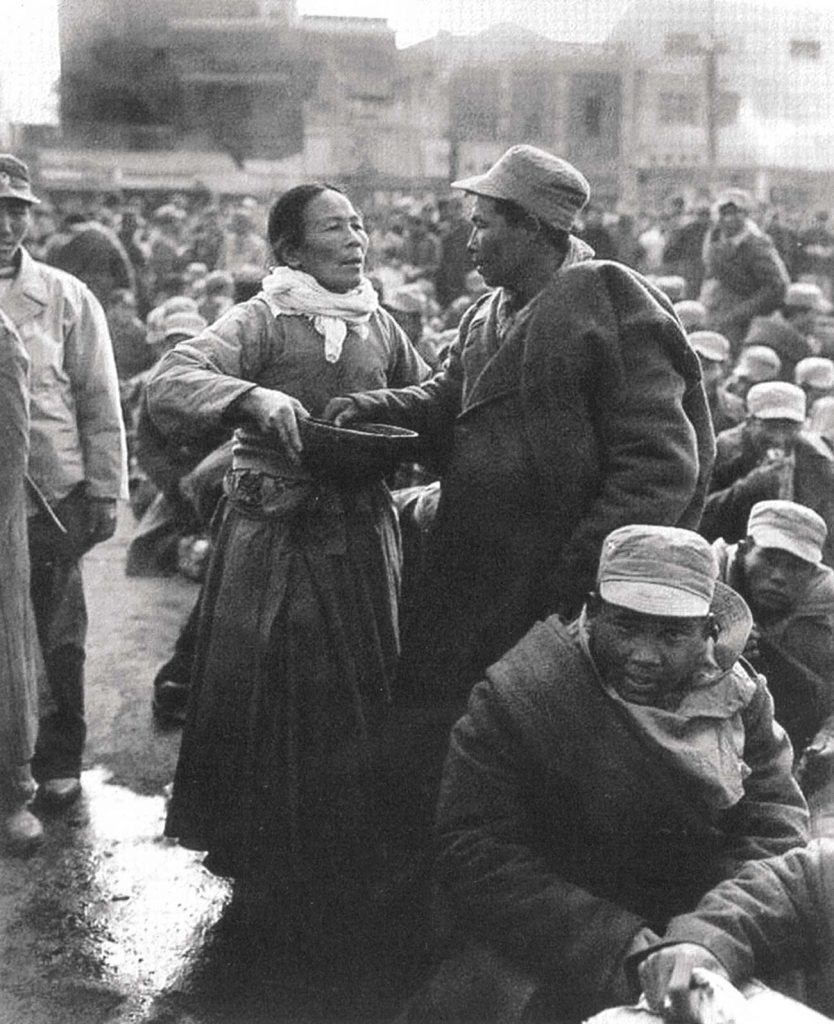
turned away the comfort of her love. Here, with Korea in the
throes of war, a mother sees off her son (in an army uniform).
Compassion for inmates sentenced to death
Prison life was the best training ground for me. It was a training ground that challenged me to feel true love for people, to truly love my enemy, and to rub noses and share breath with inmates who’d been sentenced to death.
I slept beside them; we used each other’s arms as pillows. At times, one would wake up at two or three in the morning from a dream. Then he’d inhale deeply. You don’t know how deep the attachment to life is. On many occasions, I witnessed the pitiful sight of a man calling out his own name, his face pale. He would sigh deeply, his face showing indescribable misery. He didn’t know if that would be the last thing he did.
Prisoners always thought, If I could just have the chance to do it over again, things would turn out differently.
For those under sentence of death, nothing would be impossible. If one could save his own life by walking through the whole city of Seoul with a cup of water balanced on his forehead, he would do it.
I realized that while in prison I needed to be able to shed more tears for the people I comforted than a father would when leaving his child. Unless I could do that, I couldn’t take responsibility for restoration. Only with this kind of heart could I move these people. When I held the hands of these men, I wanted to comfort them. I would explain to them that this life isn’t all that there is, but that our eternal life sprouts from our life on earth.
My mother’s visits
My mother traveled hundreds of miles to visit me in prison. When she came, however, I commanded her sternly. Shyly, she mumbled, “I am your mother.” She stood there with quivering lips, wiping away her tears with her hands. I cannot put this out of my memory.
I reproached her, saying, “What is this? Before I am your son, I am a son of Korea, a son of the world and a son of heaven and earth. You must understand that based on having loved those, I must listen to and love my mother. I am not a son of a small-minded person, please show the proper attitude of a mother who has such a son.”
To go to Hamhung,[1] one had to come down to Yongsan [in Seoul] and take the train on the Gyungwon line. There wasn’t any other way. But to travel to Seoul on the Gyung-ui line and change to the Gyungwon line. To get to Hamhung was an extremely difficult journey that took about twenty hours. To see her son, whom she couldn’t forget, in a communist prison camp, my mother borrowed handfuls of rice from distant relatives, roasted it and made flour, and braved the long journey.
She was devastated when her son reproached her. In the visiting area, he dipped his hand into the rice and distributed it among the inmates. I even shared out the clothes she brought, such as the silk trousers I had worn at my wedding ceremony. I always wore worn-out prison clothes and my skin was exposed. Even the underwear she’d brought was distributed.
My mother sobbed bitterly. She was devastated and at a loss for words. When she returned to Elder Moon Yong-gi’s house, she cried her heart out. I’m fully aware of this.
To be continued.
[1] A large city not far from Hungnam