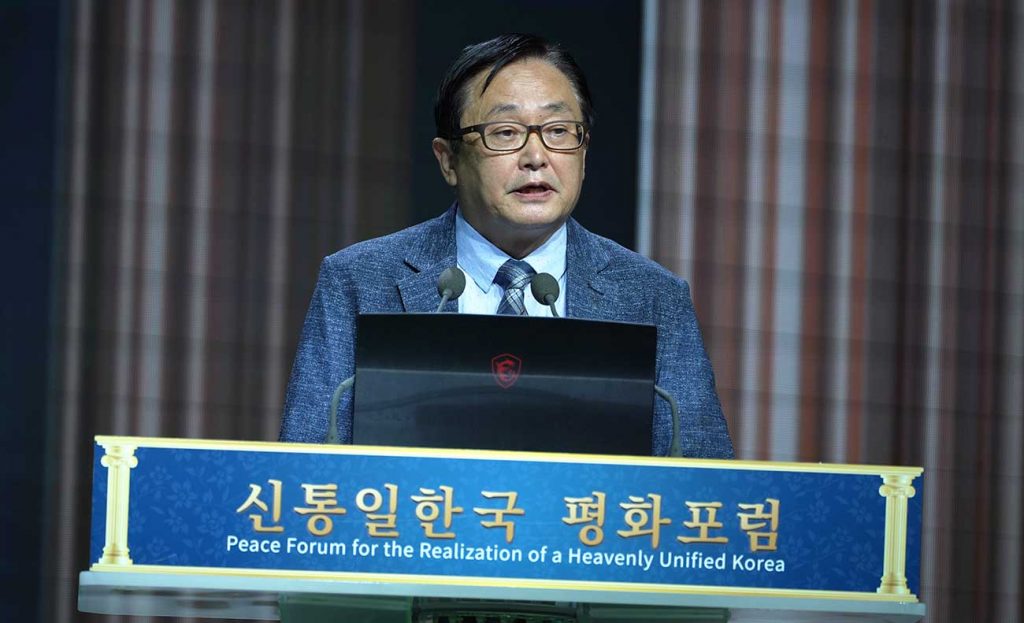
Dr. Jin Sung-Bae gave his first lecture on the theory of the heavenly unified Korea during the first Peace Forum which was held on August 21, 2021
Introduction to the Theory of Heavenly Unified Korea
South Korea established a single government in 1948 based on liberal democracy and market economy, and has grown into a G11 country. After establishing its own single government in 1948, North Korea nationalized all land and provided housing, medical care, and education for free. At the beginning of the regime, society stabilized, but as Kim Il-Sung established the only hereditary system, productivity gradually declined, economic growth slowed, finally became the world’s poorest country facing a serious economic crisis. The Chosun Workers Party, the heart of North Korean power, was founded on October 13, 1945, and defined the party’s ideology as Marxism-Leninism. At the 5th Congress in November 1970, the Kim Il-Sung Juche ideology was first introduced along with Marxism-Leninism. At the 6th Party Congress in November 1980, Marxism-Leninism was eliminated and the Kim Il-Sung Juche ideology was stipulated as the only party philosophy. Politics for the Kim Il-Sung family began, not for the people. The indoctrination in the ideology of North Korea is well evident in the Chosun national view of history. North Korea is fabricating the history of the nation in line with the history of class struggle. The history of North Korea is a story of class struggle, starting from a primitive community that shared means of production, it goes through a class society stained with possession and exploitation of the means of production, and results in a communist society in which the means of production are commonly shared. North Korea holds fast to the historical materialism of Marx, Lenin, and Juche according to which the entire Korean history is interpreted as class struggle heading from feudalism to capitalism and finally communism—a utopia. They interpret Korean history as follows: the Three Kingdoms Period ending in Unified Sinra, Goryeo, and Joseon Period were feudal-class societies, through capitalism that exploits the Proletarian class, a communist society will be built.
South Korea presently lacks any ideological system to match the North. Along comes the thought system of the Theory of Heavenly Unified Korea, equipped to spar with dialectical materialism. According to Godism, instead of class conflict, Korean history is the providential story of preparing the chosen nation of Korea to stand as the peace champion and save us from the greatest crisis of humanity. Korean history is not the class struggle but the survival epic of overcoming 931 invasions from the neighboring enemies, and eventually goodness won over evil up to the present.
Despite numerous invasions by foreign powers, for example a million troops of Suyangje in Su China and Dang Taejong in Dang China, the Mongolian Empire that conquered even Europe, and invaded Japan, the brave General Euljimundeok, Yeongaesomun, and Admiral Yi Sun-sin, who stood up to defeat the invaders, and especially mobilized the religious spirit of Buddhism by making 30,000 tablets of Buddhist scriptures to defeat the Mongols. The March 1st Movement faced Japanese imperial guns and swords with unarmed peaceful Mansei rally declaring independence of Korea toward peace in the Asia Pacific. All Koreans united into one transcending religion, ideology, class and status.
In overview of such a history of Korea, no one pointed out Korean history as a story of class struggle, but we could preserve our national identity by overcoming the suffering from all the outside invasions. Therefore, the history of Korea is not a class struggle, but a struggle of good versus evil, and in conclusion is the providential history of restoring the chosen nation.
When looking at the history of the Korean peninsula, the 38th Parallel (DMZ or Armistice Line) separating the South and North is not simply a military ceasefire line. The front line of confrontation of South and North is the very tense front line between the ideology of idealism and materialism, theism and atheism, one value view against another, with barbed wire and fortifications. This is because the two ideologies and regimes are hermetically sealed off from each other.
The philosophy that can unify the South and North is bound to be found in a third zone. This is the thought of Godism—a movement to restore the common origin of both South and North. The Godism movement exposes the fundamental problem of Juche in the North and the philosophical relativism in the South, overcomes these limitations, and arrives at the final destination, which is the common essence of both communism and liberal democracy. The essential philosophical problem of both regimes is the issue of freedom and equality. The solution means unifying the essence of these two antagonistic philosophies into one, rather than denying or excluding one or the other. This proposal offered by Godism is the only one way to guarantee the future.
Let us go back to the Dangun legend to find the common ground of South and North. King Dangun first established the Korean nation around 2,300 B.C. with his capital at Asadal in present-day Manchuria. He is revered as the founder of the nation. According to legend, Hwan-woong, the son of Heaven, desired to live on earth. Meanwhile a bear and a tiger, symbolizing a certain type of tribe at that time, longed to become a human being. They had to stay in a cave and eat only garlic and bitter herbs for a hundred days. The tiger gave up and ran off, but the bear persevered in the cave and finally became a beautiful woman, Ungnyeo. Hwan-woong and Ungnyeo married and gave birth to Korea’s founder and first king, Dangun.
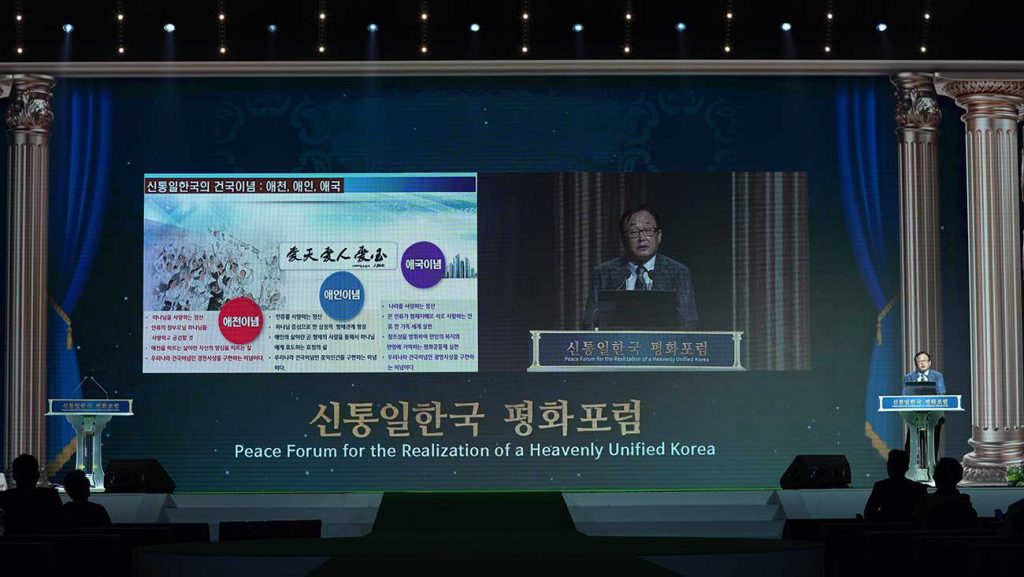
Dangun grew up, became a wise king, united the people from whom today’s Koreans are descended, desiring us to become a great, righteous nation. With divine inspiration, he taught the threefold ideal of Gyeongcheon (Exalt Heaven), Hongik Ingan (Broadly Benefit Humankind), and Gwangmyeong (Resplendent Nation). Now, almost five thousand years later, the threefold ideal of our first founder has once more become the founding ideology of the Heavenly Unified Korea: Aecheon (Love Heaven), Ae in (Love Humankind), and Ae guk (Love Our Nation)—carrying the original meaning to a new level appropriate for our time.
The philosophy of the Heavenly Unified Korea is to set up a movement that claims to restore the Gyeongcheon ideal of the first country of Gojoseon established by Dangun. Since ancient times, Koreans have been a people who serve heaven. The God Koreans have served is defined as three-in-one type of god, Hwan-in, Hwan-woong, Hwan-gum (namely Dangun). The Chinese character ‘In’ means fundamental cause. The name Hwan-in, containing ‘in’, the term for “cause” in Korean, refers to the biblical Creator. Furthermore, the philosophy of the Heavenly Unified Korea inherits and develops Dangun’s Gyeongcheon ideas as well as Hongik and Gwangmyeong ideas. Thus the founding philosophy of the Heavenly Unified Korea is love for God, love for human, and love for nation.
The philosophy of love for God is the spirit of loving God, the Gyeongcheon Ideal. The philosophy of love for human is the spirit of loving humanity, the Hongik Ideal. The philosophy of love for nation is the spirit of loving the country, the Gwangmyeong Ideal. The Heavenly Unified Korea is the future coordinates of the unified Korea. And then the founding ideology of the Republic of Korea should also be newly illuminated and re-established by the philosophy of love for God, love for human, and love for nation.
Philosophy of Heavenly Unified Korea clearly defines and illuminates the concepts of democratic freedom and socialist equality. Examining historically, in fact, the human rights derived from the French Enlightenment, are naturally endowed by God, that is life, liberty, equality and property of individual assets. These individual rights constitute the main pillar of liberal democracy. In case liberal democracy loses the foundation of Godism, the democratic system will be shaken from the root. The same is true of the issue of equality in socialism. Equality is originally the concept of object value depending on the subject, God. The meaning of freedom and equality are fundamentally valid only when these are based on Godism.
Therefore, the philosophy of Heavenly Unified Korea is the one and only thought able to bind South and North into one and the viable peace ideology bringing us back to the founding spirit of Dangun. Likewise, the founding ideology for Heavenly Unified Korea is the threefold pillars; love for God, love for human, love for nation. Furthermore, the actualizing founding ideology for Heavenly Unified Korea corresponds to the threefold pillars: interdependence, mutual prosperity, universally shared values centered on God.
1-1 Critique on the concept of God in Christian doctrine
The Ontology of Godism refers to the theory of God as the heavenly parent. All beings are composed of the spirit aspect of sungsang and the physical aspect of hyungsang. Therefore, God, who is the cause of all existence, also exists as a neutral subject of sungsang and hyungsang. Also, sungsang and hyungsang are co-related with each other centered on shimjeong. In orthodox Christian doctrine, God is a spiritual being, as mentioned above, sungsang according to Godism. God is a transcendent being who dwells high above the sinful material world, as an absolute other, self-existing being. As Hegel justifies Christian doctrine, such a Christian transcendental being is reflected in Hegel’s absolute spirit. Marx’s dialectical materialism overturns Hegel’s. In such a way, Christianity, Hegel, and Marx are theoretically intertwined and tangled up with each other.
The schemas of these three philosophies (Christianity, Hegel and Marx) are parallel in that they follow the scheme of returning to the original state. All three follow a schematic of departure and return back to the original point. The triple rhythm of the Christian schema is creation, fall, and salvation. Hegel’s idealism and Marx materialism both evolve through thesis-antithesis-synthesis. Hegel described the Christian God as an absolute spirit, also he described the creation of God as the self-manifestation of absolute spirit. This schema of creation, fall, and salvation inspired Hegel’s dialectic of thesis-antithesis-synthesis. Hegel explains that God, the absolute spirit, completes himself through the process of self-manifestation because he is a “self-exerting spirit.” Hegel’s self-manifestation of absolute spirit denotes the process of creation in Christian theology as well as the dialectic process of thesis-antithesis-synthesis. On the other hand, Marx, who opposed Hegel, also invented a relic dialectic called “self-exerting matter.” History is the development of matter by itself, not the spirit as Hegel claimed. He argues that history develops through the thesis-antithesis-synthesis dialectical process of matter by itself. If the absolute spirit of self-exertion defines the Christian God, matter that manifests on its own can also be placed in Christian God’s position.
Materialists such as Marx, Engels, and Feuerbach, belonging to the Left Hegelians, criticize the spiritual God of Christianity as fiction and delusion. The same goes for Nietzsche, who declares the death of Christian Christendom, shouting, “God is dead!” Is God a spirit or a substance? From the standpoint of Godism, mind and matter are only attributes of God, not God himself. The spiritualized Christian concept of God is wrong, and furthermore, absolute spirit, the starting point of Hegel’s philosophy was flawed. God could not be defined as absolute spirit, logos or sungsang, but shimjeong. Hegel’s starting point for his philosophy must be shimjeong, not spirit.
The essence of God is shimjeong, and God is the Being of shimjeong. Genesis 1:27 says, “God created man in his own image, in the image of God he created him; male and female he created them.” This means that the invisible image of God was embodied through the visible image of Adam and Eve. If you interpret God’s image as traditional Christianity does, as the spirit of Plato’s philosophy, it greatly erodes the meaning of the Bible. The Bible clearly defines the image of God as the image of Adam and Eve. Therefore, if Adam and Eve, who were not fallen, are corporeal beings embodying the invisible Heavenly Parent, had finally become the ancestors of mankind, God would be the intangible True Parent God present with Adam and Eve. This is the definition of God as the Heavenly Parent of humankind. In terms of attributes, God is a God of dual characteristics, namely the neutral subject of sungsang and hyungsang. But, in view of the essence of shimjeong, God is the True Parents God or Heavenly Parent. In this way, God exists as the parent of mankind, and then exists as the status of the True Parents.
1-2 Heavenly Parents Holy Community
God, the parent of mankind, does not mean the doctrinal deity of a particular religion or sect. God is none other than the ultimate source whom all humanity and religion have been seeking with their conscience. God, the parent of mankind, is the central point who can unite all humanity across borders, races, religions, languages, and cultures. As such, there is one God, the ultimate reality, thus all religions have also been oriented toward one God. For example, religions express God in various ways—Confucianism Lee, Buddhism Jinyeo, Taoism Tao, Hinduism Brahman, Islam Allah, and Judeo-Christianity Yahweh. However, the ultimate reality pursued by all religions is one and the same Heavenly Parent. Some religions advocate a personal God, while others advocate impersonal truth. In the end, we each must stand on the starting point and spirit of their own scriptures directed toward one God. Not stand on the resultant phenomena of diverse religions. All religions must gravitate toward the dream of one God and hand in hand live together in the kingdom of heaven. Religious people must not be tied to the doctrine or denomination of their own religion, but escape from the dogma and exclusivity of religion. The Pharisees who accused Jesus were severely trapped by religious dogma. Rather people ought to test the hypothesis of one God and one religion.
Dr. Han Hak-ja proclaimed Heavenly Parents Holy Community on May 8, 2020 with the vision of one family under God. It means that all mankind should come together under the large umbrella of the Heavenly Parents Holy Community. Under this auspicious umbrella many religious groups congregate. It also brings together all groups of politicians, scholars, journalists, religious people, businessmen and artists to realize the ideal world.
Heavenly Parents are not only the central point to unite all mankind, but also the source of joy and happiness in individual human life. The life of loving God implies a life of following our conscience. God is present in our conscience and the true love of God is conveyed through its medium. The imperative order of conscience based on shimjeong is identified with the voice of Heavenly Parents, and the call of the universal mandate of love. Therefore, a life of conscience precedes not only filial piety to the physical parents, but also the life of Hyojeong of Heavenly Parents. Life following conscience demands not duty ethics based on Kantian reason, but happy and joyous ethics based on shimjeong—true love.
1-3 Critique to Juche philosophy based on the Universally Shared Values
Conscience is a sacred subject deep in my heart, and a judge in the inner court. The conscience is my subject other. The basis of my existence is conscience and the Heavenly Parent as the origin of conscience. And so conscience is my subject, and Heavenly Parent is the subject of subject. A life of conscience is a life of serving conscience as a parent, teacher, and master. Parents are the subject in the family, teachers are the subject at school, and owners are the subject in the workplace, so these are called the three subjects. This theory is called the “Three Great Subjects Thought.” Parents serve simultaneously in the role of teachers and owners. Likewise, as one center, teacher and owner each combines all three roles. So is conscience, thus conscience, as one center, can be parent, teacher, and owner. This is the concept of “three subjectivities with one center.” Therefore, God, the subject of conscience, becomes the parent of parents, the teacher of teachers, and owner of owners. The parents represent all three, because the parent’s shimjeong represents the fundamental love of all parents, teachers and owners. Humans should live serving their conscience as parent, and serving God as the parent of parents. This is the theory of “The Three Great Subjects Thought,” which is none other than the ideology of Universally Shared Values. This ideology is the only alternative to Kim Il-Sung’s Juche philosophy.
Article Three of the North Korean Constitution promulgates a people-centered worldview, and defines the revolutionary ideology as fulfilling the mass subjectivity of the people. Here, the personal man of Juche is defined having subjectivity, consciousness, and creativity. This constitutional definition of human is not general human, but class human. In the book “Principle of Philosophy,” man is the master or subject of their own destiny, but in the book “Principle of Social History,” the subject can be the popular mass, not a personal human. And lastly, in the book “Theory of Father Leadership,” the Father-Head finally becomes the subject of subjects in the end. As such, “Father-Head subject” is the one and only ideology of North Korea’s authorities. From a socio-scientific point of view, Juche ideology is much more religious than Stalinism or Maoism. In the end, Juche ideology became a national civic religion. The theory of eternal life in Juche thought shows the highlight of civic religions. The slogan throughout North Korea is that Father-Head Kim Il-Sung will stay with us forever, even though Father-Head Kim Il-Sung was already dead. In Juche ideology, human life is divided into physical life and sociopolitical life. Physical life is mortal, but sociopolitical life is immortal. Sociopolitical life means the subjectivity where one wants to live being the master of his own destiny. This sociopolitical subjectivity with the Communist Party, relating by blood lineage of Father-Head, means the eternal life. Like this, the Father-Head is the giver of eternal life, the progenitor of the nation, divine being, and savior. So the Father-Head Kim Il-Sung is the God of North Korea.
In that sense, the proclamation of Dr. Moon Sun-myung and Dr. Han Hak-ja, who held counsel with Kim Il-Sung, on December 6, 1991, at Ma Seok mansion in Hamheung were a smashing historical message. As follows, “If North Korea does not give up Juche ideology, North Korea will perish. Accept Godism!” Comparing Juche’s revolutionary human concept of subjectivity, consciousness and creativity with Godism, subjectivity corresponds to the being of shimjeong, consciousness to the being of logos, and creativity is basically the same in both views. God as a heavenly parent is the eternal subject who endows the eternal life for humans through shimjeong; like a pseudo-image of subjectivity concept in Juche’s. And then who is God? Who is subject? In view of Universally Shared Values, we expose the false subjectivity of Kim Il-Sung, destroy Juche ideology and finally make them no longer linger on this planet. The subject of subject of humankind is not Kim Il-Sung, but God, the Heavenly Parent. The theory of Universally Shared Values is the only counterproposal to the Juche ideology.
2-1 Human liberation based on Hyojeong Thought
As we saw above, the ideology of love for human is a spirit of loving humanity, and embodying Hongik thought, which is the founding ideology of Korea. The love for human ideology does not mean vaguely broad love of Hongik; rather concretely, based on the parental conscience, along with exalting Heaven, then make horizontal brother and sister relationships with Hyojeong thought. The philosophy of love for human and the hyojeong thought in Heavenly Unified Korea could embrace and overcome the human concept of liberal democracy and socialism.
Originally, commemorating the slogan of the French Revolution: “Give me liberty or give me death!”, the principle of democracy stands based on preserving the endowed human rights such as liberty, and based on the sense of democratic individual being. But the democratic individual being became a chaotic subject tainted by individual desire, greed, and self-indulgence, leading to the infringement of others. As the Enlightenment philosopher Hobbes put it, democracy has been marred by a state of “the struggle of all against all.”
The value of freedom can only be recognized based on the value of shimjeong. And so, freedom is freedom of shimjeong, freedom of conscience, freedom of human character. Freedom based on individual desires might lead only to debauchery. Realization of the hyojeong thought bears fruit in a movement for human liberation modeled upon the family, and fundamentally the liberation movement based on the shimjeong of God. Class liberation of the proletariat and the liberation of labor in socialism are the same. Socialism might liberate the fury and hatred of the working class, but it cannot liberate the capitalist class who are purged by the revolution. The philosophy of hatred can only produce hatred. Originally, the concept of equality in socialism should be an objective value endowed by the subject God. This is not necessarily resultant, outward equality, but equality of conscience, equality of personal character, and equality of satisfaction. Socialist societies, outspoken for equality, became so unequal. Because their concept of equality was distorted by their subjective demands for equality and objective resulting equality. The hyojeong thought advocates realization of a genuine equal society only in case of merited value of equality centered on shimjeong.
In conclusion, the realization of fundamental liberation and equality of humans originates from hyojeong thought based on the ideology of love for human. Fundamental human liberation means the liberation of shimjeong, liberation of conscience, and liberation of ownership related to God, humans, and all things. Only hyojeong thought can vertically liberate Parent God, horizontally liberate sibling humans, and ownership within the global family, therefore can be fundamental liberating thought of humans. Hyojeong thought completely realizes the ideology of Love for God, Love for Human, and Love for Nation, furthermore fulfills the vision of Interdependence, Mutual Prosperity, and Universally Shared Values. Lastly, as already mentioned, the meaning of hyojeong thought comprises the vertical liberation of God as the Parent and the horizontal liberation of humans, and furthermore restoring the proper dominion of all beings. This threefold liberation means to fulfill the purpose of life for humans.
What is the purpose of life? In Plato’s famous Allegory of the Cave, it is escaping and liberating oneself from imprisonment in the dark cave. In view of philosophy, the purpose of life is to liberate the human being. In view of the Bible, the purpose of life is to fulfill the Three Blessings, “Be fruitful, multiply, have dominion.” This biblical passage corresponds to the terms in Godism, “heart, logos, creativity.” Likewise, Godism thought is directed toward the liberation of human beings, namely liberation of “heart, conscience, ownership.” Without liberating the heart (Heavenly Parent’s), liberating conscience (logos), and liberating ownership (creativity), no one can ultimately accomplish liberation as a human being, as alluded to in Greek philosophy through the Allegory of the Cave. By fulfilling the essence of hyojeong thought on the individual level, we could fulfill the threefold liberation of life, namely the liberation of heart, conscience, and ownership. By opening the door to the social level, hyojeong thought solves the problems of liberation in free democracy and socialist communism, and finally unites these two ideologies into one.
2.2 Comparing views of peace: false peace, relative peace, and eternal peace
Why is reunification necessary, and is it possible to achieve peaceful unification? Because the Korean peninsula is the arena of the struggle among the powers, peaceful reunification is a long way off. The sad story is that among 130,000 families separated by the war, only 10,000 applicants could meet their family. Among the 84,000 captured Korean soldiers in the North, only 8,400 have been released, and then around 70,000 survive in the North deprived of all basic human rights. In light of these facts, and considering more than ten million refugees from the North, Unification of the Korean peninsula is an indispensable task. It is foolish to tackle the division problem of Korea relying solely on South-North dialogue, because the North insists on reunification only following Juche ideology without considering neighboring nations. We must consider the four powers surrounding the Korean peninsula. Russia and China are powerful countries with many times larger territory than Korea. Russia, surrounded by frozen coastlines, regards North Korea as its backyard, and thousands of nuclear warheads are set up in the far north. China aims at hegemony in East Asia pressing its territorial ambitions, as we already saw with the project of One Belt, One Road and China’s Northeast Project. Even with one axis of triangle security with South Korea and the USA, Japan keeps chafing over Dokdo and wants to establish Southeast economic hegemony. As the only country without territorial ambitions in Southeast Asia, the United States is anxious to avoid ceding the hegemony of the Far East to China.
Due to the bombing of the South-North Joint Liaison Office in Kaesong on June 16, last year, the inter-Korean talks which began on July 4, 1972 came to naught 50 years later. The brilliant U.S. Secretary of State Pompeo, at the 2nd North American Summit in Hanoi, was the first to clarify the problem of defining “denuclearization,” indicating the endless cycle of negotiations in vain during more than 20 years. North Korea’s denuclearization ended without even taking the first step, because the North Korean and American definitions of denuclearization differ from each other. North Korea’s denuclearization implicitly expects that the entire peninsula would be disarmed, presupposing the withdrawal of US troops and strategic weapons. On the other hand, the denuclearization of the United States would entail the complete denuclearization of North Korea. The issues here are the same as the peace problem in general. Since the two sides’ concepts of peace are fundamentally different, the summit talks ended in failure.
How could the concept of peace, originally a spiritual value (value of sungsang), emerge from material ideology and class struggle based on revolutionary hatred? Such a peace based on materialism is bound to be false peace. For example, after the 7.4 Joint Declaration in 1972, long ago, Kim Il-Sung declared, “Let us not forget for a moment that there is no peace without liberating and communizing southern Korea.” While engaging in peace talks outwardly, he revealed his terrifying intentions. That is why their peace talks always turn out to be false in result. That is because their camouflage peace can only be based on material philosophy, namely false.
What about the peace of liberal democracy? Liberal democratic regimes engaged in peace talks seem to recognize the equivocal peace and define peace as absence of war. Likewise, Moon Jae-in’s policy on peace is changeable depending on the mind of Kim Jong-un. Such peace of liberal democracy inevitably has the relativistic character of peace.
How can true peace be realized? God is the origin of peace, so true peace can only be achieved based on Godism. Such concept of peace refers to essentialism in peace. The essence of peace cannot be embodied in socialism which follows materialistic conflict theory, finally producing only fake peace. Also, the essence of peace cannot be realized in liberal democracy rooted in vague freedom, finally producing relative peace. The reason liberal democracy and socialism cannot achieve true peace is that true peace only comes from God. So we could make the slogan: “Peace comes from God, then peace starts with me!” Peace from God can be realized starting with an individual being through mind-body unity. And so my individual peace can spread to the levels of family, society, nation, and finally the world. As mentioned above, essentialism in peace is none other than this. Likewise, the ideology of Interdependence, Mutual Prosperity, Universally Shared Values based on God is to be the movement of realizing essentialism in peace. Through these three pillars, we can fulfill the ultimate liberation of heart, conscience, and ownership. When this well-founded peace movement expands from individuals all the way up to the world, true world peace will come about. Next let’s look at the meaning of Mutual Prosperity.
2-3 Meaning of Mutual Prosperity
Liberal democracy refers to a political policy combining liberalism and democracy. Liberal democracy stands upon human rights, in particular freedom as its core value endowed by God, not by government. It also refers to a policy “of the people, by the people, for the people,” which is a sovereignty controlled by the people. Socialism, on the other hand, asserts a policy “of the proletariat, by the proletariat for the proletariat.” While liberal democracy is a system based on individual freedom, socialism is a system based on the proletarian class. Liberal democracy results in a “struggle of all against all” due to abuse of individual freedom; socialism emphasizes revolution based on class struggle. The philosophy of Mutual Prosperity offers a family model that envelops the opposing systems, namely, individualistic democracy and totalitarian socialism, and finally resolves the problems of the individual struggle in democracy and class struggle in socialism.
The ideal of Mutual Prosperity pursues the family model, not an individual or class model. Like a family model, Mutual Prosperity directs a policy “of the brothers, by the brothers and for the brothers” centered on parents, finally pursuing a brother democracy. Liberal democracy has a problem with an overcompetitive electoral system caused by selfish representatives and political parties. There is also the troubling problem of representatives elected who oppose the will of the people, illustrating a failing representation. In summary, the fundamental problem of liberal democracy is the illegitimate elections for political power and the illegitimate allocation of power. Sibling democracy based on Mutual Prosperity proposes changing the election method of representatives, eliminating excessive competition, and pursuing harmony of all representatives and parties. Sibling democracy suggests the harmonization of parties rather than competition of parties. The philosophy of Mutual Prosperity initiated by sibling democracy avoids monopolistic democracy based on majority principles, shares political power and co-operates with each other, and then works for the people. The government is putting forward politics that values the unity of brother parties over partisan competition in democracy. The ideal of Mutual Prosperity, which presents brotherhood democracy. This calls for the Brotherhood to share power and co-operate with each other and to do politics for the people. The ideal of Mutual Prosperity asserts brotherly relationships between conservative and liberal parties centered on heavenly parents, then provides representative politics for the people. In this way, legally elected councils and governments become harmoniously balanced as one organism, such as one human body. Next, let’s review the philosophy of Interdependence.
3-1 Meaning of Interdependence
Capitalism presented by Adam Smith grants free individual economic activity which produces national wealth without the intervention of government. Capitalism also grants harmonious distribution controlled by the market economy; an invisible hand. The labor value theory of socialism is Marx’s theory that the labor of producing goods creates the value of goods, and the value of goods is determined by the amount of labor. The alternative to solving the problems of the market economy of capitalism and Marx’s labor value theory is the ideal of Interdependence. In capitalism, the starting point of the pursuit of profit is the individual’s desire for an individual purpose, Socialism takes the entire purpose of the state as the basis of its ideology. When it comes to ownership, capitalism is based on individual private property, and socialism diverges its ideology by abolishing private property and sharing means of production. Is it an individual or a country? Is it for the individual purpose or for the whole purpose?
In this ideological confrontation between capitalism and socialism, the ideal of Interdependence presents a model of assumption. At home, the refrigerator is a property shared by my parents, brother and me. The fish in the sea belong to everyone, not anyone. As such, from a symbiotic perspective, the quality of ownership is determined to be jointly owned by God, me, and neighbors.
This is the three subjects of the ownership. The quality of ownership is determined by the three subjects of this ownership. In other words, the ownership is decided between the Heavenly Parents and Me who pursues the individual purpose, the neighbors or the other who pursue the overall purpose. With the joint ownership of this family model, private ownership of capitalism and state ownership of socialism can be unified into one.
Capitalism reveals many contradictions, including the centralization of capital, the polarization of the rich and the poor, and the phenomenon in which capital returns overwhelm the labor force. This contradiction is fundamentally based on individual desires and freedoms. Individual freedom can only be true freedom if it is based on shimjeong. Therefore, the common ownership of the ideal of Interdependence becomes the key to overcoming the contradictions of capitalism and solving the problem of individual freedom of capitalism. Furthermore, in the ideal of interdependence the appropriate ownership based on the conscience is the criterion for the amount of the possession. It means the amount of the psychological satisfaction according to the theory of effect value. The equality of Socialism is originally an equality as an object value before God, and it means equality of love, equality of character, equality of satisfaction. The concept of proper ownership of symbiosis is the key to solving the problem of ownership of socialism based on equality. As such, co-ownership of the ideal of Interdependence is the key to solving the freedom problem of capitalism and proper ownership is to solve the equality problem of socialism.
3-2 Conflict in the South concerning Juche’s and Neo-Marxism
In conclusion, let’s deal with the conflict between South and South Korea. After liberation and the Korean War, Korea achieved industrialization and democratization at the same time, creating the miracle of the Han River, and Korea has become a G11 country that the world envies. In the meantime, numerous conflicts occurred, including conflicts between North Korea, labor-management, and ideological conflicts. The degree of conflict between conservatives and liberals has reached a dangerous level. Especially with the administration of Moon Jae-in, minimum wages, welfare problems such as shorter working hours. The confrontation between the candlelight revolution and the Taegeukgi revolution has reached its limit. The biggest problem of the conflict between the South and the South is ideological conflict, and behind it lies the so-called pro-North and Juche idea group disputes. Here we need an eye to distinguish between progressive and pro-North Korean forces. 1980 was the year when the North Korean Constitution abandoned Marxism-Leninism and revised the party’s ideology to Kim Il-Sung’s only idea. From that point on, it was divided into Marxist PD side and Juche idea group NL side, leading a battle for leadership. In fact, the beginning of the debate begins with Marx’s own proposition, “The brain of liberation is philosophy, and the heart is proletariat.” This Marx proposition sparked fierce debate in the course of implementing the proletarian revolution. Is the motive for the revolution due to contradictions in the capitalist production structure, or to the revolutionaries’ philosophy of ritualization? It is structuralism’s position that the revolution occurs only in contradictions of the economic structure itself without the consciousness of revolutionary subjects. This is Marx’s law of history. But the position emerges that the real revolution is not so. It is a revolutionary subject theory that emphasizes ritualization. No matter how alienated the proletarian class is by capitalist economic contradictions, the revolution cannot succeed without the instigation and ritualization philosophy of revolutionists. This debate was sparked by a debate between structuralism and revolutionaryism. Lenin also called the occupational revolutionist consciousness of the contradiction of the capitalist economy itself as the subject of the revolution. The issue was also at the heart of the controversy over the composition of society within the Korean movement. The Proletarian Revolution’s Structuralist Marxist line is the PD faction. The NL faction is the revolutionary subject theory group that claimed the ritualization revolution. The activist group was divided into Marxist PD, and NL. The 1980 North Korean Constitution removed Marxism-Leninism and turned Kim Il-Sungism into the party’s only ideology. The influence spread throughout the fierce battle within the Korean movement. Marx’s structuralism, a revolution from below, and the consciousness struggle from above, were divided. This struggle ended with the overwhelming victory of the NL group. What ignited here is the background of the cultural revolution of neo-Marxism, such as Gramsci, Markuse, and Habermas, that thrilled young hearts at that time. Neomarxism is Marxism that has emerged anew in capitalism after communism has almost collapsed. Unlike classical Marxism, Neomarxism transformed Marx’s political revolution into a cultural revolution in the midst of capitalism. It is to overthrow capitalist society through cultural revolution, not political revolution. They dreamed of rebuilding failed political communism into cultural communism, keeping Marx’s proposition intact. Marx was revived in the skin of youth culture.
They applied Marx’s theory of substructure and superstructure, and condemn the ideological domination of the superstructure. Just as religion oppresses humans despite the absence of God. Capitalists, the superstructure, use ideology as a means to deceive workers and consolidate their dominance. Therefore, it strongly condemns the ideological dominance of the ruling class. The ideological forms Marx mentioned include law, morality, religion, culture, etc. Capitalism uses its ideological form as a means of strengthening the dominance of the ruling class, crushing and exploiting the working class. Gramsci sees capitalism as cultural and ideological domination, not political domination. He insists on overthrowing capitalism with a cultural revolution, not a political revolution. He further reverses the situation and argues: it is said that the working class should achieve the hegemony of the culture of resistance. Cultural Marxism marks the curtain of the finale with the Eros Revolution of Markuse. The Eros Revolution of the Freudian left-wing Marcuse argues against the heavens to destroy the sanctity of the natural sex and to liberate and revolutionize sexual instincts.
The Comprehensive Anti-Discrimination Act and the Framework Act on Family Policy, which have recently been promoted by some politicians, are based on the ideology of cultural Marxism. It is very worrisome that their background reflects the trend of cultural Marxism. The reason for adding the word “inclusive” to the anti-discrimination law already in effect is to recognize various forms such as gays and lesbians as families and not to discriminate. A variety of families are their slogan rather than a healthy one. So, we confirm how urgent and great the cultural revolution is to unfold the revolution to uphold pure love and absolute sex, the new values revolution, and the true family movement. In the end, it can be said that life, sex, and lineage are one as an example of the ultimate truth, and this serves as the standard for the movement of the Heavenly Unified Korea. God’s image is embodied in a family where the couple are united. In this respect, there is nothing more important than understanding sex and correcting the order of sex with God as the center. The revolution to uphold pure love and absolute sex is the only way to liberate the heart, the conscience, and the ownership. And it is the way to correct the phenomenon of the disorganized sex culture and the family collapse due to the influence of Neo-Marxism. True liberation is not the liberation of reason, the political liberation of liberal democracy, or the liberation of the proletariat in socialism, but is the creation of a new world of the Heavenly World of Peace and Unification through the liberation of shimjeong, conscience, ownership. This is a world of the culture of shimjeong centered on Heavenly Parent.
Thank you!
Saved for reference:
Slide 50 (Slide 51 is above!)
Starting with God, Heart or “Shimjeong” is what unites all into one. God has the dual attributes of “Sung-sang” (internal character) and “Hyung-sang” (outward form). They represent the more mental aspect and the more physical aspect, which are represented by idealism vs. materialism. As two ideologies, they seem to be irreconcilable. Yet both contain one aspect of truth and they are mutually complementary. The liberal democracy of the South espouses the former and socialism or communism of the North emphasizes the latter. Free democracy advocates personal liberty as a human right; communism advocates class equality. Shimjeong can encompass both personal liberty and equality as a human right. Only founded on shimjeong, free can be truly free and equality can be truly equal. Centered on “Headwing Thought, Godism,” we can encompass the free society of Korea and the Juche society of the North.
(saved)
Let’s examine firstly the founding ideology of Aecheon, clarifying the concept of God in the Christian doctrine, and then, connected with it, we review the philosophy of Interdependence as opposed to the philosophy of Juche in the North.