by David Eaton
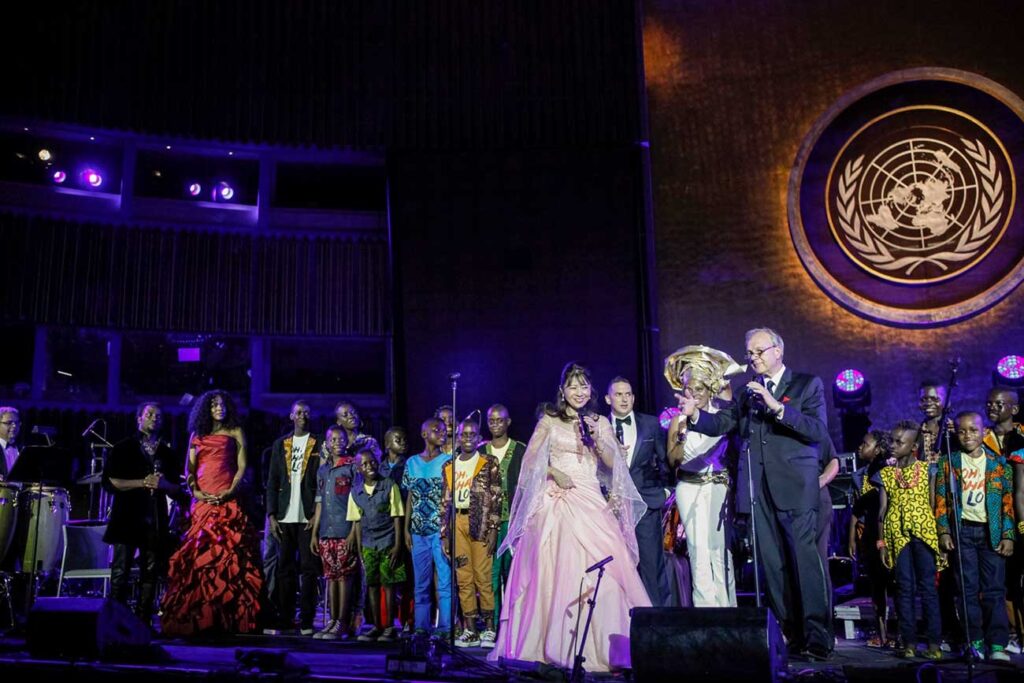
In a meeting with True Mother in May of 2020, she mentioned that one of the reasons that she asked me to move to Korea was to assist in the process of bringing harmony between the East and West by way of the arts. It was clear that she viewed the arts as a way to facilitate that harmonization. Her comments reminded me of True Father’s words regarding art and the need for East and West harmony. In Cheon Seong Gyeong, Book 10, Chapter 3 we read:
The ultimate goal of artists, and those who work with the arts, is to reach the world of God’s heart. God, the Creator, wants to feel boundless joy through all the different things He personally created with His own hands, one by one, as works of art. God’s heart is such that He wants to give again after He has given. After doing things for others He wants to do more for them, and even after investing unconditionally He wants to forget what He has done. That heart is the basis of the world of true love. God’s ideal of creation for the created world arose from that heart. The starting point of art is the desire to represent that heart.
Accordingly, in the world of art there are no national boundaries. The purpose of art is not to serve as a tool of an ideology or an agenda. Its fundamental principles are harmony and unity. Divisiveness and conflict are fruits of fallen nature. Therefore the world of art demonstrates universal characteristics in all directions, bringing the East to understand the West and the West to accept the East.
Beauty has a transcendent aspect and whether we experience beauty through nature, or art, or through human relationships, we can be uplifted by it and attain a deeper love relationship with our Heavenly Parent. In this sense music can be considered religious. True Father often said that “music and religion go hand in hand.” The word religion stems from the Latin ligare[CE1] , which means “to bind.” Religion, then, is a process or method by which we can “re-bind” to God. Implicit in this explanation is the idea that at one point God and humankind were not separated. This separation occurred and religion became a way to “re-bind” Heavenly Parent with the children who were lost due to the human fall.
According to the Divine Principle, when Lucifer rebelled against God due to his feeling a lack of love and jealousy, he distorted the truth about God, Adam, Eve’s position and himself. These lies led to the illicit relationship between Lucifer and Eve and it was the ultimate creative act of conjugal love that Lucifer used to reverse dominion and claim false lordship over humankind and all creation. This is why we read in scripture that all creation “groans in travail” awaiting the revealing of the sons of God, and we the redemption of our bodies (Romans 8:19-23). Attaining the Three Blessings and going the way of restoration is how we “re-bind” with Heavenly Parent and bring the creative process out of Lucifer’s domain and back to its rightful and godly position and purpose. Because Lucifer usurped creativity’s true purpose in Eden by way of false love, many artists have been similarly seduced by false attitudes regarding their creative gifts, and this has resulted in immorality, self-aggrandizement and selfishness in the artistic sphere for thousands of years.
According to the beauty, truth and goodness paradigm described in the Divine Principle, it is important to assess art in three ways: aesthetically (beauty), intellectually (truth), and axiologically (goodness). Axiology is the study of values; specifically morality and ethics. Too often in contemporary society there is a tendency to overlook the axiological aspect of art. In her memoir True Mother mentions that art and culture are more powerful than politics in their ability to bring about change in society. Her view resonates with the views of the ancient philosophers of China, Greece, Israel and early Christianity in Europe. Art has a certain “moral power” and artists need to understand that what they create and put before the public has consequences. Music historian Richard Taruskin makes the point that “music is a powerful form of persuasion,” and that “serious art possesses an ethical force and exacts ethical responsibilities.” In this context the role of the artist in the creation of a culture of peace is no small matter. Artists do not create in a social vacuum; therefore, they ought to take into account how their art affects the communities in which they live and work.
It is fairly well known that the philosophers of ancient Greece understood the “moral power” of the arts as it pertained to creating an ethical society. Damon of Athens, son of Damonides, was one of the first Greek philosophers to study the effects of music on our psyche—psychoacoustics in modern terminology—as well as the social and political consequences of music. Plato cites Damon’s concerns about the influence of music in The Republic:
The care of the governors should be directed to preserve music and gymnastics from innovation; alter the songs of a country, Damon says, and you will soon end by altering laws. The change appears innocent at first, and begins in play, but evil soon becomes serious, working secretly upon the characteristics of individuals, then upon the social and commercial relations, and lastly upon the institutions of the state; and there is ruin and confusion everywhere.
In our contemporary culture we can clearly see how unfettering art from moral and ethical constraints has led to various artistic expressions that a few short decades ago would have been considered objectionable. The loosening of moral standards has had the effect of normalizing decadence and lowest-common-denominator values in the pursuit of commercial success. A great deal of popular music has become “objectified” and is now viewed as a commodity to be marketed and sold for profit. The intrinsic spirituality of music has been diminished or removed altogether. As a result, our popular culture has become more coarse, far less enlightened and lacking redeeming values. Objectifying art in this manner is not unlike pornography in that it objectifies sexuality, thereby removing its divine purpose and reducing it to being a purely physical dimension in order to sell it for profit.
What might not be so well known, especially in the West, is that the Chinese philosophers of antiquity held views that were similar to those of the Greek philosophers with regard to the moral power of the arts and the role of artists in society. In the Analects of Confucius we find several insightful references to music and morality:
 If a person be without the virtues proper to goodness,
 what has he to do with the rites of propriety?
 If a person be without the virtues proper to goodness,
 what has he to do with music?
Also from the Analects:
There are three types of delights that improve you, and three types of delights that diminish you. To delight in li and music, to delight in speaking of others’ good points, to delight in having many worthy friends—these improve you. To delight in arrogant pleasures, to delight in idle wanderings, to delight in banquet parties—these diminish you.
In Confucian terminology li refers to propriety, ritual or rites. Propriety can have several meanings including modesty, politeness, respectability and decency. These attributes were considered important in the development of one’s character and in becoming a respectable person. Music in ancient China was viewed as an important aspect of an individual’s character development as well as an important means for establishing a moral and ethical society and modes of good governance.
Other ancient Chinese texts offer corroborative views regarding music: its usage, its ethical connotations and its origins. The ancient Chinese text The Memorial of Music states:
Therefore it is, that when music is generally taught, the duties of the five relations [as defined by Confucian thought] are thoroughly comprehended; the ears and eyes are quick and penetrating; the animal spirits and the emotional nature are in perfect calm; public manners and customs are reformed, and the whole empire enjoys profound tranquility.
The connection of music with the ordering principles of physical laws and metaphysical ideals was considered important due to the belief that the same laws and principles contained within music and sound production were present in the celestial order that governed the entire universe. Those who possess even a cursory understanding of the Chinese philosophical tome the I Ching understand that the Taoist axiom of harmonizing the polarities of yang and yin is one of its central tenets. The fusion of Taoist principles and Confucian ethics would give rise to various rationales that guided the Chinese in matters of art and social governance.
The issue of political and social governance with regard to music was of great concern to Lu Bu Wei (291-235 BC), who was a politician in the Qin region of China. He wrote extensively on the matter of music and its effects on society and governance. In his Spring and Autumn Annals he writes:
The will of people living in an area can be known by examining the customs that prevail there. And their virtues can be known by examining their will. Whether a state will become prosperous or face its downfall, whether its sovereign is sensible or unworthy, and whether a person is honorable or base, can all be known by the music they enjoy.
This perspective echoes that of Damon of Athens with regard to a society’s moral and ethical well-being and the music it listens to. He goes on to say:
Music is a product of the heart. When the heart is moved, the feelings can also be reflected by harmonious sounds. And when a harmonious tune is heard, the heart can also be touched by it. Hence, the customs of an area can be known by examining its tunes. … When their virtues are well cultivated, they can compose music. If the tunes composed are harmonious, they will resonate pleasantly, and they can edify and direct the common people to pursue Tao.
Tao in Chinese philosophy means “path” or “the way” and is usually associated with the beliefs that can edify and guide a person toward living a virtuous life. Tao is considered to be the natural order of the universe and one must discern through intuition the proper “way” to live one’s life in order to realize the potential for individual wisdom. This intuitive knowledge of life cannot be grasped as a concept; it is gained through the actual living experience of one’s everyday being. This concept aligns with “Godism” as explained in Book 10 of Cheon Seong Gyeong. The “ism” in Godism means “way of living,” thus “living” in accordance with axiological tenets as defined by the Divine Principle and Unification Thought is “the way” to attain our true authentic self. For artists it becomes “the path” to discover their authentic muse—their artistic Tao.
Too often we discuss issues of governance, education, commerce, the arts and journalism according to the ideological perspectives of “left” or “right,” when we ought to be more concerned with “higher” and “lower” virtues and values. As the ancient cultures of both the East and West instruct, there should be serious consideration given to the true purpose of art and culture in relation to creating a moral and ethical society. This begins with a belief that God exists and God’s ultimate purpose is love. Art that is created in that spirit and with that intention—combined with highly developed technique and aesthetic sensibilities—can be art that moves the soul and opens one’s consciousness to a higher love. In that way artistic achievement can facilitate greater harmony between the cultures of East and West in accordance with True Mother’s desire to create Hyo jeong culture.
[CE1]I’m pretty sure ligare by itself means “to bind,” so ligo would be a conjugation / derivative of ligare, which is the root term (or the infinitive).