U.S. hearing highlights freedom threat and China’s role in driving global religious repression as the totalitarian state is accused of leading a “dark alliance.”
Tokyo, 5th February 2026 – Published as an article in the Japanese newspaper Sekai Nippo. Republished with permission. Translated from Japanese. Original article.
Concerns Raised Over Religious Pressure in Japan and South Korea
Testimony by Former U.S. Officials on Detention of Hak Ja Han and Others at U.S. House Hearing
China’s “Dark Alliance” Poses a Threat
by Yuya Kawase (川瀬 裕也)
Prepared byKnut Holdhus
Washington DC (Yuya Kawase) – On 4th February, the U.S. House Foreign Affairs Committee held a hearing focused on religious freedom around the world. Testimony included not only criticism of the Chinese government for its continued religious repression, but also expressions of concern about pressure being placed on specific religious organizations by the governments of Japan and South Korea.
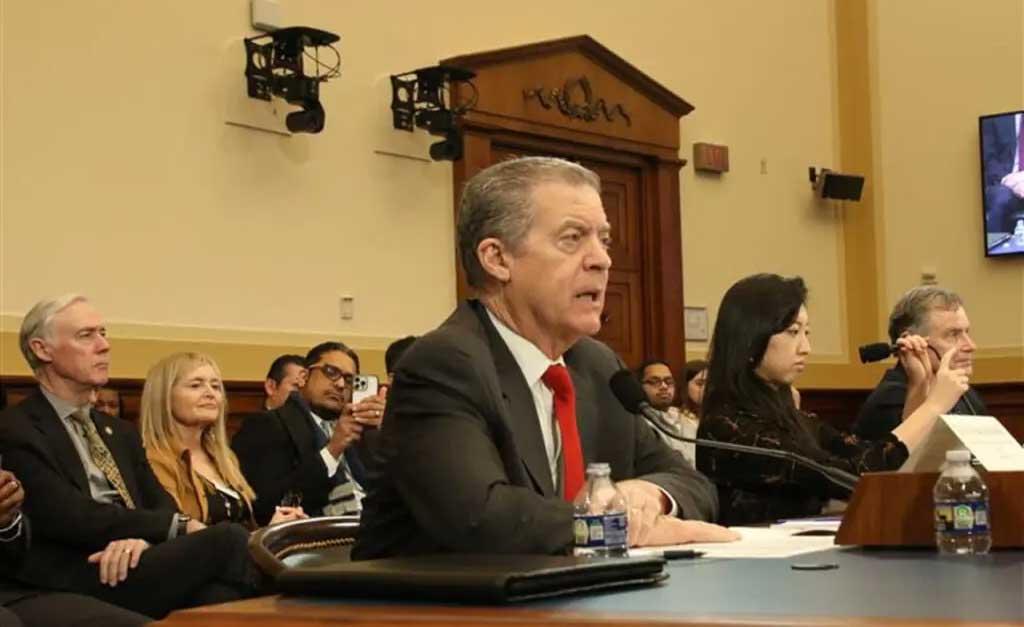
At the hearing, former U.S. Ambassador-at-Large for International Religious Freedom Sam Brownback testified and addressed the situation in East Asia. He pointed out that a “dark alliance” of communist and authoritarian states that regard religious freedom as a threat is taking shape, asserting, “China exists behind it as the mastermind.”
He went on to explain that China has invested tens of billions of dollars to build the world’s most advanced surveillance technology and is thoroughly suppressing all forms of belief, including Uyghurs, Tibetans, Christians, and Falun Gong practitioners. He warned that China’s provision of such surveillance technology to other authoritarian states constitutes an “unprecedented threat”.
Brownback also referred to the current detention of Hak Ja Han (한학자), president of the Family Federation for World Peace and Unification (formerly the Unification Church), stating, “In South Korea, leaders of Christian groups and the Family Federation who have drawn the attention of the government are being detained one after another.”
He further noted that “Japan faces similar challenges,” expressing concern about how both the Japanese and South Korean governments are dealing with religious organizations.
The hearing was also attended by Grace Drexel, the daughter of Christian pastor Ezra Jin, who is currently imprisoned in China. Speaking from the perspective of a family member directly affected, she warned of the dangers of the international community remaining silent in the face of religious persecution and called on the U.S. government to maintain sustained attention and action.
In addition, Stephen F. Schneck, former chair of the U.S. Commission on International Religious Freedom (USCIRF) [See editor’s note below], a U.S. government advisory body, also gave testimony.
On the same day, a kickoff breakfast meeting was held at the U.S. Capitol to discuss the same theme, where members of both chambers of Congress and scholars of religion called for strengthening international efforts to defend religious freedom.
Featured image above: Former U.S. Ambassador-at-Large for International Religious Freedom Sam Brownback (center) testifies at a U.S. House hearing, 4th February 2026, Washington DC. Photo: Yuya Kawase (川瀬 裕也)
[Editor’s note: The U.S. Commission on International Religious Freedom (USCIRF) is an independent, bipartisan U.S. federal government advisory body established by the International Religious Freedom Act of 1998. Its purpose is to monitor, analyze, and report on violations of freedom of religion or belief worldwide and to advise the U.S. government on policy responses.
USCIRF does not make or enforce law. Instead, it provides policy recommendations to the President, the Secretary of State, and Congress. One of its most influential roles is issuing an annual report that assesses religious freedom conditions in countries around the world. In this report, USCIRF recommends which governments should be designated as “Countries of Particular Concern” (CPCs) or placed on a Special Watch List for severe or systematic violations, such as imprisonment for religious belief, forced conversions, or repression of minority faiths.
The Commission consists of nine members: three appointed by the President, three by the Speaker of the House, and three by the Senate leadership. Commissioners come from both major political parties, reinforcing USCIRF’s nonpartisan mandate.
USCIRF conducts fact-finding missions, holds public hearings, engages with civil society and religious leaders, and produces thematic reports on issues such as blasphemy laws, authoritarian surveillance, and persecution of religious minorities. Its work aims to integrate religious freedom into U.S. foreign policy as a core human rights concern.]