Yamagami’s life sentence closes the criminal case, but dissolution efforts backed by courts risk validating the very objectives of his terrorism
Tokyo, 30th January 2026 – Published as an article in the Japanese newspaper Sekai Nippo. Republished with permission. Translated from Japanese. Original article.
Judicial Integrity That Must Not “Reward” Terrorism
The “Yamagami Terror Attack” and the Dissolution of a Religious Organization
by Seisaku Morita (森田 清策)
prepared by Knut Holdhus
The Nara District Court has sentenced defendant Tetsuya Yamagami (山上徹也) to life imprisonment. By imposing the harshest penalty short of the death sentence, the court effectively recognized that the shooting of former Prime Minister Shinzo Abe (安倍晋三) was a premeditated act of terrorism. Although an appeal remains possible, the first-instance judgment brings a provisional conclusion to the criminal acts committed by the defendant.
While the sentencing itself can be regarded as appropriate, it is regrettable that the ruling did not delve into the political and social impact brought about by the terrorist act. That remains the unresolved issue. Only by drawing lessons from a terrorist attack that claimed the life of the politician who served the longest tenure as prime minister in Japan’s constitutional history can recurrence be prevented – and such reflection would serve as the bare minimum form of requiem for Shinzo Abe.
When considering the societal problems caused by the “Yamagami terror attack”, the key point lies in the defendant’s objective in attempting to take Abe’s life. According to the judgment, Yamagami harbored resentment toward the Family Federation for World Peace and Unification (formerly the Unification Church), believing that his life had been ruined by his mother’s faith and her large financial donations to the organization.
Seeking to “strike back” at the group, he shot Abe, who had sent a video message to an event hosted by an organization affiliated with the Federation. The defendant believed that doing so would focus public criticism on the religious organization.
One particularly conspicuous development triggered by the terror attack was the move to seek a dissolution order against the Family Federation. In March of last year, the Tokyo District Court issued a decision ordering the dissolution of the organization under the Religious Corporations Act. The organization immediately filed an interlocutory appeal [Editor’s note: an appeal filed before a case has reached a final judgment, challenging a specific interim ruling made by a lower court]. The Tokyo High Court is expected to issue its decision within the current fiscal year [Editor’s note: which ends on 31st March].
In the context of terrorism, the question of what a court-issued dissolution order signifies is crucial: it would amount to the judiciary condoning a disregard for due process – the core of the rule of law. Since due process is a constitutional principle, its violation is a matter of grave concern.
The trigger for the dissolution request process was pulled by then-Prime Minister Fumio Kishida (岸田文雄), who was in office at the time of the attack. Immediately after the incident, the media launched intense criticism of the religious organization, and the Liberal Democratic Party – some of whose members had “ties” to groups friendly to the organization – was swept into the storm.
However, in October 2022, the Kishida administration issued a cabinet decision stating that a dissolution order could not be applied to an organization whose executives had not been criminally convicted, and it answered in the Diet that civil-law torts were “not included” among the requirements. Yet the very next day, Kishida reversed his previous statement, declaring that they “were included”.
Until that point, the Agency for Cultural Affairs had maintained that civil-law torts were not part of the requirements, in consideration of the gravity of the “freedom of religion” guaranteed by the Constitution. This position was overturned overnight.
Aside from objections raised by a small number of legal professionals, Kishida’s disregard for the principle of due process attracted little attention from opposition parties, the media, or public opinion. Everything unfolded in a manner consistent with the aims of defendant Yamagami.
The neglect of due process was subsequently endorsed by the judiciary as well. If, following the Tokyo District Court, the Tokyo High Court were also to issue a dissolution order, it would produce a result aligned with the defendant’s intent to “strike back” at the organization – effectively granting a “reward” to a terrorist.
In March 2019, following the mosque shootings in New Zealand, then-Prime Minister Jacinda Ardern stated in a parliamentary address, “We will give terrorists nothing.” What one hopes for from the Tokyo High Court is not a decision that rewards terrorism, but rather the sound judgment to send a clear message that society must never be allowed to be moved by violence.
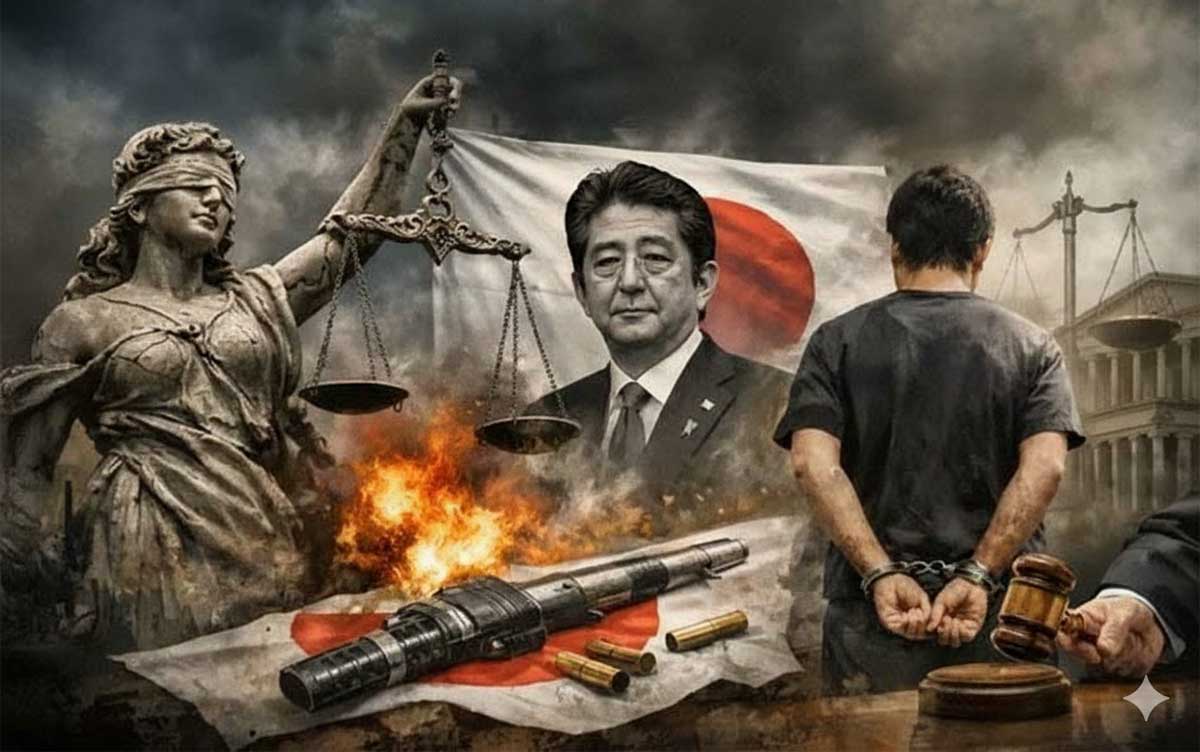
Featured image above: Courts must not reward terror. Illustration: ChatGPT 1st February 2026.