Legal expert warns that the State’s guidelines rely on unverified and time-barred claims as he questions the constitutionality of the dissolution framework
Tokyo, 29th December 2025 – Published as an article in the Japanese newspaper Sekai Nippo. Republished with permission. Translated from Japanese. Original article Part 1 and Part 2.
[Interview Feature] The Dark Side of the “Special Measures Law” Targeting the Family Federation
Suspicions of Unconstitutionality in the Guidelines for the Liquidation of the Religious Organization
Interview with Seishiro Sugihara, former professor at Musashino Women’s University and expert on issues of freedom of religion and constitutional law
by the Religious Freedom Investigative Team of the editorial department of Sekai Nippo
prepared by Knut Holdhus
On 20th October, the Ministry of Education, Culture, Sports, Science and Technology (MEXT), with the Family Federation for World Peace and Unification (formerly the Unification Church) in mind, formulated the “Guidelines on the Liquidation of Designated Religious Corporations” (hereinafter, the “Guidelines”). While the immediate appeal against the Tokyo District Court’s dissolution order decision remain pending before the Tokyo High Court, the Guidelines were prepared in anticipation of a scenario in which the High Court upholds the lower court’s decision. However, Seishiro Sugihara (杉原誠四郎), former professor at Musashino Women’s University, points out that there are serious problems with both the ongoing legal procedures toward the liquidation of the religious organization and the newly issued Guidelines intended to supplement them.
‒ I understand that you submitted a public comment to MEXT regarding the draft Guidelines. What were your main points?
Even if a dissolution order has not yet been finalized, it is, in principle, permissible to establish guidelines for liquidation procedures in the event that such an order becomes final, so long as procedures toward dissolution are already underway.
However, to provide compensation for damages ‒ described as “specific unlawful acts, etc.” ‒ from the assets of the religious corporation slated for dissolution, based solely on damage reports submitted by individuals who self-identify as victims, would infringe upon property rights guaranteed by the Constitution and may therefore constitute a constitutional violation.
‒ What exactly does the term “specific unlawful acts, etc.” refer to?
“Specific unlawful acts, etc.” is defined in Article 2, Paragraph 2 of the Act on Special Provisions for the Operations of the Japan Legal Support Center to Facilitate the Prompt and Smooth Relief of Victims of Specific Unlawful Acts, and Special Provisions on the Disposal and Management of Assets by Religious Corporations (hereinafter, the “Special Measures Law”), which was enacted on 13th December 2023, promulgated on 20th December, and came into force on 19th March of the following year.
The law defines the term as “unlawful acts that constituted the cause for a specific dissolution order request, acts that serve as grounds for the rescission of contract applications, other acts, and acts of the same kind, committed by the subject religious corporation or its believers or other related persons.” In other words, at the core are the alleged unlawful acts that prompted MEXT to request a dissolution order against the Family Federation.
However, the “harm” cited in the damage reports that MEXT treated as grounds for dissolution consists merely of damage claims made by individuals identifying themselves as victims. These do not represent acts that have been legally established as unlawful on the part of the religious organization.
‒ What do you mean by that?
MEXT applied for a dissolution order on the grounds that, over a period of approximately 43 years ‒ from around 1980 to around 2023 ‒ the Family Federation caused harm to just under 1,560 victims, with total damages exceeding 20.4 billion yen [ca. 130.5 million US dollars]. In other words, it asserted that there were 1,560 victims and approximately 20.4 billion yen in damages resulting from unlawful acts by the organization.
However, this assertion contains two major problems. First, it completely ignores one of the fundamental principles of the rule of law: the statute of limitations. An “unlawful act” refers to conduct that causes harm to others in violation of existing laws and regulations. Under Article 724 of the Civil Code, the legal effect of such acts expires after 20 years from the time of the act, at which point compensation can no longer be claimed. To invoke alleged harm from unlawful acts committed as far back as 43 years ago is to utterly disregard this principle.
‒ What is the second problem?
MEXT claimed that the Family Federation engaged in unlawful acts that were intolerable in their maliciousness, continuity, and organizational nature. However, in 2009, the Family Federation issued a compliance declaration [See editor’s note below] instructing its organization to refrain from donation solicitation practices that had drawn social criticism ‒ such as “unverified spiritual sales-style proselytization”, “proselytization linking donations to ancestral karma”, and “excessive donation solicitation” ‒ which had previously been recognized as unlawful acts by the organization or its related parties.
After that, only one case was recognized by the courts as constituting an unlawful act (one plaintiff, with damages awarded of approximately 4.76 million yen [ca. 30,000 US dollars]), and there have been no such cases at all since 2015. Accordingly, there is no continuity, and at present, the organization is a religious corporation without legal issues.
Despite this, MEXT filed its dissolution order request by including, as “damage” from unlawful acts, lawsuits in which no unlawful acts were legally recognized ‒ even at the first-instance level ‒ and for which settlement payments had already been completed. These included in-court settlements (419 people, approximately 5.7 billion yen [ca. 36.5 million US dollars]) and out-of-court settlements (971 people, approximately 12.5 billion yen [ca. 80 million US dollars]). In other words, the figures of 1,560 victims and approximately 20.4 billion yen [ca. 130.5 million US dollars] in damages was nothing more than a manipulation of impressions.
‒ MEXT also submitted 261 written statements from former members to the Tokyo District Court.
A dissolution request must be based on current circumstances. MEXT should have been fully aware that damage statements alone from people claiming to be victims are insufficient to establish unlawful acts. Presumably, in an effort to gather new evidence, it focused on collecting damage reports. However, it has already become clear that these reports not only lack legal recognition as unlawful acts but also contain numerous false statements.
In this way, the unlawful acts (specific unlawful acts) cited by MEXT as grounds for the dissolution order request reach back into the past while ignoring statutes of limitation and involve conduct that can no longer be held legally accountable. After the compliance declaration [See editor’s note below] ‒ particularly since 2015 ‒ there have been no cases that have gone through procedures resulting in legally established findings. To nevertheless include such matters as subjects for compensation is inconceivable in a state governed by the rule of law. The Guidelines must therefore be fundamentally revised.
‒ What is your view on the purpose and intent of the Ministry of Education, Culture, Sports, Science and Technology’s (MEXT) “Guidelines on the Liquidation of Designated Religious Corporations” (the “Guidelines”), which appear to have the Family Federation for World Peace and Unification (formerly the Unification Church) specifically in mind?
In the section of the Guidelines titled “Responses Such as Compensation to Victims”, it states: “The liquidator shall respond sincerely to victims so that not a single victim is left behind, including victims who reported damages within the creditor claim period and those known to the liquidator, as well as victims who reported damages after the expiration of the creditor claim period…”
At first glance, this may appear reasonable. However, in effect, it demands an almost limitless commitment to victim relief exclusively in the case of the Family Federation. This is neither fair nor equitable when compared with victims who may have suffered harm involving other religious corporations.
‒ The Guidelines also include language under “Measures to Encourage the Reporting of Harm,” such as: “Inquiring of a certain range of counterparties identified from records substantiating donations held by the liquidating corporation as to whether they intend to report harm,” and “Based on a comparison between those who donated disproportionately large sums and the number of reported victims, it can be objectively assumed that a considerable number of potential victims exist.” These passages seem to presume that high-value donors are potential victims.
In principle, when money or property is donated to a religious corporation based on faith, the donor cannot later demand its return simply because they have lost that faith. The sole exception is when the religious corporation has committed an unlawful act ‒ but even then, such unlawfulness must be legally established through an open judicial process.
For a liquidator to arbitrarily determine that a donation was “disproportionately large”, or to define a “certain range” of individuals as victims based on the organization’s donation records, is an outrageous act that ignores the very essence of freedom of religion.
‒ What do you see as the root cause of these problems inherent in the Guidelines?
The root lies in the law enacted exactly two months after 13th October 2023, when the Minister of Education requested the Tokyo District Court to issue a dissolution order against the Family Federation. That law is formally titled: “The Act on Special Provisions for the Operations of the Japan Legal Support Center to Facilitate the Prompt and Smooth Relief of Victims of Specific Illegal Acts, and Special Provisions on the Disposal and Management of Assets by Religious Corporations” (the “Special Measures Law”).
This law was enacted to monitor the movement of the Family Federation’s assets in the event that unlawful acts are established, and damages must be paid. To that extent, there was some rationale for its enactment. However, at its core, the law privileges only victims associated with the Family Federation.
Moreover, Article 5 of the Supplementary Provisions states: “This Act shall lose its effect on the day three years have elapsed from the date of its enforcement.”
This means that, in practical terms, the law targets only the Family Federation.
Under the principles of the rule of law, special legislation limited to a specific subject is permissible when it confers benefits upon that subject. However, legislation that imposes disadvantages on a specific target is not permitted. A special law that singles out only one religious corporation for disadvantage must never be enacted under the banner of the rule of law, legal governance, or a law-based state.
Accordingly, this law must be abolished. The fact that the House of Representatives Legislative Bureau, the House of Councillors Legislative Bureau, and the Diet itself allowed such legislation to be enacted is something that defies ordinary legal common sense.
‒ This law was introduced as a members’ bill.
The bill was submitted by six lawmakers: three from the Liberal Democratic Party, two from Komeito, and one from the Democratic Party for the People. That members of Komeito were among the sponsors is nothing short of outrageous.
If one were to look back far enough, Soka Gakkai [See editor’s noe 1 below] ‒ the religious organization that forms the foundation of Komeito ‒ would undoubtedly have its own share of scandals. There would also be countless individuals who could claim to have suffered harm in the past. How, then, can a political party backed by Soka Gakkai become a sponsor of a law that, for a limited time, targets only other religious corporations?
If the intention is merely to save oneself while others are sacrificed, then this behavior is even more reprehensible than Kandata in Ryūnosuke Akutagawa’s “The Spider’s Thread.” [See editor’s note 2 below]
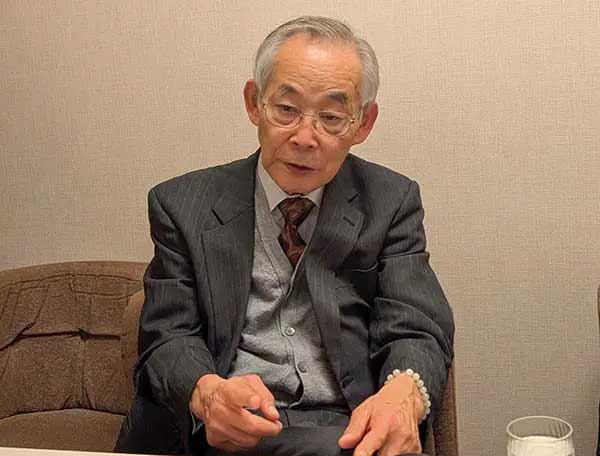
Featured image above: Seishiro Sugihara (杉原誠四郎), former professor at Musashino Women’s University and expert on issues of freedom of religion and constitutional law. Photo: Sekai Nippo
[Editor’s note: The 2009 compliance declaration of the Unification Church of Japan (now the Family Federation for World Peace and Unification) was a formal commitment by the organization to reform its practices in response to longstanding public criticism and legal challenges.
The Unification Church in Japan had faced numerous allegations related to recruitment tactics and donation solicitation, termed “spiritual sales” (霊感商法) by a hostile network of activist lawyers who had declared the religious organization an enemy. These issues led to multiple lawsuits orchestrated by the activist lawyers and significant media backlash. This prompted the organization to take measures to restore its reputation and demonstrate compliance with legal and ethical standards.
The religious organization pledged to stop possibly unethical donation practices, including what the hostile network of lawyers claimed amounted to “pressuring members into making large financial contributions under spiritual pretexts.”
This was in response to accusations from the same activist lawyers that followers “were being manipulated into giving away substantial amounts of money or property.”
The Unification Church stated it would enhance internal oversight to ensure compliance with ethical and legal standards. Measures included better training for leaders and stricter guidelines for evangelization and solicitation of donations.
After this compliance declaration, there was a significant decrease in the number of lawsuits against the Unification Church – since 2015 called the Family Federation. The religious organization has used this as evidence that it has improved its practices and should not be subject to dissolution.]
[Editor’s note 1: Soka Gakkai, a global lay Buddhist organization originating in Japan, aims to create an “ideal world” based on the principles of Nichiren Buddhism, which emphasizes individual empowerment, inner transformation, and societal harmony. Their vision is often framed as kosen-rufu, meaning the widespread propagation of Buddhist values to establish peace and happiness for all.
Soka Gakkai promotes peace, culture, and education through initiatives that focus on personal transformation (human revolution) – the belief that changing oneself positively impacts society; peace ativism – anti-nuclear campaigns, human rights advocacy, and interfaith dialogue; education – institutions like Soka University emphasize value creation and global citizenship; community engagement – social welfare programs, disaster relief, and environmental sustainability efforts.
To actualize these ideals in governance, Soka Gakkai founded the Komeito party in 1964 (now known as New Komeito or simply Komeito). The party’s purpose was to translate Buddhist-based humanistic values into public policy. While legally separate from Soka Gakkai, Komeito has long been backed by members of Soka Gakkai and focuses on peace-oriented diplomacy (e.g., supporting Japan’s pacifist constitution); social welfare policies (benefiting education, healthcare, and the elderly); grassroots democracy (reflecting the voice of ordinary citizens)
Since 1999, Komeito has been a coalition partner with the Liberal Democratic Party (LDP), influencing policies while maintaining a centrist stance.
Despite its contributions, Soka Gakkai’s political role has been controversial, with critics accusing it of blurring the lines between religion and politics. Some also argue that Komeito’s alliance with the conservative LDP compromises its original pacifist ideals.
Soka Gakkai envisions an ideal world through personal empowerment, education, and political engagement. While its approach is rooted in Buddhist ethics, its political involvement remains a
[Editor’s note 2: In Ryūnosuke Akutagawa’s short story “The Spider’s Thread” (Kumo no Ito), Kandata is the central human figure and a condemned sinner in Buddhist Hell.
Kandata is portrayed as a notorious criminal ‒ a robber and murderer ‒ who suffers torment in Hell for his many crimes. However, during his life he once performed a single act of compassion: he spared a spider instead of killing it. This small deed is remembered by the Buddha.
Moved by this lone good act, the Buddha lowers a spider’s thread into Hell, giving Kandata an opportunity to climb out and attain salvation. Kandata begins to ascend successfully, but when he notices other sinners climbing up the same thread behind him, he becomes selfish and possessive, shouting for them to get off. At that moment, the thread snaps, and Kandata falls back into Hell.]