Religion, politics, and the question of fair standards: Engagement is not corruption ‒ defending legitimate church-state dialogue
On 26th December, the South Korean daily Segye Ilbo (Segye Times) printed a column by religious affairs reporter Jeong Seong-su (정성수) headlined “Not Church-State Collusion, but Church-State Cooperation”. See the Original Article.
Prepared by Knut Holdhus
Jeong points out that in many Western democracies, the phrase “separation of church and state” is often treated as a foundational principle that implies distance, caution, and even suspicion between religion and politics. Yet historically, this separation has rarely meant absolute disengagement. Across civilizations, religion and politics have coexisted as two central forces shaping moral values, laws, institutions, and collective identity. The Korean debate examined in this commentary is not an anomaly; rather, it reflects a broader global tension over where legitimate cooperation ends and improper collusion begins.
The Segye Ilbo article argues that religion and politics have never existed in isolation from one another. From ancient empires to modern democracies, political systems have organized societies through laws and institutions, while religions have offered ethical direction, meaning, and visions of the common good. Political leaders and religious figures meeting one another has therefore been historically normal, not inherently problematic. The key concern, the author stresses, is not contact itself but corruption ‒ specifically, transactions involving money, coercion, or illegitimate political influence.
This distinction is crucial for understanding the contemporary controversy in South Korea, particularly regarding the Family Federation. While politicians’ interactions with mainstream religious groups such as Buddhist orders, Catholic institutions, and Protestant churches are widely accepted ‒ even celebrated as symbols of national unity ‒ similar interactions with the Family Federation are often immediately labeled as “church-state collusion.” The article challenges this double standard and asks why one religion is treated as inherently suspect while others are granted presumptive legitimacy.
To make this point, the author places the issue in a broader religious and historical context. Founders of major world religions did not reject politics outright. Reporter Jeong writes, “Jesus acknowledged state authority by saying, ‘Render unto Caesar what is Caesar’s, and unto God what is God’s,’ while clearly warning against encroachment on the realm of faith. The Buddha emphasized discussion and consensus within the community through the teaching of the Seven Principles of Non-Decline (七不衰法), and Muhammad regarded governance itself as a responsibility entrusted by God.”
In different ways, all recognized that political power directly affects human suffering and well-being and therefore cannot be ignored by religion. What they warned against was not engagement, but subservience ‒ religion becoming a tool of power, or power exploiting religion for selfish ends.
Korea’s modern history reflects this longstanding entanglement. Presidents routinely meet religious leaders, attend worship services during major holidays, and participate in religiously affiliated cultural or charitable events. Jeong includes, “This Christmas as well, the president visited a Catholic cathedral, while leaders of both ruling and opposition parties attended church services.”
Government funding supports Buddhist temples under cultural preservation laws and Catholic institutions under welfare policy frameworks. These practices are institutionalized, normalized, and rarely questioned. In fact, they are often framed positively ‒ as expressions of inclusivity, heritage, or social cohesion.
The controversy arises when similar practices involve the Family Federation. According to the article, even in cases where no illegal financial transactions have been proven, mere association with the Federation triggers suspicion. Photographs of meetings, attendance at events, or references to long-standing policy ideas associated with the Federation are interpreted as evidence of impropriety. Meanwhile, equivalent actions involving other religious groups are dismissed as routine or benign.
The author argues that this discrepancy does not stem from legal reasoning but from what he calls an “asymmetry of trust”. Religions that are deeply embedded in the social and institutional mainstream benefit from historical familiarity. Their political interactions are perceived as natural extensions of tradition. By contrast, religious movements that have been controversial or stigmatized ‒ even if legally recognized ‒ are judged by a harsher moral standard. The same behavior, when performed by different actors, is read entirely differently. This, the article suggests, reveals not principled secularism, but selective prejudice.
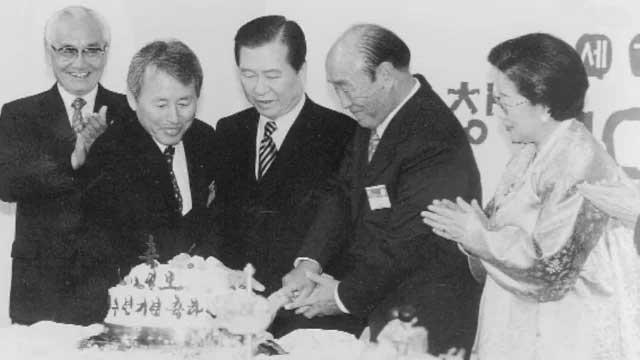
To underscore this point, the author invokes historical examples involving respected political leaders. Former President Kim Dae-jung (김대중), a Nobel Peace Prize laureate and widely admired democratic figure, openly participated in events hosted by organizations affiliated with the Family Federation in both opposition and presidential roles. He publicly greeted the founders of the religious organization and expressed favorable views on large-scale infrastructure ideas long promoted by the movement, such as a proposed undersea tunnel between Korea and Japan. At the time, these actions were framed as discussions about national development and international cooperation, not religious collusion.
Similarly, former President Roh Moo-hyun (노무현) visited a Family Federation-owned automobile factory in North Korea during an official trip, treating it as part of broader inter-Korean economic engagement. Again, the visit did not provoke accusations of improper church-state relations. These examples illustrate the article’s central question: if such actions were acceptable in the past, why are similar actions today treated as presumptive evidence of wrongdoing?
The author’s answer is that the actions themselves have not fundamentally changed; the political and media climate surrounding them has. Shifting public narratives, heightened polarization, and intensified scrutiny of certain religious organizations have transformed previously neutral or positive interactions into symbols of alleged corruption. In this environment, association alone becomes grounds for condemnation, regardless of intent or legality.
The article concludes with a broader reflection relevant far beyond South Korea. Governing a society requires more than laws and bureaucratic procedures. Political systems also rely on moral narratives, long-term vision, and social trust ‒ areas where religious institutions often possess unique resources. When politics exploits religion for private gain, serious problems arise. But preventing all dialogue or cooperation between religion and politics, the author argues, is neither realistic nor desirable.
Especially in an era marked by demographic decline, social fragmentation, and global instability, the Segye Ilbo article suggests that carefully balanced cooperation ‒ maintaining institutional distance while allowing ethical dialogue ‒ can strengthen social resilience. The true challenge, then, is not how to eliminate interaction between religion and politics, but how to apply consistent standards of fairness, legality, and intent, regardless of which religion is involved.
In that sense, the debate is not merely about one religious organization or one country. It raises a universal question for pluralistic societies: can we distinguish principled secular governance from selective suspicion, and cooperation for the common good from corruption masquerading as morality?
Featured image above: Kim Dae-jung (김대중) – President of South Korea 1998–2003, cutting the celebration cake with Father Moon, Mother Han, and Lee Sang-hwe (이상회), 1st february 1999 at the 10th anniversary of Segye Ilbo. Photo: Segye Ilbo