Bail bid of Mother Han (82) raises questions about pre-trial detention for ailing religious leader in poor health after operations
Prepared by Knut Holdhus
According to reporting on November 14th from both the Korea JoongAng Daily and Yonhap News, Hak Ja Han (한학자) – also known as Mother Han – submitted a bail application to the Seoul Central District Court on November 13, 2025. Judicial officials noted that a specific date for the bail hearing had not yet been scheduled.
The timing of the request follows closely on the heels of her short-lived medical furlough: on 4th November, the court authorized her temporary release for health reasons, allowing her to undergo eye surgery. Mother Han then sought an extension of this medical leave, claiming additional care was necessary, but the court denied the request on 7th November, ordering her return to detention after medical treatment outside the facility.
The close proximity between Mother Han’s medical furlough and her bail application has led judicial observers to suggest that her health condition – particularly her recent eye surgery – may be a key motivating factor behind the request.
The ongoing detention of Family Federation leader Hak Ja Han – alongside the continued imprisonment of Pastor Son Hyun-bo (손현보) of the large Segyero Church (세계로교회) in the port city of Busan – has become a focal point of concern about the future of religious liberty in the country.
Both leaders represent religious communities that lean conservative and maintain independence from mainstream political blocs. Their supporters and religious-freedom monitors argue that the simultaneous, long-term detentions of two high-profile faith leaders may signal an emerging pattern of state overreach into religious life.
Mother Han, who has been held since 22nd September on charges including bribery, illegal political donations, and destruction of evidence, recently requested bail after the above-mentioned short medical furlough granted for eye surgery.
Although the Korea JoongAng Daily and Yonhap News accurately report that her request is still pending, advocacy groups emphasize the broader implications: that extended pre-trial detention of a religious figure, especially amid politically sensitive allegations, risks blurring the distinction between legal accountability and the suppression of religious actors deemed politically inconvenient.
A similar narrative has developed around Pastor Son, whose prolonged detention has alarmed many religious organizations. For them, the issue is not merely the legal particulars of two unrelated cases, but the cumulative effect these high-profile incarcerations have on the wider religious landscape. Groups that monitor religious liberty argue that, intentionally or not, state action is having a chilling effect on the activities of faith communities – particularly those that are seen to hold traditionalist views or have been critical of certain political developments.
The back-to-back confinement of Mother Han and Pastor Son – leaders of large, widely recognized religious communities – has been interpreted as an indicator that the current left-leaning Lee administration is increasingly willing to use prosecutorial power in ways that disproportionately affect conservative religious institutions. Advocacy groups stress that the issue is not whether charges should be investigated, but whether extended pre-trial detention is being used in circumstances where less restrictive measures could suffice.
Advocacy groups warn that when the state criminally investigates religious leaders whose theological or political orientations diverge from the mainstream, investigations risk being viewed as politically motivated – even if procedurally proper. Such perceptions, they argue, weaken public trust in democratic neutrality and may influence how minority or nontraditional religious communities behave.
In the South Korean legal system, pre-trial detention can be lengthy, particularly in cases involving corruption. Religious-freedom monitors argue that when such detention is applied to prominent religious leaders, it sends a message – whether intended or not – that the state is willing to exert extraordinary pressure on religious actors. This, they claim, may discourage religious communities from civic engagement, charitable outreach, or vocal participation in public debates.
Bail as a Test Case
Mother Han’s bail request is therefore interpreted by advocacy groups as more than a procedural step – it is a symbolic test of whether the judiciary can provide a corrective balance when executive and prosecutorial actions are perceived as overbroad. They argue that granting bail, particularly on health grounds, would demonstrate that the state recognizes the need to protect both the dignity of the accused and the autonomy of religious institutions.
Religious-freedom organizations insist that the issue is not immunity for religious leaders but proportionality. They warn that if South Korea is seen as pursuing aggressive legal action against politically conservative faith leaders while failing to apply comparable scrutiny to other sectors, this may create the appearance of selective enforcement – damaging the country’s reputation as a defender of pluralism.
From their perspective, the cases of Mother Han and Pastor Son represent a critical juncture. South Korea must ensure that legal mechanisms for accountability do not inadvertently cross into the realm of coercion, and that the line between legitimate investigation and perceived intimidation remains clear, transparent, and vigorously defended.
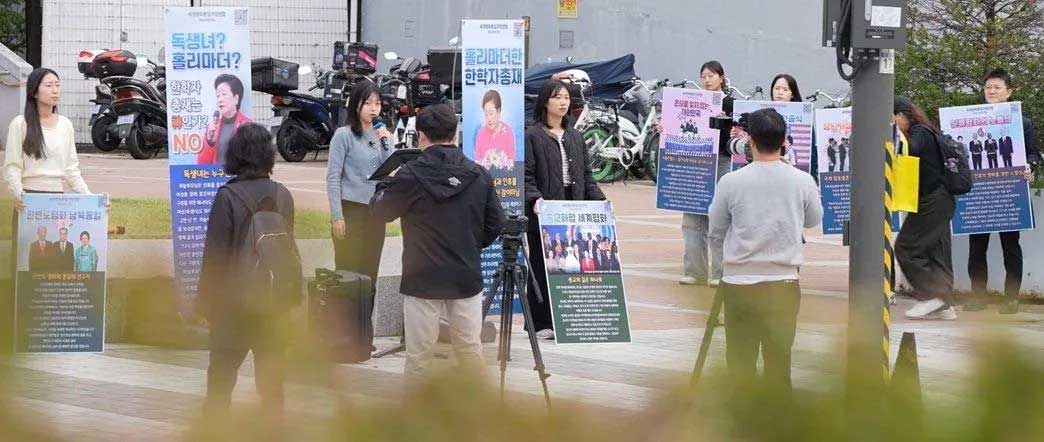
Featured image above: From a demonstration in downtown Seoul in October 2025 protesting the prolonged detention of Mother Han. Screenshot from video by PeaceTV.