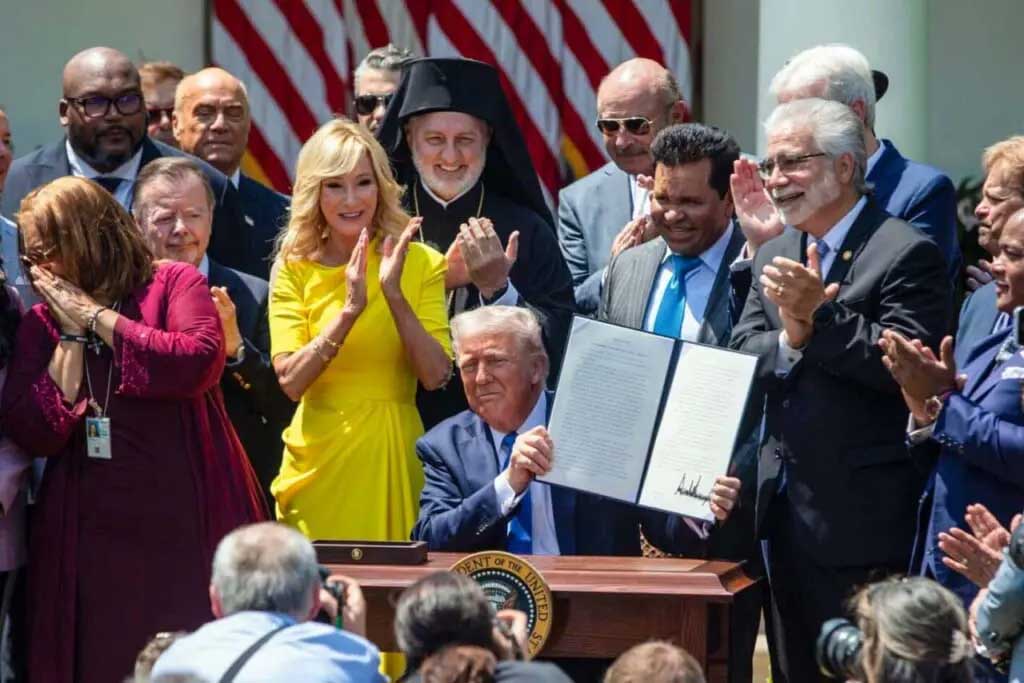
President Donald Trump Signs Executive Order to Defend Freedom of Religion, establishing Religious Liberty Commission
Tokyo, 10th May 2025 – Published as an article in the Japanese newspaper Sekai Nippo. Republished with permission. Translated from Japanese. Original article.
Trump Administration Highlights Traditional Values with New Religious Liberty Commission
by Yosuke Yamazaki (山崎 洋介), reporting from Washington DC
Prepared by Knut Holdhus
Strategic Proposal Due by Next July
On May 1st, the U.S. National Day of Prayer, President Donald Trump announced the establishment of a new commission to defend religious freedom, a founding principle of the United States. In contrast to the Biden administration, which was criticized for downplaying religious values, the Trump administration has positioned freedom of religion as one of its top priorities.
At the podium in the White House Rose Garden, religious leaders from Judaism, Christianity, and Islam, along with House Speaker Johnson – known for his devout Christian faith – offered prayers. Afterward, surrounded by representatives of various denominations, President Trump signed an executive order creating the “Religious Liberty Commission”.
In his speech, Trump emphasized that “America is one nation under God” and declared, “The radical left is trying to erase that, but we won’t let them.”
The commission will be chaired by Texas Lieutenant Governor Dan Patrick, who is known for his strong advocacy of religious values, including promoting a bill allowing prayer and Bible readings in public schools with parental consent.
Other members include:
- Dr. Ben Carson, former Secretary of Housing and Urban Development during Trump’s first term
- Cardinal Timothy Dolan, Archbishop of New York
- Evangelist Franklin Graham, head of the humanitarian organization Samaritan’s Purse
- Pastor Paula White, head of the Trump administration’s newly established “Faith Office”
One of the reasons behind the commission’s creation is growing dissatisfaction among conservatives and parts of the religious community over the perceived disregard for religious values under the Biden administration. A particularly symbolic incident was President Biden’s declaration of March 31st, 2024 – coinciding with Easter Sunday – as “Transgender Day of Visibility”, which sparked backlash.
Additionally, under the Biden administration, whistleblowers revealed that internal FBI documents treated certain “traditionalist Catholics” as potential domestic terrorism risks.
Meanwhile, after the U.S. Supreme Court overturned the constitutional right to abortion in 2022, there was a sharp rise in violent attacks against anti-abortion churches, including firebombings and property destruction. Critics argue that the Biden administration failed to respond with sufficient legal action. According to a fact sheet released by the Trump administration, “protection of places of worship” will be a key focus area for the new commission.
Another major focus is “freedom of speech for religious organizations”. This appears to target the repeal of the Johnson Amendment, which prohibits tax-exempt organizations like churches from endorsing or opposing political candidates. Conservative Christians have long criticized the amendment for restricting the free speech of religious leaders. During his first term, Trump expressed his intention to abolish it so that “faith leaders can speak freely without fear of punishment.”
The fact sheet also criticizes policies that “hinder parents’ rights to send their children to religious schools,” claiming they infringe on the right to practice faith. This refers to rules in many states that prevent public funding or voucher programs from being used for schools with religious instruction – rules that critics say limit school choice for parents seeking faith-based education.
The commission is tasked with submitting a strategic report to the Faith Office by 4th July 2026, outlining measures to defend and strengthen religious freedom, including legislative and administrative recommendations.
At the National Day of Prayer event, Pastor Paula White described the creation of the Faith Office as a “historic event” and reported that over 1,000 religious leaders had visited the White House in the past 100 days. She stated that the administration is working on initiatives including preventing all forms of religious discrimination – such as anti-Semitism and anti-Christian bias – and promoting foster care and adoption through collaboration with faith-based organizations. She concluded, “Many policies are in motion, but our top priority will always be the protection of religious freedom.”
Featured image above: President Trump (center) signs an executive order establishing the Commission on Religious Freedom at the White House