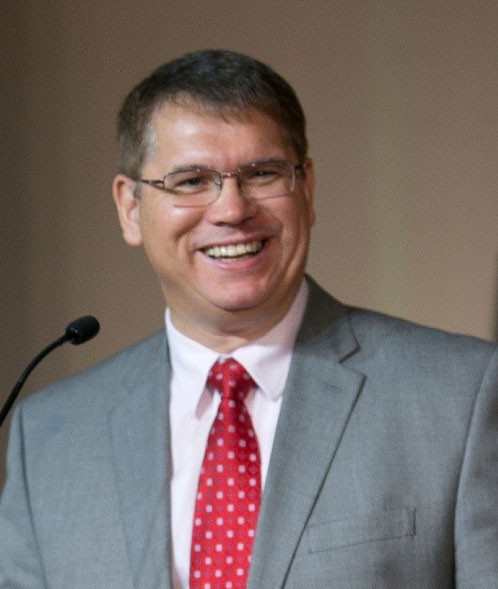
Dr. Michael Balcomb, the Regional President of the Europe and the Middle East, gave the following sermon at the Sunday service in Copenhagen, Denmark on November 10, 2024.
“While he was still speaking, a bright cloud covered them, and a voice from the cloud said, ‘This is my Son, whom I love; with whom I am well pleased. Listen to him!’” (Matthew 17:5) We don’t think of ourselves like that very often. Right?
God first says this to Jesus, when Jesus is being baptized, the interesting thing is at that moment, as far as the Bible is concerned, Jesus hasn’t done anything. He hasn’t given any sermons; he hasn’t done any miracles. He hasn’t turned water into wine. He hasn’t fed the 5,000. He hasn’t gone to the temple. He hasn’t become a sacrifice. He hasn’t done any of that.
It’s right at the very beginning. And God is giving him this blessing, “This is my beloved Son, with whom I am well pleased.” So what does Jesus say in response? What would you say in response? I know what I’d say. I’d say something like this, “Oh, God, I’ll do my best. I’ll try to be the son in whom you can be well pleased. I’ll work hard and try to live up to that great expectation.”
But Jesus doesn’t say that. He doesn’t say anything, actually. He just receives it, just lets it come upon him. Because God is well pleased. Not because of what we do, not because of what we think, not even because of what we say, but simply because of who we are.
We are God‘s sons and God‘s daughters with whom God is well pleased. No conditions, no qualifications other than that. Not because you’ve been a faithful member of the church for. Not because you are a missionary working in another country. Not because you were kind to your wife this morning and made her happy. Not because of any of those things.
It’s so hard for us to understand the heart of God, that God loves us just because of who we are. True Father used to call it the law of resemblance. Do you remember him talking about that?
We all like to see ourselves, and we like to see ourselves reflected in others. If you look at an old photograph, at least if you’re like me, you want to see, “Where am I? There I am. And then, who else can I see?”
If you look at your children or your grandchildren, you like to see them because they resemble you. I remember when Mother came to Munich. Did any of you go to Munich for the Bloom festival? The day before the festival, Mother gave me a very hard time. She did not say, “You are my beloved son in whom I am well pleased.”
She said, “You haven’t really done well, have you, in Europe? Because we’ve had a mission here for 50 years, and you’re telling me we are not that many members. […] There are many countries where even to count to 100 members is difficult.”
She really emphasized this point. But then, just when we were all wondering, how we could get out of the room, one of Mother‘s assistants, Wonju McDevitt, brought Mother her phone. And on the phone was a video from her great granddaughter, Jeon-ju. And Mother started watching this video. And then she just started giggling like a little girl. She said, “Oh, that’s so cute!” And she watched it three or four times. Then she made us all watch it as well.
So those of you who are grandparents or parents, you’ll know that when other people show you their grandchildren, it’s not the same. Not the same as seeing your own grandchildren or your own children.
Mother was almost uncontrollably happy just to see her great granddaughter. I’ve never seen her like that. She was just so happy and laughing.
I thought afterwards, “God is really trying to tell me something here: How happy God is with each of us.” But we don’t know it. We feel awkward because there’s a part of us that starts to think, “Well, wait a minute, God, you can’t really mean that, can you? Because look at me. I have doubts, I’m lazy, I make mistakes, I say things that I shouldn’t say. I sometimes upset people, or I forget them.”
I’m just thinking of all the things right now; Fumiko will be able to add more. We think, “You can’t love someone like me. I don’t measure up to your standards.”
But the point is, that doesn’t matter to God at all. And if we hear that voice, it’s really somebody else. Somebody else telling us, “You’re not worthy. Of course, you’re not worthy because you don’t do this, you don’t do that.” But that’s not true. Father gives us a good idea of this in his autobiography.
He says, “So why did God call me? Even now, at ninety years of age, I wonder every day why God called me. Of all the people in the world, why did He choose me? It wasn’t because I had a particularly good appearance, or outstanding character, or deep conviction. I was just an unremarkable, stubborn, and foolish young boy. If God saw something in me, it must have been a sincere heart that sought Him with tears of love.” (As a Peace-Loving Global Citizen, p54)
When we start to read it carefully and listen to what Father‘s saying – and Mother too; will come to that – Father is very transparent in As a Peace-Loving Global Citizen. We all know that when Father first received the commission from Jesus, he felt, “No, I can’t do it. I’m not worthy. Find somebody else.” But gently – as far as we know – Jesus pursued him, “No, no, you are that person! Of course, right now, at 15 years old, you are not the person you will become. But I will help you. I will raise you, I will teach you, and you will become the person able to do it.”
But as we heard from the above reading, even at the age of 90, Father was still wondering, “Really?” So even Father himself could feel this constant amazement, wonder, “How could God choose me?” Elsewhere you read that Father said, “There were days when I felt the presence of God like a gentle spring breeze. And Jesus came to me and spoke loving words and taught me.”
Then you turn the page, and it says, “And there were days that I felt surrounded by darkness, that there was no word from heaven, no word at all.”
Mother Teresa is famous for explaining when asked about her relationship with God and somebody asked her, “So what do you say to God?” She said, “I don’t say anything. I just listen.” Then the same interviewer asked her, “So what does God say to you?” “He doesn’t say anything,” she replied. “He just listens.”
Listening, and even without words, seems to be at the very core of coming to know who our Heavenly Parent is. These days, we’re hearing a lot about our Heavenly Mother [Editor’s note: the motherly aspect of God], right? About the feminine heart of God. And sometimes, actually almost every day, I get people complaining to me, “We haven’t heard this before. Why are we hearing this now? What about this? What about that?”
I just feel, every time, “Can you listen before asking your questions, before raising your alternatives? Could you listen?”
Imagine that our Heavenly Mother [Editor’s note: the motherly aspect of God] has been silent for 6,000 years. And finally, through True Mother, is getting a voice. And the very first thing we do is to start to argue or say, “It doesn’t sound quite like what I heard before.”
How heartbreaking would that be, right? How much better it would be just to listen, even for quite a long time, and be patient and let the truth emerge.
And then what about Mother? I remember early on meeting True Mother right after Father ascended. It was about two weeks later, and Mother called me to Korea. Actually, I didn’t know it was Mother calling, really. […]
I got a sudden call, “Come to Korea!” I came to Korea. When I got there, it turned out that Mother wanted to see me. I didn’t really know Mother at all. Of course, I’d been many times in East Garden [Editor’s note: property in Irvington, New York used for FFWPU events and gatherings] to hoondokhae [Editor’s note: Gatherings to read from Holy Scriptures and learn] meetings with the True Parents, but usually Father did the talking.
Mother asked me to sit down in front of her. […] She looked at me and said, “You have a doctorate from UTS, don’t you?” [Editor’s note: Unification Theological Seminary, now called HJ International Graduate School for Peace and Public Leadership (HJI)] I said, “Yes.” She said, “Don’t worry, that’s not why I called you here.” She proceeded to share with me and asked, “Do you know what it means to be a filial son?”
How would you answer that question? A part of me would like to say, “Yes, I know how to be a filial son. Here I am. I’ve been here for 40 years.” Another part was saying, “Actually, not really. I’m sorry, I don’t feel I am.”
I think True Mother saw my struggle. She said, “Let me help you to understand what a filial son is. A filial son has one overriding concern, and that is to see his parents dream fulfilled.
Okay, let me give you an example. Let me make it simple. As you know, in America, there are many Korean families that emigrated there. There are hundreds of thousands, and very often the parents came with nothing. But they worked hard, desperately hard, to make a better future for their children.
Very often, they’d open a laundry or grocery store, which would stay open day and night. The parents would work hard, and then they’d make money. And of course, they would like their children to do better. So they’d like them to get good educations and good careers.
I was listening to Mother, and she said, “Okay? Are you with me so far?” I said, “Yes, Mother, I understand.” She said, “Okay, then the day comes when the parents are getting old. The business that has supported the family for so long is not really working well anymore. […] People don’t want to go to the little grocery store because it’s expensive. They want to go to the big grocery chain. […]
Imagine this: the parents lifelong investment is gradually collapsing, and the children have to think, ‘What are we going to do?’
What do you think the children should do? One child might think, ‘Now we’ve all grown up, we’re mature, we’ll manage, we sell the store, get rid of it; that’s history. You retire mom and dad, and we’ll take care of you.’ Is that filial piety?” I thought, “It’s a trick question. It sounds like it’s filial piety.”
But I didn’t say anything. Mother said, “Well, it depends. It depends on whether the parents can feel, ‘I’ve done what I wanted to do. I’ve passed on everything to my children.’
But if they are just taking it away and replacing it with something else – even though it might be better – that’s not really filial piety.” Instead, you have to think as a filial son, ‘I’m going to fulfill my parents’ dream. I’m going to let them finish well, finish victoriously, not defeated and somehow sliding out.’
Do you understand what I mean? Even if I have a doctoral degree or whatever I am, I have to make sure my parents dream is fulfilled. Even if I think, “It’s maybe a little obsolete,” or “The time is over,” or “You could do it better this way or that way.”
At that moment I realized what Mother must have been thinking. As you know, the True Parents have many children, many capable children with Harvard education, great skills, but actually, unfortunately, all of them – pretty much – are pursuing their own vision of what the providence should be, or life should be, and not ready to stay until the end to see the True Parents’ dream fulfilled.
So it’s very challenging to realize that being a filial child doesn’t necessarily mean that you have better ideas than your parents. But if you do, you might have to keep them to yourself. The first thing can’t be, “Mom, dad, I have a better solution.”
But giving up that, you humble yourself to think, “Okay, before I try to change anything, let me see if I can’t bring this vision to a successful conclusion.”
And Mother said, “Then the second duty of the filial child is very simple: ‘You have to persuade your younger brothers and sisters to join in.” If only one son is doing that, and everyone else is doing their own thing, of course their parents can’t rest, can’t be happy.
She said, “And so, how is America doing in this respect?” At that time, I was in America. And she said, “I don’t think it’s doing so well. Father is not even cold in the grave, and already there are ten different ideas of what we should do next, and who should do it, and who’s best.”
Mother said, “That’s not what I want to leave behind. I want to leave behind a situation when I go where everyone is united, everyone is ready to work together.
Yes, we may have different plans. We may have ideas that would have been fine if we’d been able to make that kind of unity.” But why can’t we make unity? I think it’s because we can’t hear these words. I asked us, first of all to say to each other, “You are my beloved son.”
But when you said that did you have any doubt? Did you think, “Wait a minute, I know some things about this person.” Or did you really feel able to speak from the perspective of God, unconditionally? It’s such a difficult word – unconditional. But this is what Mother is trying to teach us, “I love you anyway. God loves us in any case and will always love us.”
There’s no one on the planet to whom God would not say, “You are my beloved son, with whom I am well pleased.” That doesn’t mean that we haven’t done things that hurt God. We have, all of us. But there’s nothing we can do, nothing that we can say that would bring God to say, “I’m not well pleased. You’re not my son.”
The only way to keep that alive is to be reassuring each other. You don’t hear the word of God so often, but what if every morning, every time you met somebody, you affirmed them in that way, to say, “You are God‘s beloved son with whom he is well pleased.” To feel that kind of affirmation and blessing.
And if you look at the life of Jesus, he always treated people that way. They might have been sick with a disease like leprosy. Everyone else would cross to the other side of the street, but not Jesus. Or they might have been somebody that society looked down on, or even, like the woman caught in adultery, unmistakably a sinner. But the only thing that Jesus had for them was to tell them, “You are special, you are loved, you are cared for.”
[…] Let’s imagine that we become so filled with the Holy Spirit that instead of a hundred people a month, we get a thousand people a month to come to our lectures. Won’t that be better? Yes, it will be better, but it will still take 4,000 years to spread the message just to one country, let’s say to Poland. So that can’t be the answer, right? It can’t be like that.
Father always gave us a very simple formula, and that was 1, 1, 1. He said, “If you find one person in a month, and then that person is sufficiently inspired to find one person in the next month, how long will it take?”
2 years and 8 months to reach 8 billion people. […] Of course, it’s easy to say, and the math is simple. But what it would really mean is that that encounter was so transformational that each new person felt, “Yes, I realize now who I am – the son of God and the daughter of God – and I’m going to tell somebody else.”
And this could really multiply. Mother has that kind of confidence. If we can be that sure of who we are, and who our Heavenly Parent is, how else can she believe that the world is going to change? That kind of conviction.
And she’s particularly asking us to feel that way, to think that way, as we look forward to next April and the great entry into Cheonwon Gung.
[…] My sermon is very simple. We already are the children that God loves unconditionally. And so are the people out there across the street, and every single one of them. But we’ve become blinded by so many things. So today I want to give you some homework. Every person you see, as you look at him or her, think, “This is a son of God, this is a daughter of God.” And maybe we’ll feel, “I have to tell them that! I have to share that!”
And if you’re living with someone, your spouse, your brothers and sisters, how about each morning before you do anything else, look at each other and say, “You are a beloved son or daughter of God, with whom I am well pleased.”
Even though there might be so many reasons that we feel we can’t. I think it’s an exercise worth doing. We need a spiritual revival here in Europe. Right? We can’t carry on doing the same thing the way we’ve been doing it for all these years.
We need something that sets free the fiery love of God. And actually, it can only come through us. Mother sometimes talks about it, that it can’t be by human effort alone. But she doesn’t mean that there’s going to be some kind of burning bush or some fire from heaven.
No, that miracle has to come out of the hearts of the sons and daughters of God, who we are!
Let us pray!
“Our Heavenly Parent, Heavenly Father, Heavenly Mother, how long you have waited to hear your children say those words.
In the beginning, we didn’t know you at all. And then later on, people worshiped you in nature and sometimes in violence, like storms and thunder. Then through the law and through the commandments. When Jesus came, he revealed that God is our daddy. But even Jesus couldn’t reveal that you are also our mom, longing for us, caring for us, seeing in us all the beauty you created.
We’ve allowed ourselves to be convinced we’re not like that, that we’re not worthy. We are! If we could treat each other that way, our world will change so dramatically. We don’t have 40,000 years or 4,000 years or 400 years or even 40 years. While the True Parents are here on earth, we have a few short years.
We want to believe that this kind of revival and change is not only possible, but probable and definite.
This is why True Mother‘s investing so much to create a place where you can dwell. Why she’s inviting each of us to come to see it for ourselves. And even before we get there, to see it in each other.
Thank you for our gathering this morning here. We’re truly grateful, and we ask you to fill us with conviction of our value and our preciousness to you.”