Sankei Shimbun: No favors ever granted to Family Federation by the Liberal Democratic Party. Claim of “ties” is false.
Prepared by Knut Holdhus
In the September 29, 2024 edition of the Sankei Shimbun, one of Japan’s top five daily newspapers, Kazue Fujiwara (藤原かずえ) presents a clear critique of the persistent left-wing allegations claiming connections between the governing Liberal Democratic Party (LDP) and the Unification Church, now known as the Family Federation.
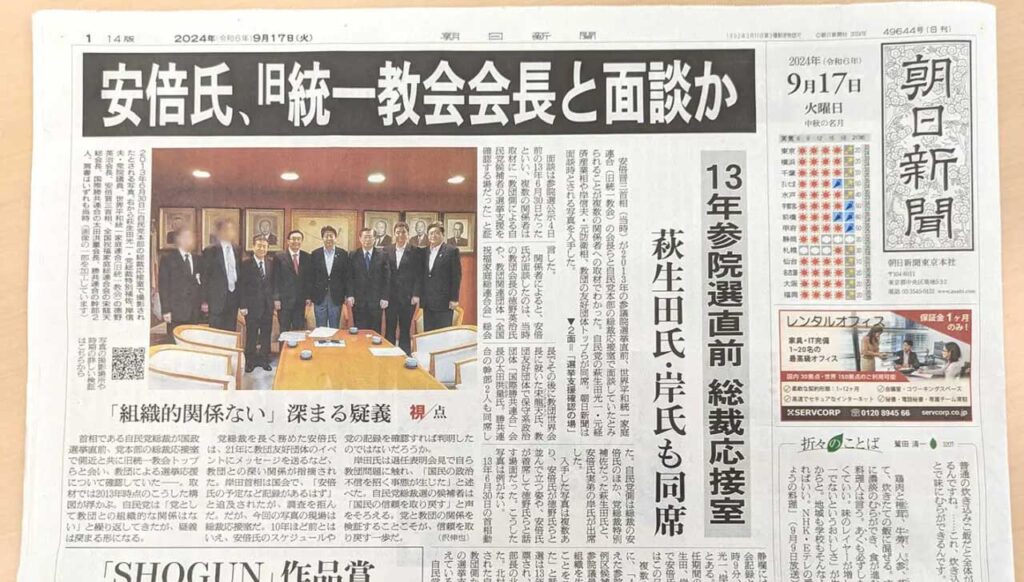
Fujiwara’s article specifically addresses a prominent Asahi Shimbun front-page report from September 17, which revisited an 11-year-old photograph of former Prime Minister Shinzo Abe (安倍晋三) meeting with senior officials of the former Unification Church in the reception room at the Liberal Democratic Party headquarters. This article by the left-leaning Asahi Shimbun sought to assert that the “organizational relationship” between Abe’s Liberal Democratic Party and the former Unification Church was “almost proven.” The report and accompanying photo emerged during the LDP presidential election’s final stages, possibly intended to challenge the LDP’s declaration of having “cut ties” by questioning, “What about this?”
Kazue Fujiwara points out that Asahi unfairly demands proof of something impossible to verify (i.e., the non-existence of an organizational relationship), deeming such reporting irresponsible. Fujiwara criticizes Asahi for speculating about and criticizing a deceased individual who can no longer defend himself, without providing sufficient evidence.
Sankei Shimbun writes that there is no reason for the LDP to reject meetings with an organization composed of voting citizens who support the party. Political parties exist to garner public support to implement their policies, and sharing information with groups aligned with their policies is a standard political activity. Voting rights are equally granted to all citizens, and criticizing individuals for exercising these rights based on personal affiliations is a violation of basic human rights.
Fujiwara emphasizes that if there were any issue with Abe meeting Unification Church leaders, it would only arise if the Liberal Democratic Party had extended “undue benefits” to the religious organization in return for election support. The question of an organizational relationship should hinge on whether any such benefits were provided.
In reality, rather than rewarding the Unification Church, the Abe-led government implemented policies that significantly disadvantaged the religious movement from South Korea. In 2018, the administration amended the Consumer Contract Act, rendering contracts stemming from spiritual sales activities invalid. The National Network of Lawyers Against Spiritual Sales, an organization critical of the Unification Church, reported a significant decline in consultations involving the religious organization during Abe’s tenure. These facts demonstrate that the LDP addressed the issue and showed no organizational relationship with the church.
Asahi Shimbun’s demand that the Liberal Democratic Party provide evidence of non-existent organizational ties with the Unification Church represents an impossible task, often referred to as a “devil’s proof”—requiring evidence to disprove something unverifiable. If Asahi bases its assertion of organizational ties on a singular meeting in the reception room, then it is the newspaper’s responsibility to prove that the governing party granted benefits to the religious organization.
In 2017, Asahi repeatedly demanded similar “devil’s proof” from the Abe administration in relation to the Moritomo Gakuen (森友学園) and Kake Gakuen (加計学園) scandals, where the government allegedly offered preferential treatment to school operators linked to the prime minister.
In her Sankei Shimbun article, Kazue Fujiwara asserts that the left-wing Asahi’s reporting during those times incited unnecessary political upheaval in Japan. Now, they pursue a similar strategy by manipulating an 11-year-old photograph to disrupt the LDP leadership election. Fujiwara concludes that this kind of reporting, which demands an impossible “devil’s proof,” is indeed irresponsible and contravenes journalistic ethics.
It’s tempting to extend Fujiwara’s reasoning further. The reason Asahi Shimbun dedicated extensive space on its front and second pages to this 2013 incident boils down to more than irresponsible and unethical reporting—it constitutes political mudslinging. Even when there’s no actual controversy, they attempt to fabricate one. As Fujiwara noted, there was “no reason for the LDP to reject a visit from a group of citizens with voting rights who support the party.” Shinzo Abe and the LDP did nothing wrong, and the Unification Church committed no wrongdoing either.
The Asahi, like the Japanese Communist Party, has persistently linked the Unification Church to Abe’s assassination. By painting the religious group as “evil,” this major left-wing paper also tarnishes the LDP by suggesting it has “ties” to this supposed “cult.”
However, if the Unification Church has committed no crimes, and LDP politicians legitimately associated with its members, Asahi Shimbun’s ammunition is weak. Yet, for Asahi, the campaign to portray both the Unification Church and the LDP negatively must succeed to maintain their narrative. Otherwise, the baseless assertions they rely on may be unveiled.
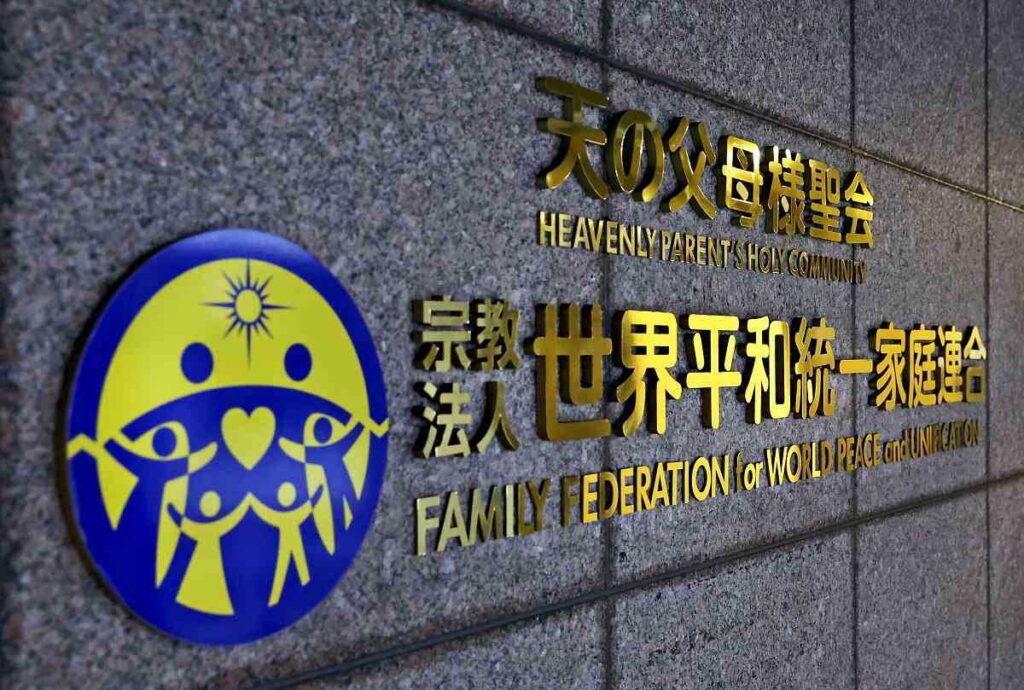
Featured image: Sign at the entrance of the Family Federation of Japan headquarters in Shibuya, Tokyo. Photo: FFWPU.