By Sandra Lowen
There have “always” been enslaved peoples in the history of the world. The slavery of the Israelites and of Africans have been considered among the most heinous, however, because of their severity.
Unlike the Israelites, who were made slaves in their own or neighboring countries, Africans were carried far away across a great ocean, where nothing was familiar to them. Israelites and the Egyptians who enslaved them did not look that dissimilar, while the Africans, with their dark skin and other prominent racial features, stood out among the people around them.
Although they were ostracized from Egyptian society, there is no record of the Israelites being deprived of family, religion, language, or culture. However, African slave families were purposefully separated and placed with other Africans who did not speak their language. Learning to read or showing those skills was punishable, in a significant number of incidents, by death. Whippings and forcible rapes were a matter of course.
How were Christian White people able to do such contemptible things? They went to the Scriptures and dredged up the story of Ham, Noah’s second son, whose offspring Noah cursed to be slaves to their relatives. White religious people designated Ham to be a Black man, destined by God to be a slave to justify their treatment of the Africans.
But even this was not enough. Ultimately, they labeled the Black race as “beasts,” who, like other animals, could be beaten and maltreated. Some “studded” their slaves, forcing them to have sex even with close relatives or with the owners themselves. In the latter cases, the mixed-race offspring were not acknowledged as a part of the White family, but were banished to the slave quarters with the rest of the Blacks.
When changing political and social pressures made it no longer easy to bring slaves to America, the Whites coupled with Black women, willing or not, to make more slave offspring. At auction, these mulatto and quadroon children sold for a higher price than their black-skinned half-brothers.
Many people called for slaves to be treated better, but they were shouted down. Ultimately, in political circles, it was allowed for a Black man to count as having the value of three-fifths of a White man. Independence Day — July 4, 1776 — granted neither freedom nor citizenship to Africans in America. A slave might be freed for extraordinary service to his master or upon his owner’s death. However, there was no guarantee, even with legal papers attesting he was free, that an African might not be recaptured by “slavecatchers” and returned to servitude without recourse.
Most Black people lift up Abraham Lincoln, whose administration freed the slaves. They were set free, but with few skills, virtually no education and no way back to Africa — a “home” many of them had never known and were by now ill-equipped to live in.
Up until the mid-20th century, Blacks were placed in a segregated status, as “separate-but-equal” second-class citizens of the United States. Although they were purportedly “equal,” Black schools received discarded books from White schools as “new,” even though they were often marked in, had missing pages or were coming apart. Even if one managed to get an equal education, there was no guarantee of a job in one’s field.
Individuals such as Rev. Dr. Martin Luther King, Jr., organized Blacks to follow the non-violent actions demonstrated in India by Mohandas “Mahatma” Gandhi against the British. Witnessing Blacks flailing in the streets under the blast of water hoses, set upon by dogs and screamed at and hit by virulent Whites, all the while silently enduring, melted the hearts of many White people.
In 1964, President Lyndon Johnson signed the Civil Rights Act into law, giving Blacks full status as citizens and allowing many to vote for the first time. However, in places where civil inequality persisted, stiff and unequal voting “qualifications” and threats continued. On April 5, 1968, following the murder of Dr. King the previous night, wholesale violence and race riots broke out in major cities. An uneasy peace was restored, but distrust between Black citizens and law enforcement continued.
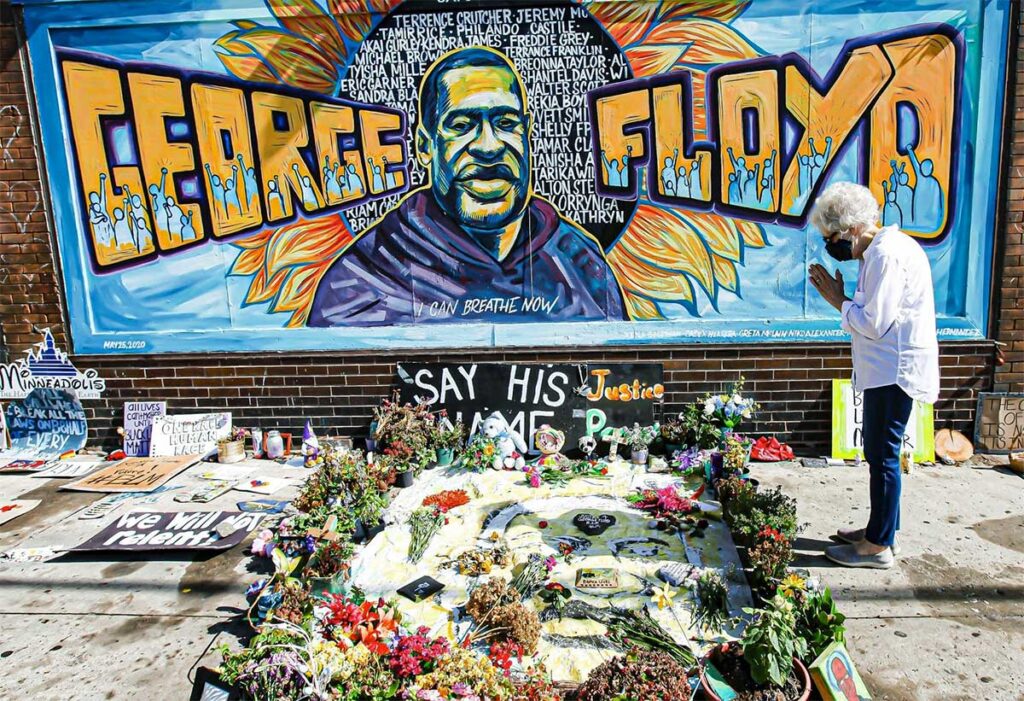
Racial profiling has long been a specter in law enforcement. It became common for people to assume that the police would respond more quickly if the alleged victim was White and the alleged perpetrator Black, even if the allegation proved false. The 2020 killing of George Floyd by police was considered the last straw, and Blacks, already frustrated over compulsory sequestration because of COVID and at least three other events that had caused the deaths of clearly innocent people, burst out in fury.
Racial Violence and Our Responsibility
Where is our Unification movement in all of these events? We can easily sit back and say, “Oh, how terrible! These people should not be doing this!” However, we have a major responsibility for what has happened, and indeed in what happens throughout the world.
We fail to understand that we, Unificationists, are the microcosm of world events, and that issues in the macrocosmic world merely reflect what we have not yet resolved. If we grasped this fully, we would be responsive — no, proactive — on any number of issues. However, that enlightenment has yet to come to us as a movement.
The Divine Principle, with its teachings of universal love and brotherhood, reached our shores in 1959, through Dr. David (Sang Chul) Kim, Dr. Young Oon Kim and Dr. Bo Hi Pak. Dr. Young Oon Kim worked in the homes of middle-class White women as a domestic, bringing Pauline (Phillips) Verheyen, Doris (Walder) Orme and Eileen (Welch) Lemurs to the Principle. They brought this understanding to their friends, and the movement began to grow. However, they were mostly other middle-aged, middle-class, conservative Christian White people, and they simply did not have the mindset of witnessing to people of other races.
As the movement spread to more urban areas, encounters with Blacks at work and in the community became more frequent. Acting on a vision I had seen of Black men in chains circling around a beautiful tree and singing, “Oh, oh, I want to know: Don’t I have a right to the Tree of Life?”, I was led by spirit up the stairs to the church center, where I joined, following a series of confirming visions. Already established in the community and no stranger to international and intercultural groups, this writer saw the movement as a way to provide the spiritual underpinnings to the growing interculturism within society, in every area from religion to social service to education.
However, even within a few days of accepting this teaching, I was helping a White church leader clean out the belongings of another White member. When he encountered a straw hat with plastic fruit sewn on, without preamble, he slapped it on my head and yelled, “Ruby!” As “Ruby” is not my name and there were no rubies on the hat, I enquired why he had done such a thing. He said when he saw the hat, it reminded him of something a Black person would wear, and he thought…; his voice drifted away into a kind of nonsensical garble. Despite the thoughtlessness behind the act, I chose to remain in the movement. Other Blacks were not so understanding.
1968 was a particularly difficult time for Washington, DC, as it was for America. In April, racially-fueled riots following Dr. King’s assassination occurred. The members quickly packed up and moved the center to the suburbs, not even informing the outlying members, chiefly minority and elderly members, where they had gone. This writer lived in the center in Washington, DC, for four years as the only resident African-American. At the time, the District of Columbia had a population that was 95% Black.
In 1975, a year after the Loving v. State of Virginia Supreme Court decision, permitting mixed-race marriages in the United States, the 1,800 Couple matching and Blessing took place in South Korea. Of the more than 3,600-plus participants, half of whom were women, two were African-American females and one was Afro-Caribbean. There were no African or African-American men. Rev. Sun Myung Moon struggled mightily to find matches for these three women, but no one seemed to want to marry them. Finally, spouses were found for the women, but all the men were European, not American. Only one of the women, this writer, remains connected to the movement, and only one of the European men remains.
1979 showed more promise. There were by now more African-American members, as well as African and Afro-Caribbean members in the U.S. movement However, there was friction between the African and African-American members. Rejection of American Blacks by African-born or descended members was that, while the Africans could trace their ancestry back 500 years or more, the African-Americans were “mongrels,” with no knowledge of their ancestors, and viewed as “bastards” because of their involuntarily mixed heritage. American Blacks, meanwhile, knew that while the common concept is of White slavers tracking them through the jungles, it was not unusual for one African tribe to turn over an enemy tribe to slavers.
Another common malady among Black people hailed back to slavery times, when the lighter-skinned Blacks were considered more “intelligent” and “acceptable” to work around Whites. Even within the movement, competition for the “White Man’s attention” or “Yellow Man’s attention” became an ancestral struggle, with some Blacks willing to throw one another under the figurative bus for the “right” of being closer to a White or Asian leader. Some leaders sensed and took advantage of this historical issue.
At the 1981 Foley Square Rally in Manhattan, True Father announced the creation of a new organization, Minority Alliance International (MAI), whose purpose was to bring non-Whites into a fellowship in which they could work together for equality. However, the $2 million allotted for this organization wound up in the hands of Whites. One bookkeeper from the parent organization took me aside and showed me a ledger that indicated that, while almost no events or projects appropriated in the MAI budget had taken place, the money had nonetheless virtually disappeared. The ledger showed who had withdrawn from that account; not a single person was from the designated minority groups.
Fundraisers and witnessers were very aware that the way to get whatever they needed, whether signatures for a campaign, buyers for fundraising products, or takers for street Blessings, was to go to areas where minorities were the chief residents. Black and Brown people have tended to be far more responsive. Members realized that and spread that knowledge to others. However, they did not pass on the granting of full membership rights to those same people of color.
Passing the Baton
The First Generation, now blessed with people with whom they felt more comfortable, had the opportunity to raise their children with better values. However, they tended to instill in their children the same prejudices they had grown up with, along racial lines.
One of the common issues among Second Generation young people of African descent, even those who have been mixed with Whites or Asians, is they feel no one will want them when they are of an age to be blessed. What counts for “interracial marriages” in the Unification movement are usually Asian-Euro-American mixes. When this African-American’s husband attended a meeting at which she was not present, an Asian member remarked, “This is a very special brother, because even though True Father gave him a Black woman, he did not complain.”
If this is our attitude, then we can expect no better from the outside world. Until we can raise up Africans, African-Americans, Latinos, Southeast Asians, and other people of color to positions of leadership in the same way that we raise up Whites and “Favored Nation” Asians; until we realize the goals set forth for us by Heaven, of bringing the Kingdom of Heaven to every corner of the world; until we encourage our young people to view every race with indifference, not just toleration or lip-service acceptance; we can never realize in actuality the Cheon Il Guk world we so proudly proclaim. This does not mean creating an “affirmative action” status for these members; most do not require it.
Many people expected that direction would come from True Parents on how to solve the issue of racial inequity. Why has this not come?
The answer is it has never been their responsibility. Although True Father often spoke out against racism and the need for universal acceptance and brotherhood, and True Mother has embraced Africa, solving racism has never been their task. True Parents’ responsibility, to discover the secret crime of Satan, to raise human beings to perfection, to confer the Blessing upon us, and to establish the standards for Cheon Il Guk, assumes universal harmony between people. It presupposes brotherhood without condition.
As people of color, we have not always helped ourselves. As in days of old, we “compete” for crumbs from people who don’t seem to mind pitting us against each other and calling it “heavenly competition.” We continue to fill our children’s heads with the concept they will be universally accepted, rather than letting them understand there are still issues with racism deep within our movement. Training them to know that their faith has to go beyond their experience is difficult but must be done for the sake of the third generation. They need to understand for themselves that being blessed to other people of color is not a “punishment,” and that the goals of learning to disseminate the Divine Principle and to live lives of purity, piety and honesty are paramount to the future of this movement.
We must not ignore the issues that plague our world today. The southern border, our overburdened hospitals, the homeless camps, and the burning, glass-littered streets of our cities are our home church areas, too. They are the areas to which Satan has retreated, knowing that God’s people will be too fearful or preoccupied with small tasks, small thoughts and small distractions to follow him there and root him out. If there is even one corner where Satanic separation exists, then nobody is truly safe or truly saved. It is not enough merely to save our own souls. As Unificationists, we must take up the gauntlet and save this world — this whole world.♦
Note: Wednesday, June 19, 2024, is Juneteenth National Independence Day, a federal holiday in the United States. It is celebrated annually on June 19 to commemorate the ending of slavery in the United States. Dr. Lowen’s article, timed for this holiday, is adapted from a longer work.
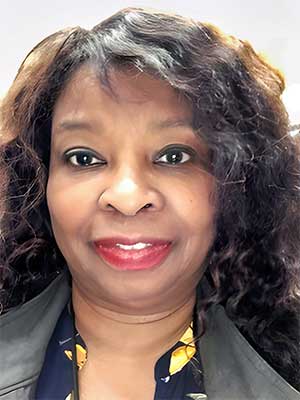
Sandra Lowen, PhD, is a supervising licensed clinical social worker (LCSW) with over 35 years’ experience as a trauma therapist, field instructor and clinical diagnostician. She is one of the pioneer disciples of True Parents in North America, joining the Unification Church in 1966. Rev. Moon ordained her in 1972. Dr. Lowen’s three novels, Reflections of a Very Bad Girl, Chi-Chi’s Song, and Ordinary Boys and Favorite Sons, are available on Lulu.com. With her husband, John G. Lowen, she has maintained a private therapy practice since 1992, specializing in couples, family and group therapy, and has conducted marriage and other seminars throughout the U.S.
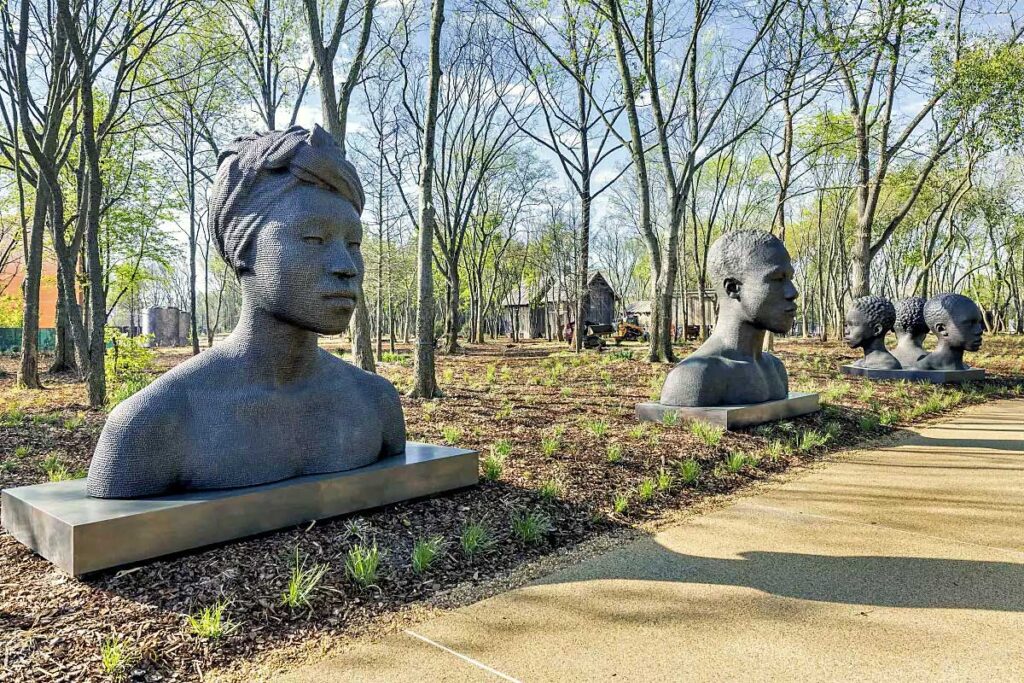
Photo at top: “Black Renaissance” by Rayvenn D’Clark is among the works on display at the new Freedom Monument Sculpture Park in Montgomery, Alabama.
🦻Listen to this text using the NaturalReader Google Chrome extension. Download it here. 🙂