
Early Days Internal Guidance
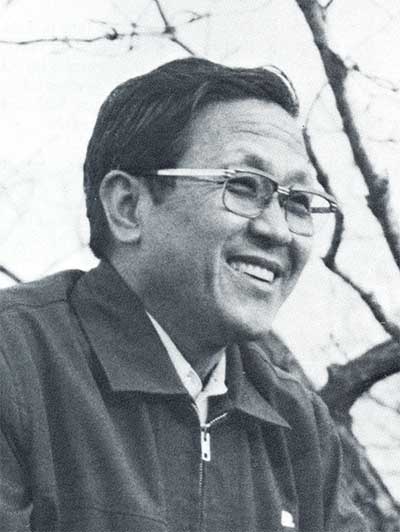
Rev. Yo Han Lee joined our Family during the difficult year of 1952 in the city of Pusan. He was a Christian minister, and became the second member to pioneer, in the military city of Taegu. Since those times, he taught training sessions for the Japanese Church, became the leader of our Seminary in Seoul, and was the Church Director of Chungpa Dong Church.
Most young people in Korea are anxious about their own future, but the conscientious ones believe that they as individuals exist on the foundation of the family, the family on the foundation of the race, and the race on the foundation of the nation. So, in Korea, most of the people who cared about the nation came to believe in some religion. Religious people were persecuted by the Japanese, during the Japanese occupation. The reason why faith is identified with patriotism is that both exist for the public good. For a similar reason, in the spirit world, patriots and scientists are treated more warmly than those who lived for their own sake on earth.
If you use your heart to try to figure out what you should do in a particular mission, you can easily understand what to do. You will yearn to do things like cleaning the bathroom.
In Korea, a high school teacher who majored in philosophy and visited the most famous philosopher in Korea to discuss the problems of life, listened one day to the Principle of Creation and discovered that it clearly answered all his unsolved questions. Because of this, he felt like coming to the church and helping in any way that was needed. He began cleaning the bathroom secretly early in the morning or late at night when no one would notice. We couldn’t order this high school teacher to clean the bathroom, yet he eventually quit his work and devoted himself completely to the church without being asked to do so at all.
In Korea, when we do pioneer witnessing, we look first for the most miserable family in the village or town-women whose husbands left for the war, or old people whose sons and grandsons had left for the war. Instead of using words to talk about our faith, we visit these homes and make a relationship with them as people of character, making ourselves useful and bringing them joy. In this way, we come to the town in the position of a servant and look for work that we can do with the physical body, following Father’s example.
Biblically speaking, the witnesser represents the chief priest of a village, the one who keeps the fire burning on the altar throughout the night. Not letting the fire go out means to protect this world with all your heart. As Father often says, we must go to bed after the last family in the village goes to bed, and we must serve this family by doing such things as cleaning up their yard before they awake. Then you can make a heartistic relationship with them without even speaking a word about faith. When you become the object of God and serve them, you grow so much. When you have this kind of “secret” with God, God helps you so much.
When I was in Manchuria or in Japan, the Japanese did not like me or Koreans in general. A Korean remains silent, giving no greeting, even in the morning. He looks hard to please, even when he doesn’t mean to do so, and Japanese people tend to get angry at him.
In Japan, people greet each other, even when they are not in the mood. In Korea, however, people don’t express their appreciation, even though they feel very grateful-this is sometimes their weak point. However much they may appreciate, respect, and even worship someone inside their minds, still they don’t express emotions in words. If they do show their feelings and thoughts, they think something is wrong. In other words, a full mind is to them something like a balloon that has been inflated, and to express your thoughts and feelings is like popping this balloon. Our parents educated us to be this way. “Don’t be so frank and expressive,” parents urge their children. “Don’t follow your heart; hide your feelings deep inside your mind and don’t take them out so often.” A Korean wife does not come out of the kitchen to greet her husband when he returns home, even if she loves and respects him. She suppresses her feelings. This is general family education in Korea.
Japanese may misunderstand this behavior. It doesn’t mean that something is wrong. After all, you cannot order someone to do exactly what you expect him to do; he will express his feelings in his own way. You cannot judge a person because he is not the same as you are. There are always internal reasons for his actions.
In Korea, when we have some problems and suffer an emotional collapse, we call it a “wrinkle.” Just as you must iron clothes after washing them, you must iron out your “wrinkles” each day. This means that when negative feelings influence you and cause your mind to “shrink,” you must iron them out before going to sleep. If you pass the night in that frame of mind, you can hardly iron out the “wrinkle” the next day. This is similar to being unable to make your clothes look smooth once you have ironed them carelessly.
Once you do something wrong, Satan comes to accuse you in periods of three: three hours, three days, three months. In this case, you must find the cause of the “wrinkle.” This means resolving what caused the wrong relationship with the other person, by talking with the person involved, either directly or accompanied by the church director. Small things often become big problems after some time, so a man of faith must be aware of this point and take care of problems as they arise.
Many faithful people attending God’s providence got off the track, somewhere along the way, even though they started with such high motivation in the beginning. For instance, the Israelites willingly left Egypt for Canaan, but because they encountered so much poverty and suffering along the way, they switched their standpoint. Instead of heading for Canaan under God’s guidance and for the purpose of providence, they switched to their own standpoint and thus also destroyed their sense of value. Those who failed generally turned in the direction of self-centeredness, destroying the subject of their life and eventually their sense of value. Thus, the major problem is the control of your spirit.
Are you really being resurrected by the word? Do you truly realize God exists? Many people who have been in religion for a long time eventually doubt whether God exists or not. It was a professor of theology-not an atheist-who wrote an essay proclaiming that God was dead. I found many ministers who carry on their lives without God. Many ministers relate to people based on what they know from their studies, instead of teaching people the living God as they have known Him and lived with Him. They have the name of being a minister, but they don’t bring God to others. There are many people like this.
Among our family members, many are more occupied with their work instead of with the living God-even though they heard the Divine Principle and joined the church, devoting themselves completely. You must have noticed this kind of situation. For example, some people come reluctantly to Sunday service, saying “It’s Sunday. I want to rest, but I have to go to service.” Instead of overflowing with spiritual motivation, they form habits and go through the motions of religious actions-even though once they have spiritual vitality. In this way, they run off the road.
If you are committed to the public good, the spiritual world will give you revelations. If you are in trouble and God cannot reveal something to you directly, He will reveal it to the person who is praying for you. There is a spiritual law that God will always show you the way whenever you pray in a group of three at the same time and place.
Those of you who are central figures should not lead members by your own standards or feelings. Since God cares about us and takes responsibility for those who carry the heavenly mission, He always shows us the way-as long as we recognize His care and follow His desire.
When Father was in Korea, he would appear to church directors and guide us spiritually. Sometimes he showed us spiritually the title of the speech he was giving to the members in Seoul. When there was an important event at headquarters that church leaders longed to attend but could not because of responsibility for local churches, they were often spiritually shown all that transpired in headquarters.
In Korea, most of the major leaders learned through spiritual communion whatever new directions the Father gave on Sundays. I have had the experience of going to Seoul for monthly meetings and finding to my surprise that Father emphasized the same points I had been teaching to the family throughout the month. With this kind of standard, we could climb a mountain and hold our service there, and all present could hear spiritually whatever Father was preaching in Seoul.
(Selected from the booklets “Faith and Life,” published in 1978.)