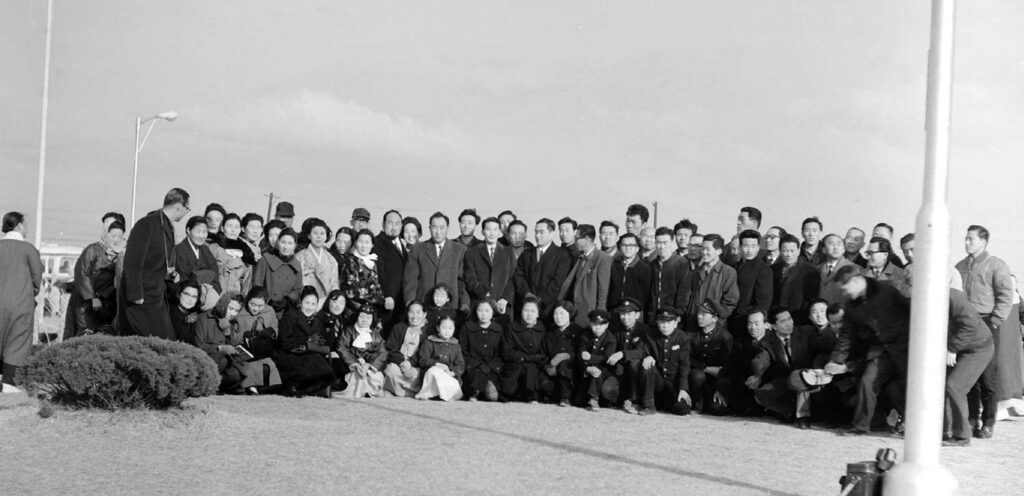
Mr. Choi Sang-ik (who later received the name Bong-choon from his father), better known to many of us as Papa-san Choi, ascended to the spirit world in late February this year. A national-level Seonghwa Ceremony was conducted in California, USA, on March 18.
Papa-san Choi was our first missionary to Japan, and the first missionary True Father sent out with the mission to restore another nation back to our Heavenly Parent. This testimony has been translated from original texts that Papa-san wrote in Korean and Japanese and draws from both. Some of the content is written more in the form of a daily journal, and these parts are dated.
Papa-san Choi has escaped from the hospital and begun his mission in Tokyo.
By Papa-san Choi
Part 14 (Click here to read Part 1, Part 2, Part 3, Part 4, Part 5, Part 6, Part 7, Part 8, Part 9, Part 10, Part 11, Part 12 and Part 13)
Witnessing while hungry
I bought bread for 30 yen and had that and water for a few days. Had no energy maybe for lack of nutrition. Still, the mission had to be carried out even unto death. At times, I used food money for train tickets and fasted so that I could go witnessing. I was hungry and wanted to buy an apple with 10 yen but used it as a donation to meet a minister. For a while, I was physically weak without funds but tried to maintain myself spiritually. I pushed myself to go to the YMCA to find young people and didn’t give up.
I was out of money. I could not buy food or go anywhere, and so I visited people and a church nearby on Sunday. The young pastor was just out of seminary, and seemed to be kind to those who appeared wealthy but was indifferent toward me. Whenever I sensed such things, I’d think, “Just you wait and see!” I shared parts of the Divine Principle introduction, creation, the fall and other sections with him. He listened but said this was just one interpretation, and did not try to study it further, so I gave up on witnessing to him.
After I told one professor that a “revolution of character” by itself would be enough to change everything, the professor told me to leave since he wasn’t interested in such fantasies. “You must think you are even greater than Jesus, Buddha, or Confucius,” he said.
I went to see several of my friends, but I had nowhere left to go. I was completely famished and totally exhausted. I thought that if I could just have one good night’s rest, I would lack for nothing. Buffeted back and forth, facing hunger and feeling cold, I felt like a 40-day fast would be no problem at all. On a 40-day fast, as least there’s the hope that on the 41st day you can have something to eat, but the way I was living, whether I fasted for a few days or a few months, it didn’t seem as if there would be an end to such hardship. When I drank water after fasting for a long time, the water tasted more bitter than medicine.
My energy was gone. Why did my reflection in the window look so shabby? Standing there I saw I was the lowest of the low, the most beggarly of all beggars, the poorest of all the world’s poor. Looking at my reflection in the window, I looked so pitiful that I asked myself, “Are you a son of God? Do you mean to become a father of the faith by restoring Japan?” No matter how much I thought about it, there didn’t seem to be any hope.
While I was staring at myself, I toppled over from sheer exhaustion. Thinking that something even stranger might happen if I lay there on the ground, I mustered the courage to get up again and started walking. At that point, I stumbled upon a company that a friend of mine was running. My friend had not believed in my message, but I didn’t have the luxury to think about whether he disliked me or not. And when I went up to his office on the second floor, he surprised me by welcoming me in. This friend, who had opposed me and tried to kick me out, gave me 3,000 yen. On the very brink of death, [God] used someone who had seemed like one of my worst enemies to give me money. When I was truly in dire need, our Heavenly Father provided for me through others. While I was doing witnessing work, I used that money to buy bread and to feed myself.
My faith in God was absolute, I had passion for my work and accepted the hardship as indemnity. I only prayed, “Father, don’t make me succumb, but help me to fulfill the mission as quickly as possible.”
An income to live on while carrying out the mission
By then it was already the end of July. I made up my mind that instead of relying on others to support my mission work, I must become self-sufficient so that I could do my work continuously. Fortunately, I was able to make contact with a certain Mr. Jarvis from the Shinsei [New Life Movement] whom I had known before, and with his help I was put in charge of assembling radios. I wanted to work during the day and witness at night, but evenings were not a good time to visit people, so I asked for breaks at noon and in the late afternoon.
I wanted to speak with Mr. Jarvis of the Shinsei movement, but he was too conservative and I shared just a part with another missionary, who listened well. But there were few such chances, and although I wanted to convey the word to the Japanese staff of the Shinsei movement, there was no one on that level. I spoke with Mr. Nakata, visited his home and shared, but he wouldn’t open his heart. I couldn’t talk with anyone, and later found a student named Asai, who listened with surprise. He learned how wonderful Divine Principle was, but he was secular in mindset.
One evening, I visited a large church in Kitazawa and spoke with the pastor, but he got upset, asking, “Did you come to preach to me?” and kicked me out. Another day, I met the leader of a Christian peace movement, but he couldn’t believe in my peaceful means of unifying thought by unifying religion, and treated me like a fool. I was kicked out in the rain.
Turning point
Thinking I ought to get some schooling not only to learn about approaches to mission work but also to maintain my status in Japan, I enrolled in the Tokyo Biblical Seminary.
Mr. Yoneda at the school introduced me to a Korean Christian, Mr. Shimizu. He had become a Japanese citizen, and had a watch shop, Yuukeisha. I quietly decided this was to be my base, and told Mr. Shimizu I would like to quit the Shinsei movement and work here, which he accepted.
I sold installment plans for in the morning, handled contracts for theater clocks in the afternoon, and repaired clocks at night. At first there was no time to witness, but later I set it up so that I could work in the mornings and went witnessing from noon. I made contact with all sorts of people—pastors, students, and regular churchgoers—and witnessed to them. I was anxious. I wanted to find someone quickly, and start a church. There was no one who followed from the bottom of his heart. To restore Japan in the shortest possible time, I lectured Divine Principle in the afternoons on the second floor of Mr. Shimizu’s place, but not many came. When four came to my first lecture one evening, I was pleased. I wished this would continue. The Shimizu family listened intently to the Divine Principle.
At any rate, I wanted to start a church, so, for the first time in Japan, I printed and passed out fliers bearing the name “HSA-UWC Tokyo Church.”
Beginnings of the Unification Church in Japan
At 7:15 pm on Friday, October 2nd, 1959, the first service was held of what we called the Tokyo Church of the Holy Spirit Association for the Unification of World Christianity. Mr. Shimizu hosted the meeting and I preached the sermon; thus, the Unification Church of Japan took its first step. While quite a few people were supposed to be at the service on that day, including seminary students, in the end there were just four of us—Mr. Shimizu, one Mr. Suda, Mrs. Tamura, and myself.
Continued next week…