Early Days Internal Guidance
Helping others to participate with the Messiah on earth is perhaps the single most important thing we can give to them and their lineage for all eternity. We hope this lecture, given by Rev. Kevin McCarthy to ministers in Korea, to assist in that work.
Part 1
There are various expectations and doctrinal agendas with regard to the events of the Last Days. For example, is Christ coming imminently or will there be events that will precede his coming? We cannot resolve everything here, so let’s focus on three areas of Unification eschatology: when, how, and where Christ will come again.
WHEN?
Some scripture seems to suggest we cannot know that day and hour when Christ will come and that we should not make a prediction or prophesy. Yet other scripture like Amos 3:7 says that God does nothing without revealing His secrets to His servants, the prophets. One thing is clear, though: Jesus definitely spoke to that generation of Christians who would be alive on earth to participate in and experience the day of the Second Coming. He warned that generation not to be asleep, for he would come at an unexpected time and in an unexpected way. Yet he was very explicit about what the environment would be like at the time of the Second Coming, describing the Last Days in Mark 13 and Matthew 24. We need to ask ourselves: Why does Jesus want that one generation to be awake? It should realize: “Hey, we must be that generation. Look, the signs are being fulfilled!” We have to know when Christ comes, not to face the final judgment or the rapture, but to rise to the responsibility of being the ones to recognize the Christ at his second coming.
Let’s think about a parallel time 2,000 years ago, when a particular generation of chosen people had to deal with Jesus face to face. What made them different from any other generation up until that moment? Were they any better, more spiritual, more prepared than any previous generation? No, not at all. What made that generation of chosen people unique is that all previous generations had been judged by how they related to the law how they kept God’s decrees, commandments, and traditions. Then Jesus arrived. No one alerted them that the criterion by which their faith would be judged had changed. They had to recognize that now the criterion was their relationship with the man from Galilee. Look what happened! The scholarly, the devout, the well trained all those who knew the letter of the law and could recite the scripture passed by the wayside. It was the humble, the meek, the prostitute, the publican, the fisherman, the uneducated, and the un-doctrinal who recognized that Jesus was the Christ. Isn’t that amazing? What have we to learn from this? That generation of chosen people expected Christ to come and exalt their nation. They thought that they, by being devout, would have automatic entrance into God’s Kingdom. But Jesus indicated that there was one more qualification the responsibility to transpose their faith in the expectation of Christ’s coming into recognition of and participation with Christ. That’s where those who were proud of their faith stumbled and failed in their responsibility.
The important lesson is that no one followed Jesus as a natural conclusion of doctrine. Jesus was recognized only by humble, pure hearted people who could receive testimony from God that Jesus was the Christ. Hence, Jesus warned the generation of people who would be alive in the Last Days not to make the same mistake when he said, “Not everyone who says to me, ‘Lord, Lord,’ will enter the Kingdom of Heaven, but only he who does the will of my Father who is in heaven. Many will say to me on that day, ‘Lord, Lord, did we not prophesy in your name and in your name drive out demons and perform many miracles?’ Then I will tell them plainly, ‘Depart from me, you evildoers; I never knew you.”‘ (Matt. 7:2123) Jesus isn’t referring to backsliders but rather to people who are faithfully awaiting Christ’s coming. But that faith of itself will not automatically translate into the faith of recognition and participation. Will those people at the time of the Second Coming fulfill the will of God and the global responsibility of that era? It will be by this criterion that Christians in the Last Days will be judged.
When is that time, according to the historical parallels? The signs of the times in biblical prophecy are being fulfilled now in the 20th century. You and I are that generation to whom Jesus was speaking. Will we repeat the failure of the past or will we change and make the right choices?
HOW?
How will Christ come? Matt. 24:30 says, “They will see the Son of Man coming on the clouds of heaven with power and great glory.” Did Jesus mean literal clouds? We should definitely pray about this question, because 2,000 years ago in Israel it was also an issue of much argument. Some of those who were awaiting Christ’s coming pointed to Daniel 7:13 which said he would come on the clouds. Others pointed to Micah 5:2, which said he would “come forth” from the city of David. Still others, as we see in John 7:27, believed that no one could know from where Christ would come. In such an environment of debate and confusion, Christ appeared. There were even many other figures who thought that they themselves were the fulfillment of the Davidic covenant prophesy. One of the most famous was another man named Jesus (or Yehosua) whose large movement thought that he was the Christ. A lot of folks were saying that other figures were the Christ. When the Pharisees sent delegations out to John the Baptist to ask him if he were the Christ, they actually never considered that he could be the Christ; they only wanted to pin him as a false Messiah.
Why did God send Christ into such a confusing environment? The key point is that each chosen person of that generation was individually responsible to recognize who Jesus was.
Because it was such an issue 2,000 years ago, it will absolutely be an issue today. The reason why there are so many different expectations of how Christ will come has more to do with the parallels
of history than with someone being right or wrong. Some believe that his coming is imminent. Others believe certain events must precede the Second Coming, such as the rapture, or the rise of the Antichrist. Some believe that the Second Coming already took place on the day of Pentecost as spoken about in Acts; still others believe that the Second Coming will be a general Christ consciousness that will suddenly rise in the world. There are three options to consider, given such different viewpoints. Option number one is: Somebody’s got it right, and everybody else is wrong. Option number two is: Everybody’s wrong. And option number three is: Everybody has got it mostly right, but everyone has something that’s not exactly right. I’m sure everyone here would say, “It’s option number one, and it’s my church, my doctrine, that’s got the agenda right.” If you’re right, the problem is: How much anguish must Jesus feel looking at his body –the church–if your doctrine is the only correct one? He must be feeling really sorrowful that only one denomination has it right, especially in view of his prayer in John 17:2023 that we should be one as God and Christ are one. Certainly God and Christ don’t just tolerate each other! We all know there is no doctrinal schism between God and Christ! Another thing we can all agree upon, no matter who is right: Jesus must feel urgent to end the confusion in his body because it means the body is not ready for the Second Coming.
I believe that Jesus will send a revelation of clarification that will prepare us to unite to receive the Second Coming. I believe the Principle is that revelation from Jesus, and its purpose is to help all of us resolve the doctrinal schisms that have divided us and prevented Christianity from fulfilling its global responsibility. The result of this failure is that real people in the world today lose their opportunity to hear the gospel.
Violation of Jesus’ prayer
This point was brought home to me when I looked over the DMZ and saw a schoolyard in North Korea filled with children. I realized that because we Christians failed and allowed this line to be established, those children not only don’t get to hear about the love of God, but also are systematically taught that there is no God. The message of Rev. Moon is that we all must feel the
responsibility to let everyone know about the love God feels for them and all mankind. That’s one reason why so many people don’t like him. We want to be told that we’re all right and just be taken home to heaven. But when Jesus comes back, he’s not going to be satisfied with everything that we’ve done, for we stand in violation of his word and his prayer that we be united. If the desire to resolve this disunity is not burning in our hearts daily, then we need to repent. Whether it’s this revelation or another one, Jesus will bring words just as challenging and just as difficult as the ones brought by this Unification movement.
Christ will not come back for the purpose of fulfilling everyone’s doctrinal agenda, but rather to establish his Kingdom. If Rev. Moon is praying more, working harder, giving more to bring people together and to God than the one who has the “correct word,” then how will Jesus feel? Won’t he wonder how you could allow a “heretic,” an ignorant man, to shed more tears, to give more of his blood, sweat, tears, money, manpower and family to build the Kingdom than you did?
Whether Rev. Moon is right or wrong, this is a serious moment in history. If you’re feeling right now, “I’m the only one that has it right,” then you should also be feeling, “Oh, my God, what should I do about that? How urgent Jesus must feel, being dependent on me!” If we all feel that way, then Jesus will certainly be able to bring us into full knowledge of God’s will. On that day prophesy and tongues will cease, doctrines and knowledge will cease, and we will be standing in front of Christ face to face with no doubt and clear hearts. That’s the age we are on the threshold of today. It will be a great blessing if we fulfill our responsibility. But it will be a terrible curse if we cast it aside.
Daniel predicts First Coming
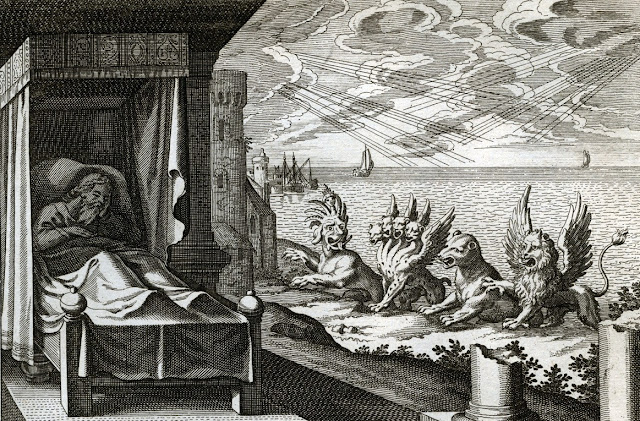
Will Christ come on the literal clouds? In Daniel 7:13, Daniel predicts that Christ will come on the clouds. Many people today read this and say, “Daniel is talking about the Second Coming already!” But Daniel was speaking about the first advent of Christ that Jesus of Israel would come on the clouds of heaven. How can we know that? This seventh chapter of Daniel is about a dream and its interpretation. Four beasts appear in this dream, and during the reign of the fourth beast Christ comes on the clouds of heaven. The 17th verse tells us that the four beasts represent four kingdoms that will rise between the time of Daniel and the time of Christ’s coming on the clouds. The first kingdom (lion), which existed in Daniel’s time, was Babylon. It declined and gave rise to the Persian empire (bear) which then declined and was replaced by the Greek empire (leopard). After the third kingdom came Rome the strong beast with iron teeth. Therefore, the Christ prophesied to come on the clouds of heaven is Jesus, who we know actually was born of a woman during the time of the Roman Empire.
Many historical theologians just can’t believe that anyone could prophesy the historical events leading up to Jesus so perfectly as Daniel describes in the second and seventh chapters. They feel that parts of Daniel were written with hindsight after the coming of Christ. Now I believe that Daniel was definitely an accurate prophet. what cannot be disputed is that Daniel was referring to the first coming of Christ Jesus in Israel and that Jesus was born of a woman.
Therefore, we have to think carefully about the meaning of the Lord coming on the clouds a second time. When Jesus repeats the same prophesy of Daniel, he isn’t saying that this time it will be literal, but simply that the second coming of Christ will be the same way as the first coming was. So what is the meaning of “clouds”? Heb. 12:1 refers to the gathering of saints as a “cloud” of witnesses, a foundation of believers, a group of people gathered together who are in a state of righteousness. Conversely, Rev. 17:15 declares that waters symbolize people, nations, multitudes, and tongues who are in the state of unrighteousness. Jude 1:13 uses the wild waves of the sea as a symbol to mean unrighteous people. Therefore, clouds symbolize a righteous people who are lifted up from an unrighteous foundation. This doesn’t mean physically lifted up but rather spiritually sanctified, becoming a part of the “cloud” of enlightened, sanctified believers awaiting Christ’s coming.
Now where was the cloud that Jesus appeared upon? It was the mission of John the Baptist to create this “cloud” or foundation of laborers ready to receive and follow the Lord (Luke 1:17). Jesus waited for 30 years for that “cloud” to be established. When the time was right, Jesus was to be revealed to the nation on that foundation, but it was lost. Jesus himself then tried to erect that very necessary foundation; he desperately prayed for laborers for the harvest was great (Matt. 9:3738).
When Jesus quoted Daniel’s prophesy, he could only mean that the Second Coming of Christ as well should be to a unified, sanctified foundation of believers. It is why he also prayed that we must be one as God and Christ are one. In Ezekiel 37, we see that Israel and Judah are united, and it is on that united foundation that Jesus Christ is received and the new covenant is established. Contrary to this, we see in Zechariah 11:1314 and 13:714 that when the king is rejected and the unity between Judah and Israel is broken, the covenant isn’t established. Christ must come on a unified foundation; therefore, Jesus prayed for that unity. That foundation is the “cloud” upon which he will appear.
What about the scripture in Acts 1:11 which seems to suggest otherwise? The angel appears and says to the men of Galilee as they were watching Jesus ascend into the spiritual heaven: “Why do you stand there looking into heaven? This same Jesus who has been taken from you into heaven will come back in the same way as you see him go.” What does he mean here? In the Greek text, the same Greek word uranos can be used to mean sky or spiritual heaven. If the sky is the correct place for the men of Galilee to be looking at, then the angel should say, “Well done, men of Galilee. Yes, keep looking up in the sky, for one day, Christ will appear up there.” But instead, the angel’s statement indicates looking into the sky is superfluous and needs to be corrected. Also in John 3:13 Jesus says, “No one has gone into heaven except the one who came down from heaven, the son of man, who is in heaven.” Jesus did not mean that no one has gone into the sky except the one who came down from the sky, the son of man who is floating in the sky. Jesus went into heaven in a very internal way, just as he came down from heaven in a very spiritual, internal way that was not perceivable with the physical eye. The angel in Acts 1 :11 is testifying to that very process by which Christ will come in the same internal way that he was seen to go.
Elijah is described as going up to heaven in a very dramatic way. Therefore, the chosen people were expecting him to come down in the same cataclysmic and obvious way just as we hope that Christ will come now in an easy and obvious way. But in fact, Elijah returned in a totally unexpected and very subtle way, surprising even Zachariah himself.
The return of persecution
So how will Christ come? Rev. 12:5 tells us, “She brought forth a male child, one who is to rule all nations with an iron scepter, and her child was snatched up to God and to His throne.” Therefore, we see that Christ will be born on earth in the flesh in the same way as he was the first time. He will walk among us as our contemporary. Our age parallels the time of Jesus’ first coming. The first chosen people were expecting an obvious, very cataclysmic coming; in fact, the Israelites were confident that his coming for them was already guaranteed; they merely had to wait around until it happened and they would automatically be saved. It’s in the midst of that same expectation and same attitude that Christ will return today. He is not coming to fulfill everyone’s doctrinal agenda or expectation; he may appear as unorthodox as he was 2,000 years ago. Will the religious leaders of this age repeat the failure of history? When God placed Esau in exactly the same environment and position as Cain, the feelings, the consternation, the anger, the hatred, and the bloodlust of Cain came into Esau. God set that up not so that Esau could kill Jacob but in the hope that Esau could reverse the failure of Cain. God has placed Christianity –the New Israel–in the same position as the Old Israel in order to indemnify its failure. In the midst of our doctrinal expectations, Christ will come again in a very unexpected way. The tendency will be for religious leaders and people to hurl invectives, to vilify his name, to cast him out of the congregation and throw him into prison.
We have to realize our position and responsibility to reverse this tendency. Standing in the position of the Sadducees or the Pharisees, we must ask ourselves: When Christ comes, what role will I play? Will I, like the unrighteous Pharisees, search the scriptures just to find a way to entrap the Lord in a contradiction? Or will I, like the righteous Pharisee, welcome Jesus to my table? We should not be arrogant or lighthearted toward anything new that we hear.
The Second Coming of Christ is not just the coming of Christ alone. It’s the second coming of Israelite history reflected in Christian history. The Second Coming of Christ is the second coming of all the institutions, attitudes, struggles, and figures that existed 2,000 years ago. And this time the New Israel you and I must fulfill the responsibility that was left undone 2,000 years ago. It is indeed a great and terrible day.