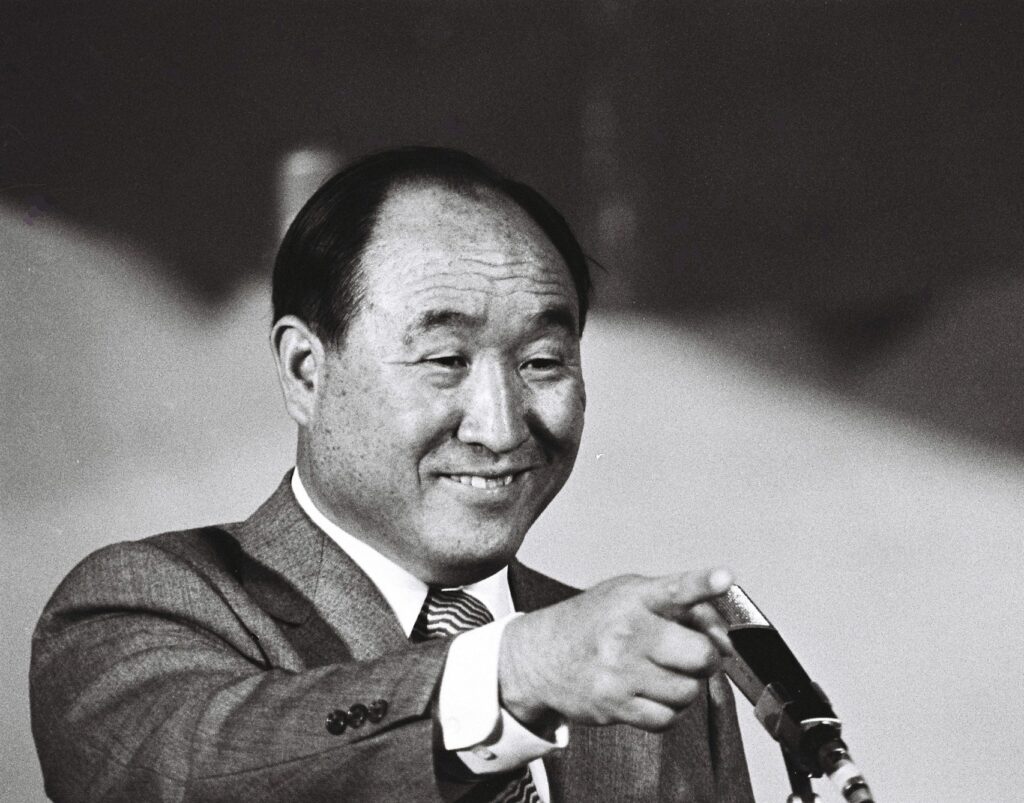
Mrs. Kang Sun-ae was born in Seoul in 1915. She graduated from Ewha College in 1937. She lived during a time when the role and value of women were changing in Korea. She had married and had children before she joined our church in 1958, without her husband. This is a testimony that evokes the Korea of a past time, and as such is a study of some of the values and sacrifices that characterized the spirit of the early period of our movement.
Part 6 (final)
I spent every single day in nature; during the day, I met Father, took care of the children and conducted my life; at night, I spent my time in a refreshing and tranquil environment. I completely recovered from my illness and my health was gradually improving.
One day, Father decided to hold a district leaders’ meeting in Jangja-mot Park[1]. He came early in the morning on that day and caught fish by casting a net late into the night. We had a basketful of fish. Then Father instructed us to buy ginseng and carp. After the carp were boiled, Father instructed us to put in the ginseng that we had pounded into powder, in the broth; the fish were used to make a spicy fish stew. We had a feast. I still remember how someone brought some water pigeons and pheasants, which he had killed with a shotgun that day. We plucked the birds that night and roasted them on a wood fire. I remember them being such a delicacy when we tried them.
When winter came in, I moved to a yellow house near Jangja-mot Park; however, being uncomfortable, I took a lease on a room behind the factory. It was during this time that I was given responsibility over the preparations of Father’s meals. Together with one young female member, I prepared meals with all the dedication and all the ideas I could muster. After every lunch, I served cinnamon and bean rice cakes using glutinous rice, which Father enjoyed.
Around mid-February 1967, a second factory was built in Sutaekri and Father would come every day at six in the morning and would stay there until 11:00 pm. I would prepare his meals with all my heart and on days when he would eat everything, I would carry the table back to the kitchen and jump for joy. Father’s room in Sutaekri was first in a thatched house; it was later moved to a tile-roofed house.
On February 5, 1968, I was delighted to receive an achievement award bestowed by Father himself. A few days later, Teacher Kim Won-pil told me, “Father personally recommended you.” I was quite surprised to hear it and also felt humbled.
Father would often go to Cheongpyeong in the summer. I did my best to supply side dishes from Sutaekri. Father would be immersed in deep thoughts while fishing and catching carp in Cheongpyeong. At times, he would continue fishing until late at night in the moonlight and would be completely enveloped in the fragrance of nature. Mother and Hyo-jin nim would entertain him at his side and though the meals I served during those days were rather simple, Father would eat them as if they were delicious and then say, “That was good!” which was a source of great joy to me.
A few times, we had to relocate the tents when flooding occurred. I often thought that I would have never experienced such a lifestyle had it not been for God’s will; I was ever grateful and in awe.
During those days, the headquarters expanded the Seoul district and chose women community leaders. I was also appointed and was given the responsibility to guide university students in Dongdae-mun District. At 5:00 pm, I waited in front of the bus stop and guided middle and high school students to listen to our lectures. I taught university students Japanese. Four months flew by in this manner. The factory dormitory at Sutaekri was completed by then and this happened on the day the inauguration ceremony for the new dormitory.
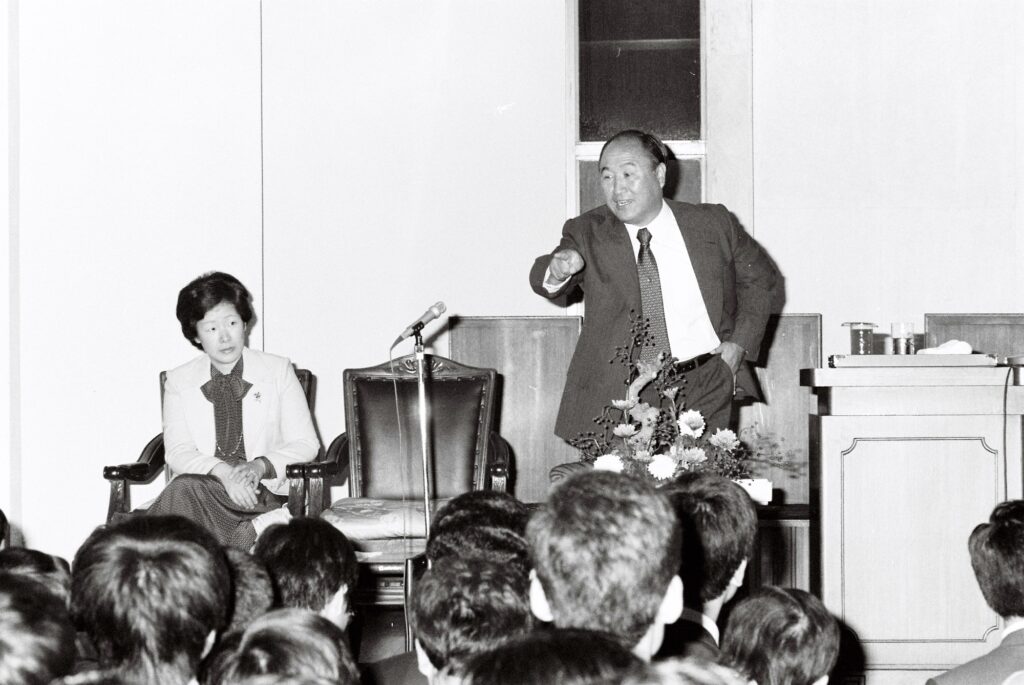
On this day, a “heart and friendship” meeting was held in the annex building with Father. Mother kept telling me to eat from Father’s table and giving me meat from the meal. Mother completely showered me with all the love I had been unable to receive until then. A few days later, I received a message instructing me to “stay in the newly completed dormitory.” I was not delighted by the news at all. Hence, I went to the headquarters church and when I met Father, I asked him, “Do I really have to go?” Father then told me to go immediately.
Since Father said so himself, I now had no alternative but to pack my belongings and go to Sutaekri. Han Gun-ja was also living at the dormitory. I once more had to cook food with my clumsy skills.
On May 27, 1971, Father sent the national leader and all the heads of departments to Cheongpyeong without any warning. He told me to go as well. I quickly prepared myself in the minibus and set off for Cheongpyeong. Once I arrived, I prepared lunch at Kim Jun-gu’s house and then rode on a boat to get to Father’s tent. Father’s tent was situated on a three-pyeong[2] piece of land between a mountain peak and the riverside. Father was the first to take a pickax to this peak. The heads of departments followed him in doing this. After a week of hard work, a construction team was organized and thirty-six people came. Father supervised and commanded the construction until it was completed. He would encourage us and at times gave out some refreshments. Mother often bought everyone tasty fruit and meat. At the end of our collective efforts, we readied the construction site in fifteen days, working rain or shine, and we constructed and completed a building in eight days.
The first rally held after this completion was on September 12, 1971 when Father opened the summer assembly for pastors on self-discipline training. Not only were the air, water and mountains in Cheongpyeong clean, the food itself was served with dedication. Hence, all participants listened to the new truth happily and were able to receive grace in its fullness, both spiritually and physically.
Following this, a workshop camp for university students was prepared and 240 students took part in it. A few days after the camp started, I noticed a student approaching me. After I closely observed the student, I realized it was my youngest son whom I had left behind eleven years ago. He ran to me saying “Mom” and I was quite surprised. He did not want to leave my side anymore. Seeing him so weakened, my heart was in much pain. I inquired about his state and heard that after his sister had gone to the United States, he could not go into the army and his life had lost a sense of direction. I then made a big decision; the feeling came to me that he might put an end to his life if I were to leave him in this state, so I told him to stay with me. I reported this to Father and he gave me his permission. I suppressed my gratitude and joy and began raising him. I made him do the lowest chores, starting from feeding the pigs, dogs and chickens and carrying their food in buckets, to outside work such as weeding pepper fields. While doing this, he participated in the camp for university students and came to understand the Divine Principle anew;[3] he started becoming internally strong and even helped me attend Father and the True Children. Just thinking of how other members would have resented me if I had asked them to do what my son had done, I came to a deeper understanding and appreciation of lineage, family connections.
If it were not for this path, I would have not been able to push my way through this disorderly world and advance with firmness; nor would I have been able to understand the fortune and destiny of this troubled world. The more I think about it, I came to realize that heavenly fortune moves toward the side of goodness and my heart felt more secure as I came to understand the direction of history.
Whenever I reflect upon all these things, my only thought is about how I can repay this tremendous grace. I firmly believe that this providence will truly be achieved and I gladly step forward toward that task.
This is the final installment of this testimony.
[1] A park with a lake about a kilometer from the Sutaekri factory (now part of the city of Guri)
[2] Ten square meters
[3] Father had instructed Mrs. Kang to witness to her family in Japan, but this son was not among them there. No portion of Mrs. Kang’s testimony explains this son’s earlier involvement with the church.