Based on extracts from his speeches throughout his life
Earlier installments are available for reading.
Part 82
Countering Communism in Korea and Japan
True Parents’ vision for the world includes the right of all people to know and serve God. For this reason, the task to expose the flaws of the communist ideology became an urgent one, which True Parents undertook as one of their main responsibilities from the mid-1960s onward, quickly expanding this work to Japan.
First God’s Day, January 1, 1968 (proclaimed by True Parents at 3:00 am)
January 1, 1968 is a joyous day, because, for the first time in history, God can come down to earth based on the love emanating from Adam and Eve’s God-centered oneness; this has been God’s hope according to the ideal He held at the time of the Creation.
Winning (sometimes reluctant) respect
It seems that Christian ministers now tell their believers that even if they think the Unification Church teachings are wrong they should nevertheless model their activities on our members’ work. Why would they say that? We do things that members of other churches could not even dream of doing. Having carried out our activities in the rural districts, counties and provinces, we are now moving them into the central city areas.
Our Nongdowon[1] won a 5.16 Citizen Award.[2] A great number of our church members have received individual awards. The world probably did not imagine that the Unification Church would do so well. We love our country more than anyone else does, and we work harder than anyone else to stop communism.
Thwarted assassination attempt
The so-called “Shin-jo Kim incident,”[3] the infiltration of armed North Korean commandos on January 21, 1968 was as an opportunity for South Korea to pull itself together and to reach a new level. Shin-jo Kim belonged to North Korean Army Unit 124. You all heard the kind of training the commandos were made to go through. It was rigorous—ordinary people would have fallen down and given up, on the verge of death. By having gone through that training process, which gradually grew more severe, they would later be able to overcome situations that are even more difficult.
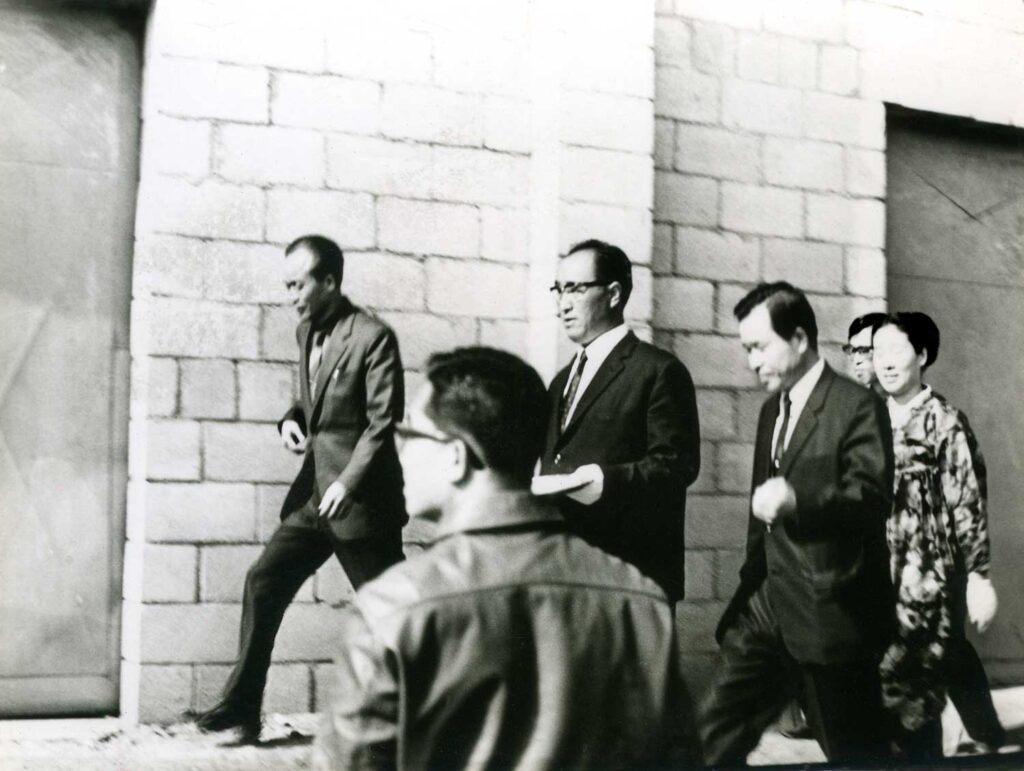
Nevertheless, why did North Korea attack the South Korean president’s residence? The numbers actually add up. It was January 21. The Unit consisted of thirty-one soldiers. January refers to a new beginning. The twenty-first signifies three times seven, and the thirty-one soldiers symbolize the number four. It is all based on the Divine Principle. The fact that they attacked the external president signifies that Cain attacked Abel externally. From the viewpoint of God’s side, we are Abel whereas North Koreans are Cain, so it is almost as if Cain struck at Abel. However, because the time has come, Cain could not kill Abel. Through the incident, the Korean people united. When faced with an attack from Cain, you need to unite with Abel.
Working to drive out communism
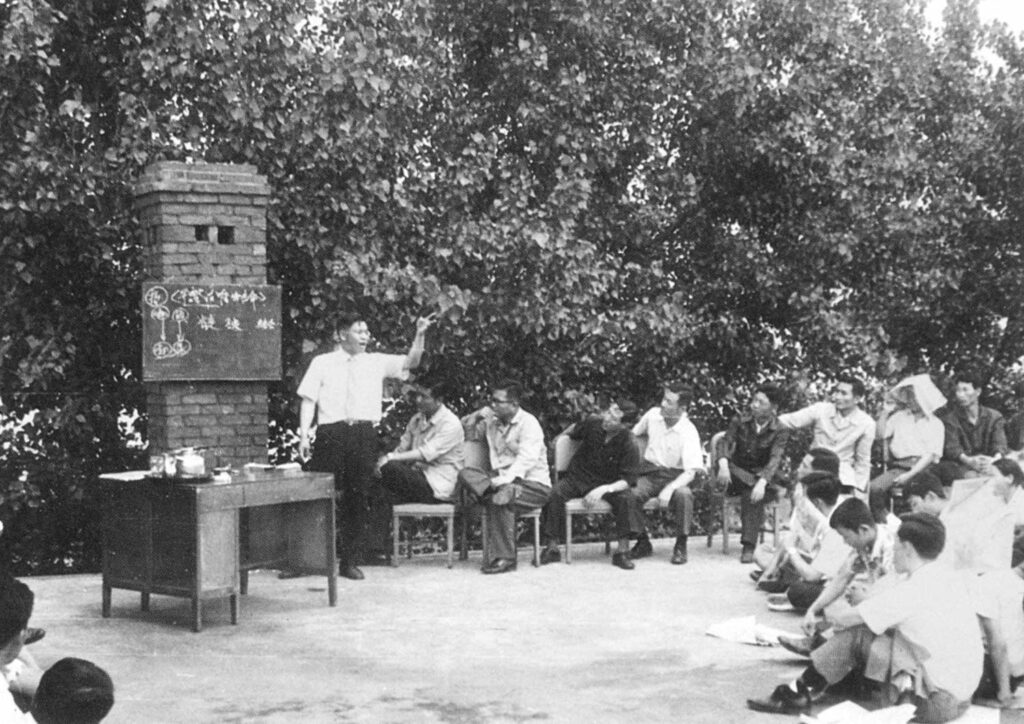
The people know they need Unification Church lecturers, so they come to us in their cars[4] to invite our lecturers to their halls. They have learned that the Unification Church wants to win against communism, so they have given us the name “Victory over Communism Enlightenment Group”….[5]
Our church has many anecdotes to share. One church leader went to a village as an anti-communism lecturer. Everyone of importance came to listen to him, including government officials ranging from the police chief to the county magistrate. They had heard that an anti-communism lecturer was coming, but the only person they saw was a young man with unkempt hair walking toward them. At first, they thought he was the lecturer’s assistant, so they asked him, “Where did you come from? When is the lecturer coming?” The lecturer hesitated to answer. They said,” We heard that Mr. Kim from the Unification Church was coming today to give a lecture, and we want to know where he is.”
He replied, “I am Mr. Kim,” They hadn’t realized that the young man with disheveled hair was the lecturer and began to mutter among themselves. No doubt, they were embarrassed to learn that a man young enough to be their son was the lecturer. Nevertheless, they had no choice but to give him the podium because they had officially invited him. He gave a two-and-a-half-hour lecture. By the time he finished, their way of looking at him had completely changed.
Our anti-communism lecturers are all young people in their twenties. They are friends with county magistrates and police chiefs, so you could say they have gone up in the world after joining the church. Has listening to and putting my instructions into practice ever destroyed anyone? No matter how great an ideology is, if you fail to practice it and your results do not reach the standard, the ideology will not properly manifest its value.
The founding of IFVOC in Japan
In 1965, I visited forty countries and reexamined the problem of communism. I examined to what extent it was expanding. I thought then that we did not have much time. Therefore, I made a plan to send forty-seven leaders to Japan in January 1967, but the South Korean intelligence agency blocked it. Behind the government were prominent members of Christian churches, who said “Moon, with his Unification Church foundation, will disgrace our country.” As a result, I had to postpone implementing the plan.
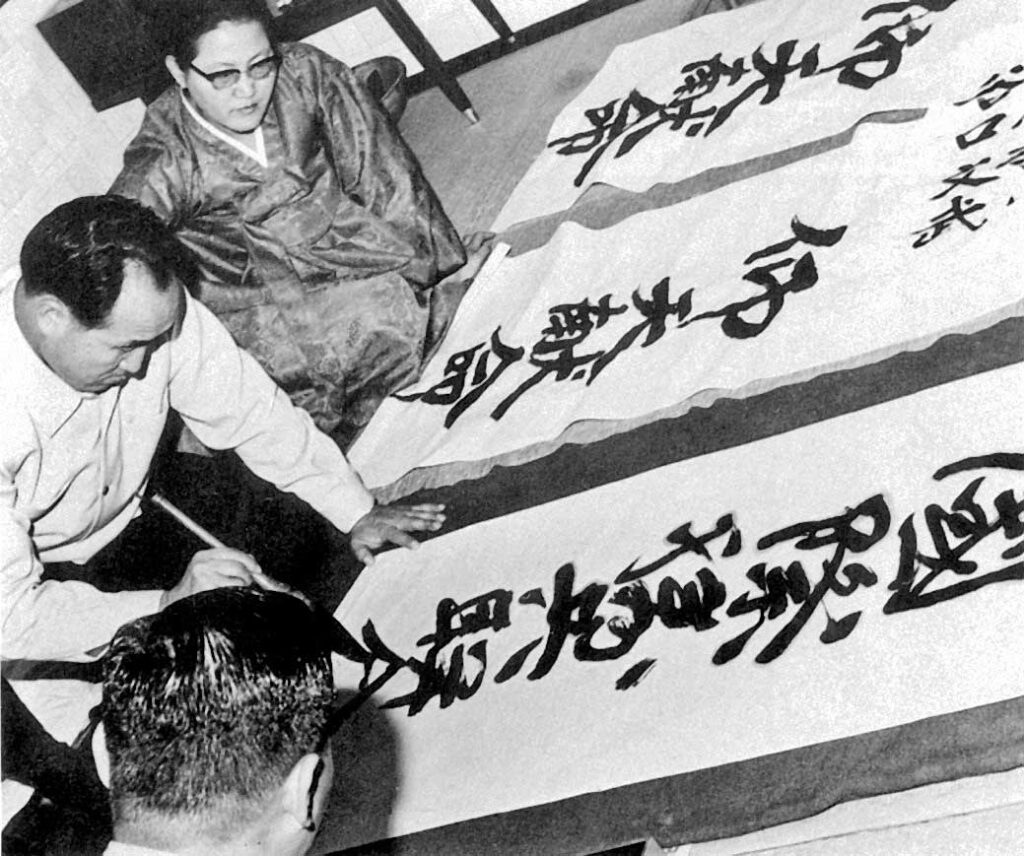
We had no alternative to working quietly behind the scenes. Finally, on April 1, 1968, the Japanese chapter of the International Federation for Victory Over Communism was founded. I held a meeting with the Japanese leaders and said, “From now on, we must promote anti-communism, VOC activities, here in Japan, which is a free land.” In the beginning, none of them welcomed what I said. I had to persuade them by explaining why it was historically necessary.
I armed them with theoretical weapons. I trained Japanese members so that they could give VOC lectures and sent them out. They went to areas where many communists could be found. I sent them to Chosun University.
I prepared one bold Japanese woman and commanded her, “You are to stand in front of Chosun University[6] and give VOC lectures for three years, at the risk of your life! You could be shot, or run over by a truck; death will follow you wherever you go, no matter what. You must still go!” I could tell you many stories about that. Chosun University tried to put pressure on us through the Japanese Ministry of Foreign Affairs. We, however, continued to fight them at the risk of our lives. We carried out an active campaign against communism in famous areas throughout Japan, including Tokyo Station.[7]
The 430-Couple Blessing Ceremony (February 22, 1968)
When I blessed the couples, I told them to become tribal messiahs. I meant that they should not live in comfort by themselves…. I want them to become tribal messiahs and as the embodiments of the resurrected Jesus and of the Holy Spirit save their clans…. The date of the Blessing Ceremony marks the twentieth anniversary of my imprisonment in Hungnam Special Labor Camp….
Church president Osami Kuboki[8] represented Japan. I had originally wanted to bless him when I visited Japan in 1967, but I could not do it. For that reason, when I blessed the 430 couples in 1968, I invited Kuboki to come to Korea as Japan’s representative and I blessed him.
I invited Ryoichi Sasakawa, a rich Japanese, to our large wedding ceremony. I sent him an invitation that read, “Sir, I believe you should come and offer your congratulations this time.” Rev. Kuboki and his wife were blessed in the ceremony, and Mr. Sasakawa actually came. In other words, Adam, Eve and the Japanese archangel have been restored. When you think about Sasakawa being the Japanese archangel, you realize that this year’s Blessing Ceremony served as a good starting point. At the end of the seven years, people such as Osami Kuboki were restored, which served as an important turning point in Japan’s restoration. Sasakawa came to the ceremony and thus established a standard on which we could begin to carry out our plan to put an end to communism.
To be continued…
[1] The name indicates a rural learning center. It was a church-run program in the southern South Korean provinces that taught modern farming techniques, literacy, etc. Nongdowon was a forerunner to the New Village (Sae-ma-ul) Movement, a government initiative begun in the early 1970s that developed rural South Korea.
[2] 5.16 (May 16) brazenly refers to the coup d’état that brought Chung-hee Park to power in 1961. The government bestowed the award in recognition of contributions to the nation.
[3] North Koreans in South Korean Army uniforms infiltrated on January 17. The South Korean military learned of their presence the following night. The commandos entered Seoul on January 21 intent on killing President Park. An alert policeman confronted them, and a running firefight erupted. Four were killed in Seoul and two captured. The others split up and fled north. Twenty-three were tracked down and killed. One was later discovered frozen to death. Only one soldier escaped into North Korea. Of the two captured in Seoul, one killed himself with a concealed hand grenade. The other was Shin-jo Kim.
[4] These apparently were wealthy civic leaders. In 1968, South Korea had fewer than 1,450 cars..
[5] The teams of members that this casual name refers to had been working throughout Korea for several years before joining forces and registering with the government as the International Federation for Victory Over Communism on January 13, 1968.
[6] North Korea funds the university, which is in Tokyo. The Japanese government neither funds nor recognizes it. The woman was Mrs. Yasue Erikawa, who recently explained that Father had told her, “Even if you die, it’s okay.” After about forty days, Father was again in Japan and asked her how it was progressing. She said, “Well, I am still alive.” Father reminded her that she had to continue for three years, which she did.
[7] To Koreans in those days, Tokyo Station was a tourist draw. In Korea, the old Seoul Station, built under the Japanese in 1925, was based on the design of old the Tokyo Station, built in 1914.
[8] 1931–1998, president of the church in Japan 1964–1991