Theory of Heavenly Unified Korea
I’ll continue from the last lecture. The Heavenly Unified Korea we are talking about is the unified Korea of Godism. It doesn’t just mean a politically and socially unified country. In order to understand the valuable Heavenly Unified Korea, we need to know what a country is and how to understand and diagnose the liberal democracy and socialist political system of the two Koreas. Also, it is a fundamental question of whether we can present a milestone to the future-oriented unification of Korea.
Like we talked about last time, traditional liberal democracy is that every individual has as much value as the whole. Mechanism became the ideological foundation of liberal democracy. Just as a entire machine is equal to the value of a part, the value of the whole is reduced to the value of the individual. Therefore, the natural human rights of individuals, freedom, equality, and philanthropy of individuals, and this idea of respect for human rights of individuals is the starting points of the liberal democratic system. The French Enlightenment was meant to individual human rights in a monarchy. It can be said that it occurred in terms of “Give me death if not freedom!” In that respect, the liberal democracy system is to return the whole purpose to the individual purpose. In other words, individual’s natural human rights and dignity are fundamental ideology and philosophy for maintaining a liberal democratic system.
On the contrary, an individual’s rights and freedom is bound to be reserved more for the benefit of the whole in socialism. It is socialism that has an ideology towards a class and a totalitarian state. Liberal democracy is an ideology that returns the whole to individual human rights. If you look at the ideological system, it’s the opposite of each other. Socialism ignores individual human rights, freedoms, and equality, but the interests of the whole nation and the purpose of the whole nation are considered more important. So, the principle of all individuals is to serve the purpose of the nation and the whole. On the contrary, liberal democracy is a totalitarian society in which every individual return to the whole.
What is the Cheon-Il Guk that the Heavenly Unified Korea aims for? What is the ideology of the nation of Cheon-Il Guk that the Heavenly Unified Korea aims for? This is something that the whole purpose and the individual purpose share. In other words, everyone is a personality truth that pursues an individual purpose. I am an individual who is said to be a living organism and an organism in which the whole purpose and individual purpose consisting of a public-minded relationship with other things are embodied for one purpose. So, it’s not just about individualism like liberal democracy, it’s not about nationalism like socialism or nationalism. The Heavenly Unified Korea theory is a theory in which individual purpose and overall purpose, individuality and public purpose are shared and unified by an individual and the whole. It is the idea of a Heavenly Unified Korea that is presented by some ideological basis. We can talk about this as the idea of a Cheon-Il Guk. What is the unified shared value for this object purpose and the whole purpose? The shared value that can unify this is the mind. We’re not human beings with individual reason, we’re public beings living for others with Shimjeong which means a deep heart of love, both vertical and horizontal. It defines human nature from reason to Shimjeong and is called a Shimjeong being. Shimjeong is a shared value in which individuality and public purpose are shared by sharing the individual purpose and the entire purpose.
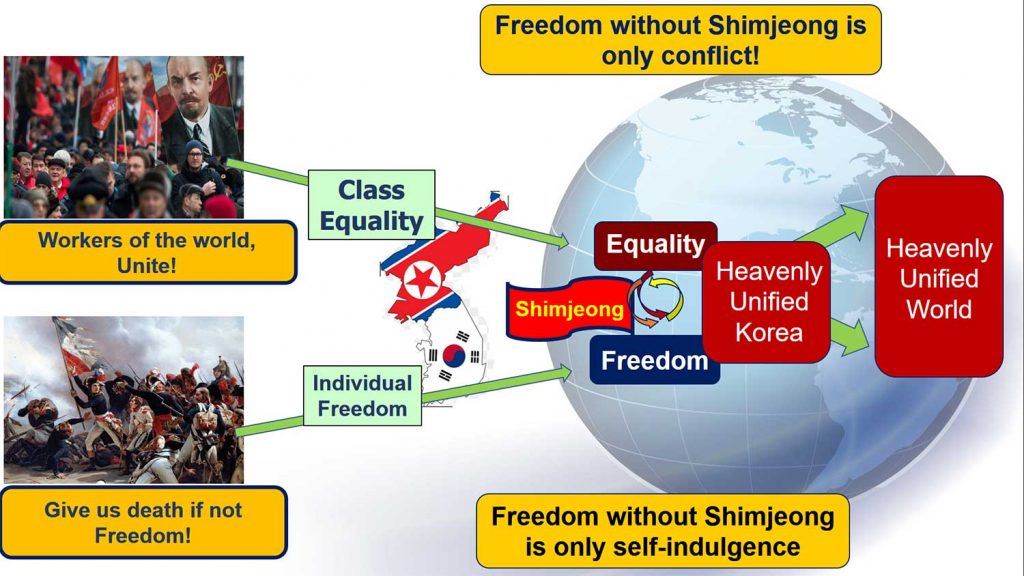
Therefore, a Heavenly Unified Korea or a Unified Korea centered on Godism is centered on Shimjeong as shared values. It is the national ideology of Heavenly Unified Korea that we aim to realize the ideology of the Heavenly Unified Korea, centering on the value system and values of Godism. This can be defined as an organic biological theory. By setting Shimjeong as shared values for the whole purpose and individual purpose, individuals can overcome the limitations of liberal democracy in which they sink. We can also overcome this socialist system or nationalist system in which individual human rights fall, centering on the values of the whole. It is an ethical system that can implement a Heavenly Unified Korea and Cheon-Il Guk in terms of the purpose of the whole and the national ideology based on feelings. Or in terms of the ethics of life embodied in our lives, we can say it’s a co-righteous country. You can see it like this. I’ve said this many time, but in the video, we saw last time, the dog gets angry at himself. He doesn’t know it’s him and he’s looking in the mirror and arguing. Then this is Aphrodite looking in the mirror by Velázquez in 1950. Aphrodite is the goddess of Greek beauty. It turns into Venus when it comes to Rome. Aphrodite and Venus mean the same things in terms of the goddess of beauty.
Here, Aphrodite is looking at herself through the mirror, looking at the sensual self. At the same time, she is also looking at the young men looking at her through a mirror. This isn’t a childish talk about the voyeuristic women or peeping-tom scene of young men looking at the goddess. It reveals the essence of beauty on a deeper level expressed well in Aphrodite’s art. It contains a philosophy of beauty. What is beauty? The essence of beauty is praise. There’s a saying that compliments make whales dance, right? The desire to be praised is the desire for beauty.
Last time, I explained about a social tragedy about a mother was killed by her son who was addicted to computer games. Everyone, singer Jin Mi-ryeong and comedian Jeon Yoo-sung are famous for being married and then getting a divorce. It’s the famous naengmyeon (noodle soup) incident. Jeon Yoo-sung and Jin Mi-ryeong went to a popular Korean noodle restaurant, and Jeon Yoo-sung ate naengmyeon first and left. The rest of the people there are interested in watching the famous singer and comedian eat naengmyeon together in a marital relationship, but Jeon Yu-sung ate naengmyeon (cold noodle soup) first and left. Jin Mi-ryeong, who remained there and swallowed naengmyeon, decided to get a divorce there. Jin Mi-ryeong was damaged when her pride was hurt in front of many people. It’s a simple story about Jeon Yu-seong eating cold noodles at a naengmyeon Korean restaurant, but Jin Mi-ryeong decided to divorce on that spot.
This is the essence of Aphrodite. When self-esteem and praise are brutally trampled on, the goddess of Aphrodite becomes angry. As I said earlier, a child has a great desire to be praised and recognized by his parents regardless of his behavior, such as the murder of a mother who scolded her son who was in love with computer games. When he was scolded, the nature of beauty, the nature of praise and the beauty of wanting to be recognized, became angry. It leads to murder. When the couple who were living well hurt their pride and touched their own desire to be recognized, the goddess Aphrodite becomes angry and this leads to divorces. It’s the essence of Aphrodite that we only see ourselves, even if we take pictures together. The need for self-confirmation, praise is the need for the essence of beauty. In mythology, Aphrodite, looking in the mirror, speaks well of the essence of beauty.
What is a human being? Human beings are not the kind of beings that identify themselves. Descartes said, “I think. Therefore, I exist.” Humans are not a rational, individual subject. Also, humans are not a rational self, a subject, and an individual. Humans are Shimjeong beings who want to be recognized in relationships with others. Human beings are relational beings. We call this kind of Shimjeong and relational view of human beings’ co-righteousness (a.k.a. “universally shared values”).
The word “co-righteousness” goes up to the myth of Dangun in Korea. Hwanin, Hwanwoong, and Hwangeom are the three bodies that became one. It’s the Three-in-One Principle. Hwanin represents the divine authority of parents, and Hwanwoong is the god of teachers. The Hwangeom is the god of politics and subjectivity. It is the idea of the Triune God united into one personality that is the ancestor god in the ancient Gojoseon. This is the most important part of our culture and society of the Korean people. I won’t talk about our culture any more. The unique philosophical and ideological values of our people are not individual, selfish, or independent concepts as rational individuals and subjects in Western society. In the sentiment of the Korean people, “we” is the basic value. We have a value culture that we share with our identity.
We say our house, school, grandfather, and even our wife. In English, our wife is my wife. Does it mean that we share the wife? That’s not true. Our wife comes from the unique culture that Koreans have. The community ethics and values that sprouted into our community culture are clearly flowing in our minds.
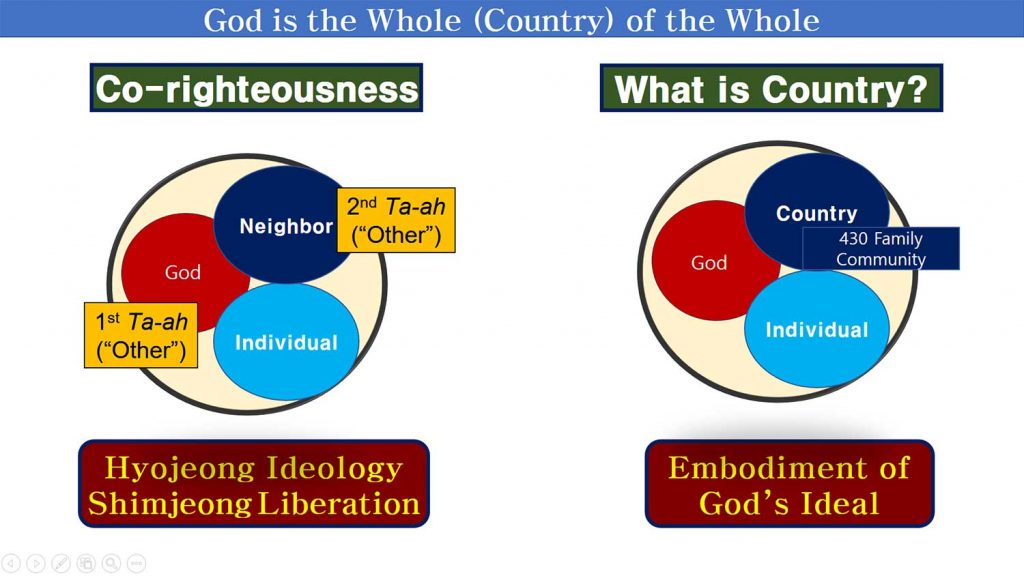
Co-righteousness [universally shared values] is the ontology in which God, me and my neighbor, the three subjects, become one. You and I, we are one, this is our ontology. The ta-ja is bigger than me. Therefore, I am myself from my parent and conscience as a vertical subject. And the horizontal subject is you, brothers, parents, family, neighbors, and country. The existence of me is basically not an individual of independence and selfishness. As a public-minded being of Shimjeong, it is the theory of existence in which God, me, and my neighbors become the three subjects. It is a great Korean ontology, a great God-centered view of humanity, and an ethical system and a value system. It’s not the starting point of a democratic individual, but the ontology that started from God’s Taja. It’s not as if the center of the universe has changed from the celestial theory to the theory of heliocentric, which cosmologically defined the basis for all beings. It is the same as changing to the theory of heliocentric, me, that revolves around the sun. Like this Copernicus transition from celestial theory to the theory of heliocentric, the Ta-ahism (“Other-and-I” philosophy) of God is the starting point. The starting point is you. Who are you? As I said before, it is my conscience, my physical parents, and Heavenly Parents. So, who is the horizontal subject? Who is the horizontal Taja? It’s a brothers, wife, family, neighborhood, and country, a neighborhood enlargement.
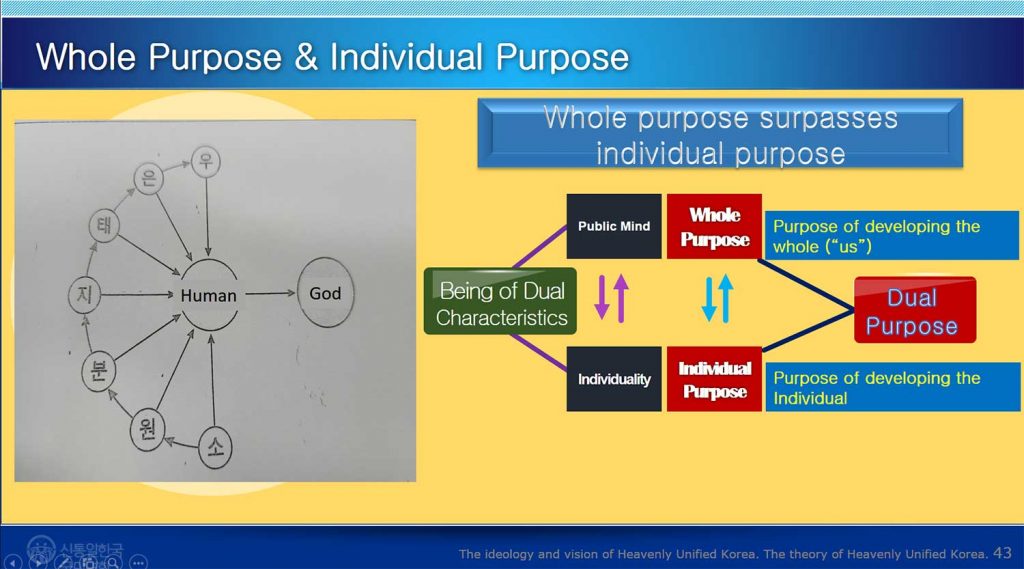
Gentlemen, can you see yourself? You can’t see yourself. This is because I am myself to show others. Didn’t you see the dog fighting in the mirror? It seems ridiculous, but there is an important philosophy. It is that I don’t see myself. I mean, I’m a Taah being that is meant to be seen by others.
Both men and women have genitals. Are a man’s genitals for a man? No, it’s concave and convex. That in itself is that a man’s genitals is for his wife, and a wife’s genitals is for her husband. Isn’t it? Your genitals don’t exist for yourself. The starting point of liberal democracy that I am my rational starting point is wrong.
After all, liberal democracy should also focus on the values of Shimjeong and Godism. My starting point is defined by the Ta-ah of God vertically and you horizontally. I am a being defined by ta-ah (“Other-and-I”). This kind of Ta-ah (“Other-and-I-ism”) is called true love. Ta-ah is not an independent being that is individually separated by the Shimjeong as its essence. It’s a whole relationship, it’s a whole being devoted to the public purpose, for others. When we know that we have a unified value system centered on the value of Shimjeong and love, the view of liberal democracy human beings has limitations. Furthermore, there is a limit to human view of socialism. It unifies the liberal human view centered on the individual and the socialist human view based on the whole purpose. To reconcile and unite, we need the unification of human views. Also, it is necessary to unify the values of humans based on Godism. In other words, Ta-ah. It’s our ontology based on true love and Shimjeong. Only when the Korean people’s unique ontology is restored will Western liberal democracy become a value system that can be established in Korea. Also, this socialist system is not unique to Korea, either liberal democracy or socialism. When the liberal democratic system is newly implemented by our ontology or co-righteous human view, co-righteousness in the Korean sense is completed.
In that sense, in the end, co-righteousness re-identifies human views as relational and public-minded beings. If you look at this diagram, liberal democracy as a whole is the individual reduction value or the state system that the state returns to the individual. Socialism is socialist with values that individuals return to the whole purpose as human rights of all individuals are ignored and a political system that aims for the whole purpose. So is the demographic return of liberal democracy a fundamentally legitimate political system? Or is a political system that returns to the whole like socialism justified? You should not emphasize only object objectives. The whole purpose should not be emphasized. Nationalism toward individual ends, liberal abuse seeking individual ends, and individual selfishness of liberal democratic systems are caused by losing their center. It’s a contradictory system. In order to overcome the contradictory system of liberal democracy and socialism, God must be defined at the center. Only then can the freedom and human rights of liberal democracy restore the nature of human rights. It is said that the value of equality of socialism can also be realized when the concept of equality of socialism is based on the Shimjeong of God. Freedom of liberal democracy and equality of socialism can only realize true natural human rights and equal values of socialism based on the Shimjeong of God. It can be a political system that embodies the whole purpose. In this regard, unification of the Korean Peninsula and unification of the South and the North cannot complete the purpose of unification with unilateral unification. The fundamental ideology of socialism that can realize the value of the whole ideology and the natural human rights, which are the basic values of liberal democracy, should jointly become Godism. Only then can we deny that the values of freedom and equality of liberal democracy and socialism are fundamentally embodied.
This is the Heavenly Unified Korean ideology that overcomes the two systems. It’s simple in our principle. Liberal democracy is the embodiment of internal nature values based on Shimjeong. The socialist system of the North Korean People’s Republic of Korea is the value of material and labor based on Shimjeong. An embodiment of external form. After all, the fundamental frame of liberal democracy and socialism is internal nature and external form based on the Shimjeong that we talk about in principle. It’s just a confrontation, a struggle, a contradiction based on that. In order for the value of internal nature and external form to be basically unified, you have to focus on your Shimjeong. The unity of liberal democracy and socialism can only be realized based on Godism, which is fundamentally based on the values of the mind. This is the Heavenly Unified Korean national ideology. This Heavenly Unified Korea’s national ideology is a national model based on a model of living things that organically unites individuals and their entire purpose. Objects become independent, struggle, and fight against each other. Hobbs said that not the “fight for all” and the chaos of liberal democracy, but that eventually all the people could be unified. Basically, the idea of reconciliation is the value of the heart. Only when the value of God is realized, the national model of life in Korea can be implemented.
So, let me explain a little bit more about the orientation of the model as an organism and a living thing based on Godism and what theoretical foundations are implemented. Hegel, a philosopher, started the modern philosopher. You know, Marx and Engels are the left Hegelian. Hegel’s Christian philosophy was subverted by Christian idealism to embody ideas and communist ideology based on materialistic and atheistic ideas and philosophy. So, Hegel’s philosophy has the character of a political philosophy that disproves Christianity. Marx and Engels, on the other hand, are one national ideology centered on communism and the euronic system of values. In that sense, it reversed Christianity. You reverse theism to atheism, you reverse idealism to materialism. He tried to embody a materialistic ideal that was completely contrary to the ideals of the Christian state that Hegel argued. That’s the theory of communism.
So, the purpose of Hegelian philosophy is to explain briefly here. Hegelian philosophy goes back to a complex and esoteric forest of idealism. But the esoteric ideas and Hegel’s philosophy is simple. The state of the Christian Logos is the thoughts before God created the universe. There was a process of God’s thoughts before the creation: Logos’ thought, reason, and logical dimension. This is the logical dialectic. God created light and created everything as he thought. He creates nature first. This is the natural dialectic as the second process of creation. After creating nature, he eventually created humans. You know, he created Adam and Eve. God fulfilled his creative purpose and then rested. Human creation is a mental dialectic for Hegel. Hegel’s logical dialectic and mental dialectic are the creation of nature and the universe in which God is embodied in the state of Logos in Christian philosophy. The creation of the universe was the final creation for man. Through this dialectical process of logic, natural philosophy, and mental philosophy, ultimately, the dialectical cycle of returning to God and unifying it is the philosophical system of the vast idealism of Hegelian philosophy.
What’s the purpose of history? In the philosophy of human mind, the purpose of history is realized. The purpose of history is a rational state. A rational state is a state in which God’s reason is embodied. It’s a country where God’s freedom is embodied. Hegel talks about the goal of a rational state is the goal of history. It’s the perfect spot in history. This is a Christian country. The Christian state is embodied by that heterosexual state. In other words, his national ideology is presented through a dialectical cycle in which God’s creative purpose is realized by a rational state.
The diagram on the left is God’s idea. What was basically in God’s idea? There was minerals, plants, animals, and humans. There must have been an idea of creation in which God created all of this nature. There must have been an idea of creation in God’s thinking. In God’s Logos, there must have been a picture of a complete model of minerals, plants, animals, and humans. There must have been an idea. It is the minerals, plants, animals, and humans of this earth that have emerged according to the creation process of the earth according to its concept. The whole process of creating the universe seems to be a process of development and evolution from a natural cycle point of view to a higher level of existence. But the process of creating the universe was already conceived in the sense of God’s circle. The embodiment of that concept can be seen as the creation of the universe and man. The same goes for Hegel’s story. It is nature and human that the idea of God’s logical thinking is embodied. It’s a natural dialectic, it’s a mental dialectic. Similarly, the implementation of the Logos is the creation process of the universe, and the development of the universe.
So, what was the most ideal in God’s ideas and logos? I’m sure it’s an ideal for a family and country. I think that family is the starting point of the most important ideal that God wanted to realize. If you look at the Bible, it is said that God created Eve because it was not good for Adam to be alone. The most basic idea of God’s creation is to form a family ideal through the relationship between the couple and the relationship between Adam and Eve. It can be seen as the purpose of creation in the final stage of all of God’s creation. Therefore, I think the starting point of the completion of God’s Logos is the nation.
In a way, is the family first? Is the country first? Does the whole thing come first? Is the object first? Look at the chart in front of you. Is that mineral first? Do humans come first? In God’s conception, he created natural minerals, plants and animals to create the perfect being of man. Just as he created nature, God’s ideals were already premised on the ideal of human. Man, as a whole was premised. I think he created minerals, plants, and animals for human creation. The creation of the middle stage of all creation is ultimately a process of creation to embody Adam and Eve and the creation and welfare of humans. God’s creative idea presupposes the whole purpose of man.
So, with the same logic, what is premised on the ideals of the family and the state? It presupposes the ideal of a nation and an ideal state in God’s Logos idea. There was an ideal of Adam and Eve’s family as the core medium for embodying the nation. So, in some ways we cannot deny that ideals about the state were more premised than ideals about the family.
In that sense, let us define co-righteousness [universally shared values] once again. It’s a theory of co-existence (interdependence), as I’ve explained. My neighbor and I, centered on God, said that it was a theory of ontology of co-righteousness defined by the existence of three subjects. It is co-righteousness that basically embodies an ethical relationship by the three subjects, God, me, and my neighbor, me-you. Now, if we zoom in on the neighborhood a little bit, it could be a family, society, the country, or the world.
Assuming a philosophy that calls the most basic model of co-righteousness a state, after all, a typical form of neighborhood is a state. After all, it is the most ideal frame that co-righteousness embodies. The most ideal and basic model is fundamentally implemented by God, me and the state, and the subjects of the three beings. That is the state of Godism. In other words, it is me who comes from God and me who comes from the nation. This theory of Ta-ah ontology can be seen as a co-righteousness theory of man and state.
Let me summarize a little bit more about co-righteousness. Plato talked about the nation based on the basic needs of man. He said that the first country consists of people who produce what they need. The house builder, the fabricator, the shoe maker, these four or five people is said to form a minimum state. Plato’s ideal state, Polis, said that a population of 5,000 constitutes a great city-state. The model of the minimum country consists of a productive relationship of 4-5 people, which is the minimum country model. And the expansion of this country model could consist 5,000 people, 10,000 people, 100,000 people, or 10 million people. That’s why we can see that the 430 heavenly tribal messiah we proposed is not a missionary strategy, but a national return strategy. The 430-community household of heavenly tribal messiah is a complete return to the state. Three, twelve, and forty-three families are small national units. Evangelism is the natural result of the heavenly tribal messiah movement. 430 Community Home is to find my country, my people, and Korea. You should know that it is a model of my country, my people, and a typical model of my return to my country. And 430 family Community is the work of reversing the Republic of Korea into Cheon-Il Guk. It’s about building an open culture country. In general, three households, 12 households, 43 households, and even 430 households have a basic common family model, which is the model of the country as a neighborhood extension. Three families can take the form of a state. It’s not as if Plato is bringing together four or five people and maintaining the shape of the state, and it’s not a transmission of principles when three families, 12 families, 43 families, and 430 families come together to form a community family. Community life is basically me who comes from God and me who ends comes from the nation, so as the most basic model of the country, 3 families, 12 families, 43 families, and 430 community families go through the model of the state. We have to understand that the most fundamental ethics of co-righteousness can be completed as a nation. That’s about it.