Based on extracts from his speeches throughout his life
Earlier installments are available for reading.
Pioneering Korea and Looking Out to the World
Even as pioneer witnessing was just beginning to gather pace in Korea, True Father was already thinking about the next stage of the mission—sending missionaries out to the world. Amid the impoverished aftermath of the Korean War, and even right after his harsh experience in prison in Seoul, Father’s boundless ambition to bring the new understanding of truth to all of humankind was apparent.
Part 64
When we started this witnessing campaign for the first time in 1957, I gave members only enough money to take a train or bus to their mission places. They left any other money they had behind when they went. I also gave them two sets of clothes to wear before I sent them off. I told them to work hard and to eat just powdered grain for forty days. Start out by doing physical labor, I told them, or beg for food.
Pioneering from the lowest position
Because people opposed them, they did cleaning campaigns and helped with housework without telling anyone that they were from the Unification Church. They woke up early in the morning and cleaned the entire neighborhood for several hours every morning. We did this kind of thing. People in the villages did not know who was doing it and only realized several months later.
I also told the members to push themselves to the point of experiencing misery that causes them to sweat and to cry. I told them to overcome that wretchedness. They ate only cups of powdered wheat mixed with water. Going out witnessing for forty days is the same as fasting for forty days.
When the members returned afterward, I made them eat good meals. When I saw them eating like crazy people, I asked myself, Am I not a sinner?
I often felt guilty. I thought I must create a group that would continue on even if Korea were to go to ruin in the future.
They were eating boiled barley. Boiled barley is nothing. They were all starving and ate what a dog might. But they all went out and came back after having overcome their difficulties. They said in whispers, I was so hungry that I took dog scraps and ate them.
They began from the very lowest point that a human could be at. When the members were witnessing in their assigned pioneering areas, it was difficult to raise enough money to survive for a day. Even after working all day long, it was difficult to eat one meal. Some of the young members would stumble because of hunger.
During that pioneering period, our witnessing members worked in this way and became leaders. When they went pioneering to a village, they did not have anything to eat. Although they were able to work, when they tried, rumors went around the village that the purpose for which they had come was to work, and for that they were persecuted.
Leaders at the church headquarters didn’t send them any money. In that situation, they pioneered and witnessed. However, they never complained about their miserable circumstances to their leaders at the headquarters. When, after six months or a year, leaders came to realized what each pioneer’s situation had been, they hugged each one and cried.
Bond of heart among the members
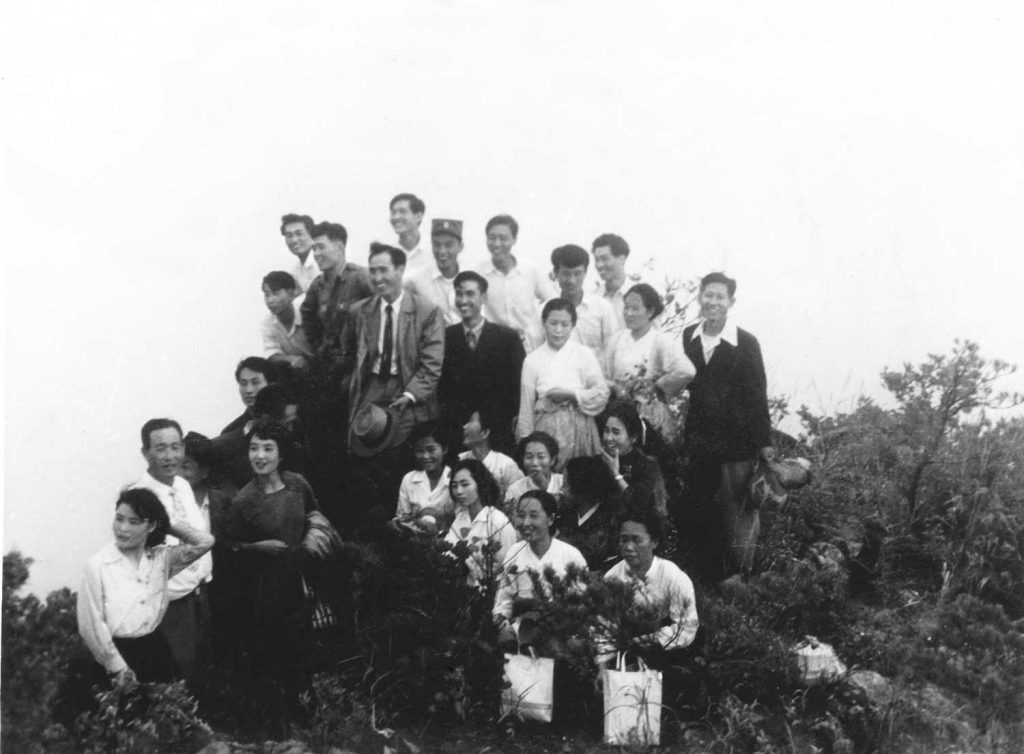
Members had precious experiences in the witnessing campaigns, such as the joy of meeting each other and separating in tears with the hope of meeting again. You couldn’t buy experiences like that for a hundred million dollars. In the early days, members felt that getting acquainted with another member was of eternal value….
In those days we all walked because cars were still rare. Our members helped one another and parted in tears in the evening by moonlight or early in the morning, pledging to do their best for Korea’s sake, for God and for the future. There were many unforgettable instances of this kind. In that type of situation, a patriotic spirit arises.
Those members will always miss the days when they worked in a high, elevated atmosphere, like that which surrounds a person who has fallen in love for the first time. It is up to the people who are guiding the church to work out how to stimulate that spirit within members. You have to establish goals for your activities. Your efforts should connect you to that time honored tradition.
The warm atmosphere of pioneer churches
After you join the church, you become fonder of it than of your home. You want to come to the church without even going to school. Your heart is always at the church. Why? God’s love is there.
In the evening, any food we had, I would save in order to share it with others later. I would bring people together and help them feel at ease. That’s why people followed me even though they were persecuted, even though the entire neighborhood was in an uproar, and even though the nation was trying to get rid of us.
In those days, the atmosphere of the church was like that. When a person was converted, he or she very much wanted to be at the church and came every day.
I told the members to witness with that kind of heart. I taught new members that way. Thus, they all felt that the church was better than their homes, or their schools. They did not want to go to school, to work or to their houses. They all met at the church. This became a problem.
The heart of the early members
Among the early members who followed me, none was praised by spouse, child or relatives. They all faced opposition. Why? In order to join the church, those early members had left family behind. If they had loved and stayed with their families, all of them would have perished. Early church members had to choose between the two. You need to understand that this is why early members have never received praise from their relatives, friends or children.
That’s why members who have been in the church for a long time cry profusely when they pray. They have lived where God is directly with them. That is what makes those people different; they survived difficulties together with God. The question is whether the early church members’ tradition will become your tradition. We are like a single tree.
First thoughts about the global mission
In 1956, just after being released from Seodaemun Prison, I went to stay at the Gabsa Buddhist temple,[1] where I did research. I thought to myself, From now, Japan will become important. She is currently weak and insignificant, but the time when Japan will become important is coming. We must stop regarding her as our enemy.
With that in mind, for the purpose of saving Korea, I prepared to make a connection with Japan and to secretly send someone there. That the Soviet Union and communist China were supporting North Korea under Kim Il-sung’s rule was certain. In order to break through in the work to save South Korea, I felt we had to make inroads into Japan. Although Japan had been our enemy, I decided to love Japan more than anyone else did and that my love would induce Japan to establish a condition on which God’s will could flourish in Asia. Otherwise, we would not be able to find an object-partner nation for the subject-partner nation.
If our objectives are on a global level, we are responsible for our neighbor Japan and for other countries as well. That is why we must send missionaries to the world even if it means we are sending them down a path of suffering. If we have abundant food and live comfortably, we cannot fulfill our responsibility. We must take responsibility while in difficult situations.
Sending a missionary
During a visit to the same temple in 1958, I called a young man, Choi Bong-choon,[2] and told him, “You must smuggle yourself into Japan for the sake of that nation. A man must be prepared to die in order to accomplish his mission.” I met him on the mountain behind the temple and instructed him to go to Japan as a missionary.[3] I strengthened his resolve by saying, “You should not return before you die. The way of God’s will is that strict.”
He stowed away on a trader’s boat bound for Japan. I told him, “I will pray for you. I’ll devote my heart to you without sleeping until you arrive safely in Japan.” I added that I didn’t want to see him again until he had accomplished his mission.
I thought to myself, “Wait for ten years.” I knew entering Japan was illegal,[4] but I was certain that the time would come when we could freely travel to other Asian countries. I was sure the day would come when history would justify what we were doing, and I went ahead with firm resolve. Unification Church members were going hungry then. In those days, when church members sold pictures and barely made enough to live on from day to day, I borrowed 1.5 million won to send Choi Bong-choon to Japan.
To be continued….
[1] The temple is in South Chungcheong Province. At some point, Father did a forty-day fast there.
[2] He was born in 1925 as Choi Sang-ik. At the age of two he had moved to Japan with his family, returning to Korea when they were forced to repatriate in 1945. His own father had given him the name Bong-choon when he was in his twenties. He adopted the name only after joining our church in April 1957. During his missionary days in Japan, he went by the Japanese name Nishigawa Masaru.
[3] Mr. Choi had already wanted to become a missionary to Japan. Father spoke with him at length at the temple, one purpose being to check that Mr. Choi had the requisite level of faith.
[4] Mutual hostility contributed to Korea and Japan not restoring diplomatic relations until December 1965. In 1958, severe travel restrictions existed between the two countries. Talks recommenced in December that year only after Japan dropped its long-standing claim to about 80 percent of all property in Korea and its claim that Korea was the beneficiary from 1910–45. It has been a long and difficult road to rebuild trust and goodwill, but True Parents have invested greatly for this cause.
My understanding of True Father’s life is enhanced by his own words. They motivate me to work harder.