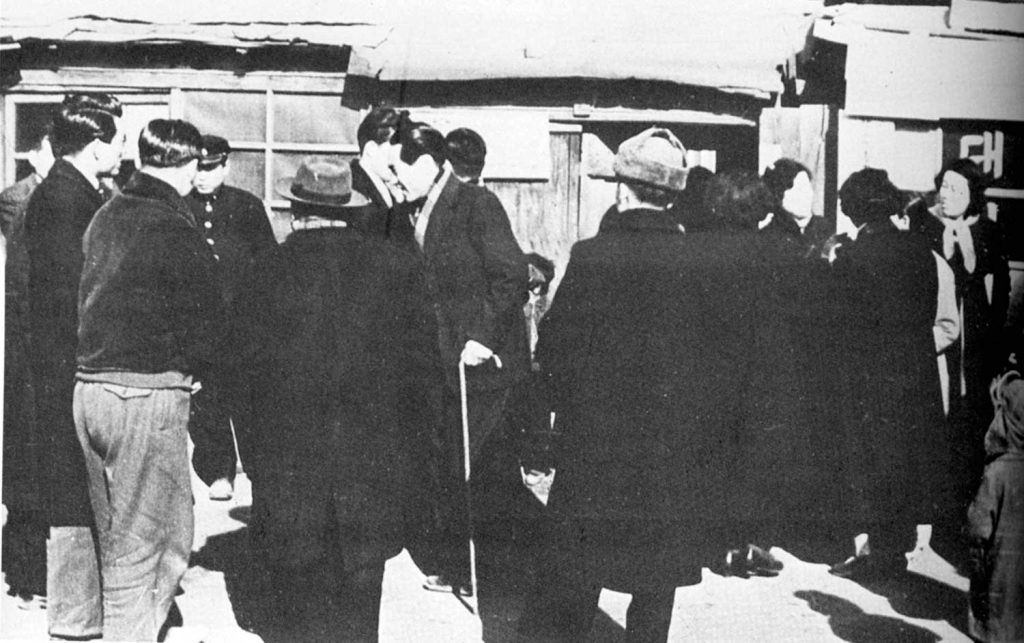
Based on extracts from his speeches throughout his life
Earlier installments are available for reading.
The Founding of Our Church
The Holy Spirit Association for the Unification of World Christianity (HSA-UWC) was founded on May 1, 1954. In 1955, True Father embarked upon a remarkable witnessing project aimed at attracting many good young people from the top Christian universities in Korea.
Part 55
When the Unification movement first started in Korea, everyone was skeptical about it. All churches and denomination were skeptical. But that didn’t concern us. There was persecution and we just accepted it.
We were ostracized by individuals and families, by many different religions and by the government, but I never once tried to defend myself or make excuses. Why? Because I knew God, who sacrifices the one He loves most without asking for compensation and without making excuses. In order to become a person who can follow God, who exists for others, you have to endure what has to be endured in silence. Because there are so many things to do along the way, you don’t have any time to worry about the commotion that surrounds you. Even though you have to endure all types of insults and plots, you are just too busy: “I am too busy. I have no time to worry about such things.”
Religion has to overcome things. It has to go beyond the family, beyond the society and beyond the nation. Because God wants to set up the path to the kingdom of heaven, all the forces in the satanic realm will be mobilized for an all out attack. The day we succumb to that attack, we will become the losers, and the day we overcome the attack, we will be the winners. This is the path that religion is to take. Since the Unification Church is no exception to this, it is the path we have been walking until now.
It was the destiny of the Unification Church to begin on the foundation of Christianity. Since Christianity had been lost, we had to establish a religious body that could stand in place of Christianity. The Unification Church thus had to work with those second-generation Christians who had been dismissed from the Christian churches[1] and create a foundation, by having them suffer again to indemnify everything in history as members of the Unification Church. In other words, since Christianity could not fulfill everything based on the historical global standard by breaking down walls between individuals, walls between clans or tribes and barriers between peoples, everyone had become enemies. To make up for this, the Unification Church had to pay the sacrificial price in relation to the spiritual and physical foundations.
In South Korea, as I worked to rebuild the foundation, with the indemnity conditions Heaven had established, the Unification Church developed, moving straight forward. We had to move at the level of the churches and the whole nation rather than at the level of individuals. This was the work of finding the highest-standard Christians centered on the educational institutions. I did this, and there was opposition. But because I had the conditions to form the heavenly side, the first generation was put aside and the second could be won over.
Why did I abandon the first generation? The first generation was already tainted. When I was working to accomplish God’s will in South Korea, people from this generation stood against me. So I went to North Korea and before I could return to the South, I had to advance the providence of salvation, always centering on the second generation and not depending on the first, because the foundation was laid by making conditions that Satan presented.[2]
From the time we began our activities on the university campuses of Yonsei and Ewha there was a clash. The government and the Christian churches joined forces and broadened their mobilization to stop our work. So, though I was back in the South, I would have to go to jail again; this was to set the condition of indemnity beyond the individual level, on the level of the family, clan [tribe] and ethnic people.
The whole purpose of the providence in relation to the first generation had been to unify the leaders of Christianity who were the first generation of that time. However, since they took a position absolutely contrary to God’s will, a vital movement based on the second generation had to start. This movement’s beginnings involved the incidents at Ewha Womans[3] University and Yonsei University. It did not start from some church. Students of Ewha Womans University and Yonsei University were its foundation.
The students from these universities were the best representative men and women of this second generation. If God’s will had been accomplished there, those universities would have been the center of every organization in the nation. If those from Ewha and Yonsei had restored everything, the children of the congregants of the six large Christian denominations would have joined; we would have instantly won the support of the second generation.
Yonsei[4] and Ewha were like Adam and Eve. These universities were centers of activity for second-generation Christians, both men and women, weren’t they? Single men and women were meant to follow me. Young people. I wasn’t meant to bring just anyone to save the world.
To climb over a mountain, you must conquer the summit. When you confront Satan, you must settle accounts and separate the blood lineage from Satan, put down new roots on new ground and go on. If this task had been accomplished within the nation, by now, the leaf bearing branches from that tree would have expanded and covered the world.
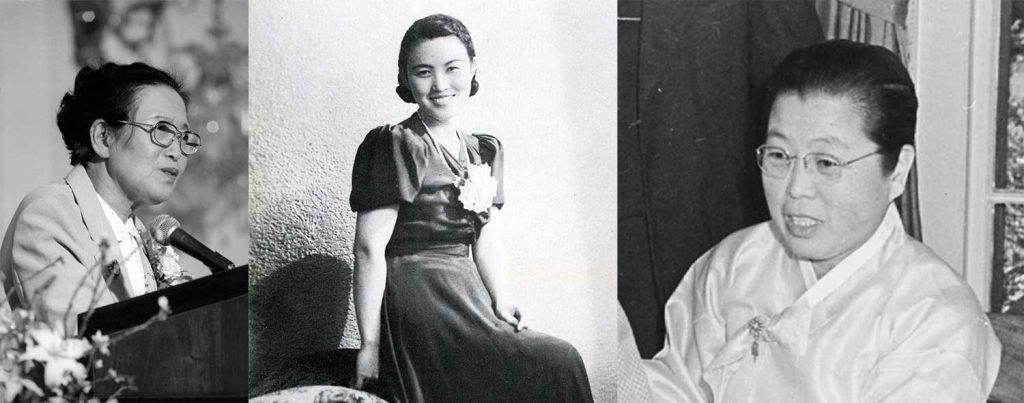
Before meeting the nation’s president I went to see the president of Ewha University, Kim Hwal-lan.[5] Didn’t she live alone? What I mean is that she was waiting for the Messiah. As for Yonsei University and Ewha University, the first was connected with the Presbyterian Church and the second with the Methodist church. At that time, Ewha University was connected to President Syngman Rhee’s wife through the vice-president of the university, Maria Park.[6] Based on her relationship with Christian missionaries,[7] at that time there was a foundation to be united with the government.
If we could have won over the Western missionaries, and if Kim Hwal-lan and Baek Nak-joon[8] could have united and fully accepted the Unification Church, everything would have been realized on earth. If that had come about, I could have reached across to America, with its Christian culture, at one stretch. Through Syngman Rhee, and based on national support, we could have accomplished as much as we wanted.
To restore the mistakes of the first generation, we had to bring those of the second generation together in unity. Everything depended on the second generation. They were the children of religious people, children of those who went to worship at the Shinto shrines[9] and children of people who did not believe in religion. There were all kinds. Everyone was mixed together. If the second generation had been present and had fully united, and had reversed the mistakes of the first generation, after that rectification we would have gained influence in the nation and church and moved onto the world stage.
If the Unification Church, centered on God’s will, had made unity with the second generation and stood in the Abel position, and had completely brought the parents in the Cain position to its side, the parents and the children would have become one Centering on the second generation, I worked to vertically connect Yonsei and Ewha universities with the first generation Christians, a parent–child relationship.
The first generation Israelites died in the wilderness, but now we are in the realm of God’s protection; therefore the first generation does not die, but can enter the land of Canaan along with the second generation. That is the Principle. In that light, the incidents at Ewha and Yonsei occurred in Korea because I tried to make that connection.
To be continued….
[1] By second generation Father means the younger people that joined our church resulting in their being generally ostracized by mainstream Christians or expelled from Christian universities (in the case of some students and professors from Yonsei University and Ewha Womans University). Father uses “second generation” in comparison with his own generation whom he refers to as the first generation.
[2] Such as Father having to be incarcerated in the Hungnam labor camp
[3] Although incorrect English, this is still the official English translation of the university¡¯s name
[4] Yonsei became the first Korean university to accept students of both sexes in 1946. Since 1915, under different names, the university had taught only men.
[5] Kim Hwal-lan, known in English as Helen Kim, was president of the university from 1939 to 1961. She died in 1970.
[6] The wife of Lee Ki-bung, then Speaker of the National Assembly. Lee was Syngman Rhee’s running mate in the 1956 presidential election, but vice-presidents were then elected separately from the presidential candidate, and though Rhee won the election, Lee Ki-bung lost.
[7] An American woman missionary founded the university in 1886; all the presidents before Kim Hwal-lan had been American missionaries.
[8] First president of Yonhi University (1946–1957), which became Yonsei University in 1957. He was born in True Father’s hometown in 1895.
[9] When Japan occupied Korea, dedicated Christians risked death by refusing to follow an order to worship at Shinto shrines. Father is referring here to less committed Christians.