Based on extracts from his speeches throughout his life
Part 36
Earlier installments are available for reading.
Imprisonment in Pyongyang and then at Hungnam special labor camp
Each morning when we left the prison, we had to line up in four lines and hold hands with the persons next to us. Next to this formation were guards who were carrying guns. If someone fell out of line, or was caught not holding hands, he would be reported as having attempted to escape. You couldn’t hold your head up straight.
Even though we would eat before leaving the prison, our legs were so weak that prisoners would often stumble on the way to the factory. Over a four-kilometer distance, this might happen five or six times, sometimes more than ten times in one trip. We lacked energy, but we had to drag our legs to the factory and do the work. I remember this every time things seem to get difficult. In that situation, when my mind seemed to wander far off, I would pledge to be a man of God. That is how I endured to the end.
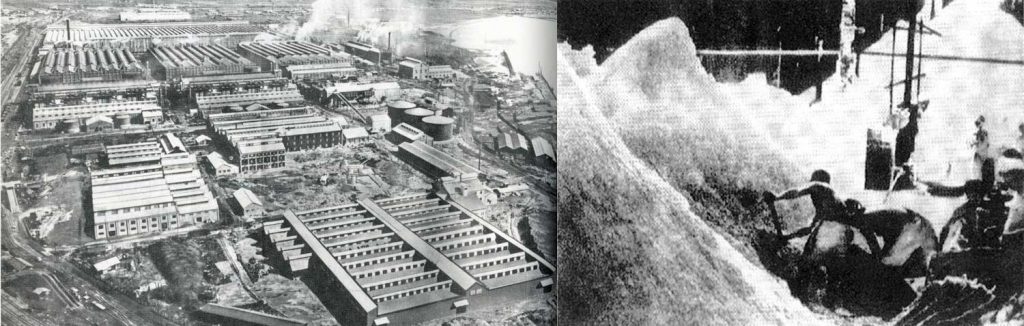
Forced Labor at the Chosun Nitrogen Fertilizer Company (Hungnam Factory)
We worked at a fertilizer factory, where ammonia sulfate would come in by conveyor belt and pile up on the floor; it looked like a mountain. At first, it would be hot. As time passed, the crystals would melt and stick together, becoming solid like ice. It looked like a waterfall when it fell off the conveyor belt into a pile on the floor. It was just like a white waterfall. The pile was about twenty meters high. We had to dig the ammonia sulfate out of this mountain and put it into bags. Eight hundred to nine hundred people would do this work. We would normally take a single large pile and divide it in two.
It was very difficult work. Per day, each team of ten people was responsible to bag one thousand three hundred bags, each weighing forty kilograms. If a team couldn’t finish the work in eight hours, its members had their food ration cut in half. We wore thimble-like protection on our fingers. As we would tie the bags, though, these protective covers would get holes in them and eventually fall off. Each person was responsible for a hundred and thirty bags a day, and this was truly hard labor. A normal person living in society probably could not do even seventy or eighty. We were told to do almost twice that. Essentially, we were being told to die.
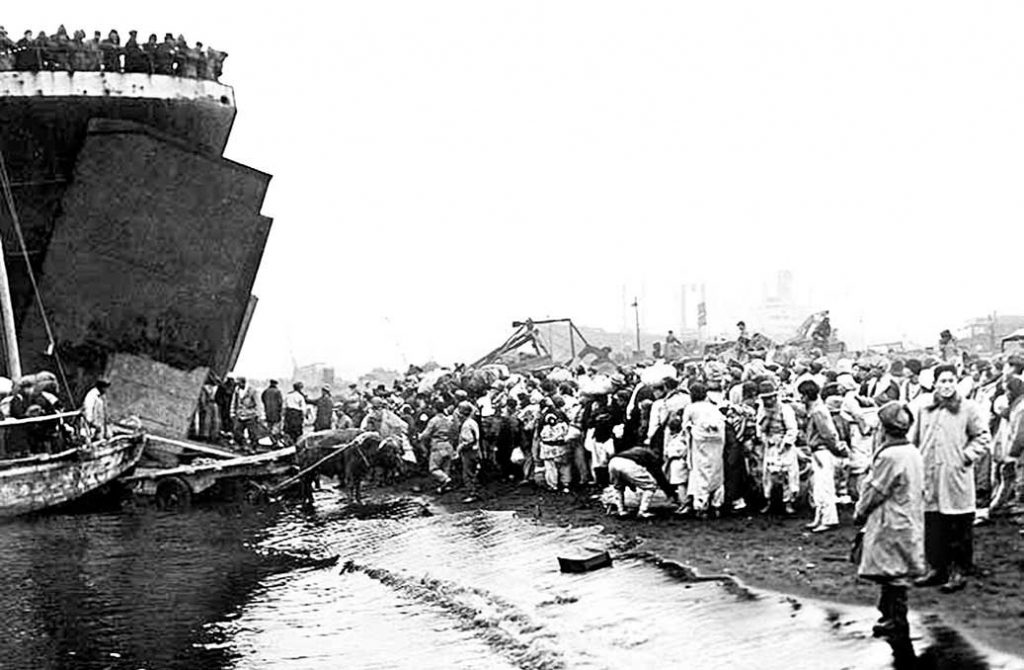
We had to take the bags to the dock, and load them onto a Soviet ship that was moored there. We had to achieve a certain tonnage, which was checked on a daily basis.
Sulphuric acid is harmful to the body. It causes your hair to fall out and your skin to yield water when squeezed. After six months, you start coughing up blood. Most of the time, people thought they had contracted tuberculosis and became so despondent they would die. They’d last a year and a half, two years at most.
Your skin begins to crack and bleed—so much so that after a while your bones become visible. It took less than a week for our cotton uniforms to become torn. After a person had worked for six months, all his skin cells would be dead, and water would come out when he squeezed them. You wake up in the morning to find blood dripping from the cracks in your skin.
Each day, we were given a fifteen-minute break about halfway to lunchtime, an hour for lunch and another fifteen-minute break halfway through the afternoon. So we had about an hour and a half to rest. At lunchtime, all the men were so tired they just ate where their teams were working.
You may be curious about the toilets. In a large factory like that, they would dig a hole in the dirt floor and harden it with concrete. A channel at the bottom of that hole let the excrement wash away. We used that for a toilet, but when we were working and had to have a bowel movement, our only real option was to dig a hole in the ammonium sulfate do it right there. It was all fertilizer anyway, so we just deposited it in there. We would squat down and fire off like a cannon, quickly. We had to do it quickly, otherwise, we would be beaten severely.
Total investment in the work
As I was tying those bags of fertilizer, I told myself that this was the final front line. Although I was engaged in labor, I did not think of it as labor. The time spent engaged in labor was time for prayer. I told myself I had been born to perform this kind of work. Always, I poured my full sincerity and dedication into the work, as though I were engaged in the providence of restoration. While I worked, I always thought of what I had experienced in the spirit world, and I imagined I was the main actor in a movie that I would one day show to my descendants and to the people who would follow me. Sometimes, the bell would ring for us to take a break and I wouldn’t even hear it.
I have often heard people describe me as a man who is like a steel rod. Whenever I applied myself to a task, I did it with true joy. I liked doing that task more than anyone else did. I simply gave precedence to that emotion; there was no other secret to my work. Eventually, I would work through the task. Prison life is difficult; you have to find a way to work through it. I told myself that even if I were to die in that prison, I wanted to leave behind a philosophy that would make people say of me, You died in victory, not in defeat.
I weighed 19 kwan 300[1] (72 kg) then. Other prisoners all became thinner, but I did not lose weight. People began to make me an object of study. During the almost three years I was in that prison, I almost never became ill. Just once I caught malaria. No matter how sick I became, I didn’t take medicine. I continued working, sometimes even as I fasted. I suffered from malaria for twenty-four days, but I never took time off from work; anyone who tries to avoid a difficult task will not be able to endure.
Volunteering for the most difficult tasks
When you are in prison, it is important not to allow yourself to be indebted to anyone else, no matter how difficult your situation may be. This is the way for a person to rise to the highest point. Receiving special favors from others is not allowed on the road of indemnity.
Because I knew this, I decided when I first entered the prison that I would take responsibility for the most difficult tasks, ones that no one else could perform. In terms of taking responsibility, I would be responsible for several times what others did. I was already telling myself this.
As we worked our way through the mountain of fertilizer, we would get farther and farther from the place where we would take our bags to be weighed. If we took time to carry the bags to the scale, we wouldn’t finish the work within the deadline. If we had worked our way four meters into the mountain, it would take five minutes to take a bag to the scale and have it weighed. We would not be able to work fast enough, unless someone stood in there and tossed the bags out. Who was going to do such a difficult task? I took responsibility to do that.
I did about thirty percent of my team’s work. I did the most difficult task and took care of the other team members so that we always finished our work by half past twelve, instead of five o’clock.[2] Once we had met our quota of one thousand three hundred bags, we could spend the remainder of the time relaxing. The satisfaction of finishing the work by twelve, and then eating lunch and relaxing the rest of the day is something that can only be appreciated by someone who has actually experienced it. I became the champion in doing that work, so everyone wanted to follow me.
To be continued.
[1] An antiquated standard of weight, one kwan was equal to 3.75 kg.
[2] This paragraph and the one immediately preceding are drawn from different speeches (given in different years). It is the opinion of a researcher at our History Committee (where True Parents’ life history and the history of the movement are researched) that Father’s seriousness about surviving Hungnam prison while establishing the necessary conditions to continue his mission fueled his desire to maximize efficiency; he learned, then helped other prisoners to learn, how to work together like the parts of a machine. With practice over a period of time, the prisoners would be able to fulfill their goal more swiftly.