Theory of Heavenly Unified Korea
I’m glad to see you here today. I’ve been working on the Theory of the Heavenly Unified Korea from the beginning, starting from my original, first presentation at this Peace Forum.
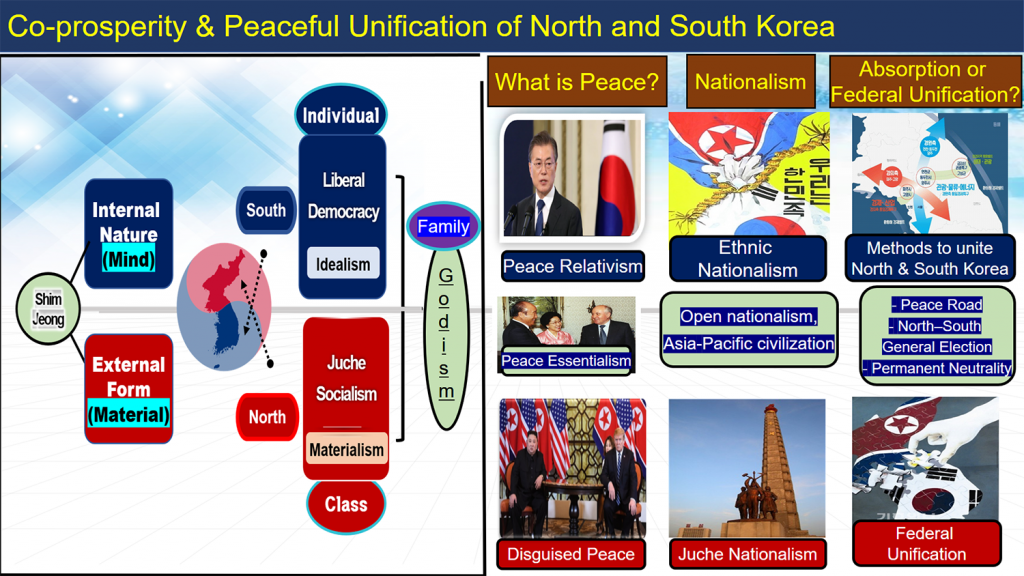
I’ll begin with some points we all share in common. When we speak of the situation between North and South Korea, we must address the conflict between the liberal democracy and hardline socialism. It resembles the challenge of uniting our mind and body, of uniting sung-sang and hyung-sang, internal and external, idealism and materialism. In such a situation, the way to resolve conflicts can only be found in shimjeong. Military, diplomatic, or other solutions will not work. To address the two dual characteristics of sung-sang and hyung-sang is the core of the solution. We can’t find any other common ground to unite North and South Korea. This can only be through the give-and-take of sung-sang and hyung-sang (internal character and external form). This requires shimjeong and the “event of shimjeong” which Dr. and Mrs. Moon pioneered; which they have campaigned for all their life. I’ve pondered this event of shimjeong from all different angles on a philosophical foundation. (2:08)
There are different approaches to bringing unification between the two opposing sides. It’s not an issue of doctrine; rather, it’s an issue of the spirit or mind and the physical body. These two are in a state of contradiction. When we first began speaking about Heavenly Unified Korea, it was from a conceptual standpoint, through the event of shimjeong. Looking at God’s existence, people tend to neglect or deny God, because God is immaterial. Christian tradition, on the other hand, depicts a spiritualized, transcendental God. The issue of sung-sang and hyung-sang comes up again. (2:09:40)
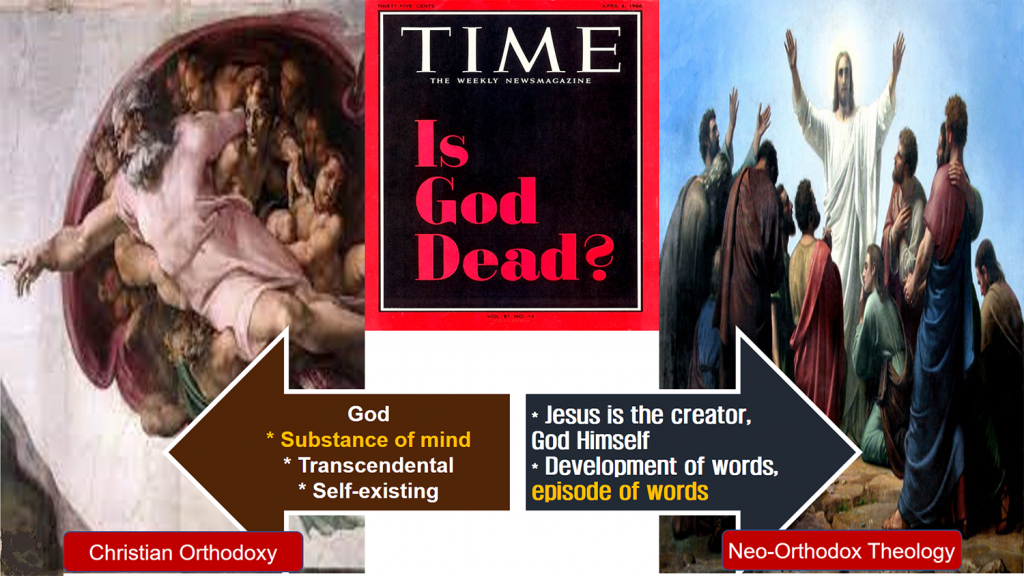
In 1966, the theology of the “Death of God”, first proclaimed by Nietzsche, came to the fore. Many had seen the spiritualized God as actually a negative factor. In fact, based on any physical evidence, we cannot speak of the existence of God. Then even pastors giving sermons at church would start concluding, “God must be dead.” It seemed the pastors themselves didn’t believe in God! Some American ministers were even talking about “the God who has died.” (2:10:31)
Jesus Christ came as the incarnated Word of God, or “event of the Word.” Calling out to God at His crucifixion, Jesus out, “My God, My God—why hast Thou forsaken me?” Even Jesus Himself seemed to question, “Where has God gone?” Later we first witness the event of shimjeong in the Resurrection. (2:11:13)
So when Dr. and Mrs. Moon introduced themselves to President Mikhail Gorbachev and his wife Raisa on April 10, 1990 he spoke about God the Father and God the Mother. Then Adam and Eve ought to be be the manifestation of God as man and woman, as father and mother, so we can confirm God’s existence in Adam and Eve. (2:12) So when Sun Myung Moon and Hak-ja Han first presented themselves to President Gorbachev and after that went to meet Kim Il-sung on December 7, 1991, Rev. Moon told Chairman Kim to abandon Juche ideology—a shocking proclamation right in the North Korean Parliament! It was an historic event. Likewise he told Gorbachev to give up Soviet communism, proclaim God, and grant religious freedom to his people. This event was none other than an event of shimjeong. It is as if Adam and Eve, the embodiment of God in substance, stood before those leaders in the person of Father and Mother. (2:13)
Important for our talk is the ideals of coexistence, co-prosperity, and co-righteousness. In our life here on the Korean peninsula, how can we achieve the vaunted yet challenging goal of unification? Taking these ideals of coexistence and co-prosperity, we have the contest of socialism vs. liberal democracy as opposing rivals. The thing that can unite them is co-righteousness. We must identify our universally shared values.
So how can God accomplish the unification of North and South Korea in the present situation? The peace approach of the North is one of “absorbing” the South with their ideology. From the material standpoint, the problem is “ownership.” Private property is totally forbidden in the DPRK. Despite the difficulties, all the problems can be substantially solved in detail through the event of shimjeong. (2:15)
Let us examine the issues of democracy. In North Korea they claim “people’s democracy,” which is not individual democracy but might rather be termed “social democracy.” Juche is the ideology of the North. The “Parent Leader” wields complete control. People do not have autonomy or independence there. At the Sixth Party Congress in 1980 the leadership repudiated Marxism and began advocating Juche nationalism instead. In the 1970s and ‘80s the idea of national democracy became popular on university campuses in the South. Why were some people in South Korea supporting the North Korean dictatorship? It is because South Korea emphasizes nationalism centered on lineage, language and culture, while North Korea emphasizes nationalism under the banner of class revolution. (2:16:41)
In the South we observe a kind of “tribal nationalism.” Here when we speak about “the people,” issues of lineage, language, and issues of culture become a primary concern. Then what about Juche in the North? What commonality can we find with them? How can we overcome this rift? What we need in its place is an “open nationalism.” Recently Jim Rogers, famous as the biggest investor in the world, spoke about this open nationalism. Talking about the restoration of our nation, he said that, until we solve the problem of the DMZ, we cannot unify North and South Korea. He delivered important words in front of the people of our nation. (2:18:17)
President Moon Jae-in also publicly shared his approach on the issue of national unification, and also spoke to American representatives when he visited New York City. (2:18:37)
Dr. Moon was the first to propose an International Peace Highway which would unite Japan and Korea via an undersea tunnel, Russia and the USA with a bridge‒tunnel spanning the Bering Strait, to open a global route making it possible to drive from the Cape of Good Hope in South Africa to Santiago, Chile or from London to New York. Such an International Peace Highway can unite the world as one family. It would link North and South Korea too. The era of the Pacific Rim civilization is coming to Korea. (2:19:19)
Neither the Juche of the North nor the tribal nationalism of the South can unite the world, but only through a higher ideology. There was a great scholar, Harvey Cox, who spoke of the “Decline of the West.” Only by turning to the Orient could the West be revived and keep its position. Now his words make sense! (2:20)
How can the United Nations unite all the peoples of the world? How can we overcome all the problems? We need a fundamental approach, not merely a diplomatic approach. In contemporary society many different methods and strategies on how to unite the world have been discussed: through technology, war, culture, and so on.
Now we witness the extent, the extremes, to which capitalist society can go: Extreme mass production, extreme consumption… The movie Squid Game depicts graphically how monstrous capital and material civilization have doomed us to be slaves. Capitalism is drawing near to its point of contradiction and limits. Harvey Cox spoke on that: The only solution for the West is to turn to the East, where we can find solutions to the problems of left and right. (2:21)
On the Korean peninsula we see the fruition of Hellenism, centered on the human body and humanism, and the God-centered Hebraism. These are in opposition, and we find both here on the Korean peninsula; now this has developed into a world-level confrontation. To address this problem, we consider the idea of God as three-in-one, from a Buddhist approach, a Zen approach, and a Confucian approach. We need an ideology that can unite these three on a higher plane. (2:22)
Let us look at the time of the Chinese Tang Dynasty, when Korea was threatened by neighboring nations. As we studied this period in school, I could feel that what my teacher was telling us was wrong: The scholars did not understand the real problem on the Korean peninsula. What moves people? Can you find the answer in the New Testament Bible? Here was a well-known professor, and I listened to his lecture, but it was clear that history scholars do not recognize the root of the problem.
Within 35 years, China has emerged as a major economic superpower. Yet despite Xi Jin Ping’s One Belt One Road strategy, China now faces opposition. In Pakistan there was a terrorist act against the Chinese project. China behaves as an “economic animal” exhibiting selfishness on a national level, and naturally arouses opposition from others. The USA is now confronting China with a “Star Wars” program. A new type of “Star Wars” has arisen. The USA is intensively developing space warfare, launching thousands of cube satellites. Whoever can dominate space can control the world. The StarLink internet system is facilitated through thousands of CubeSats so that everywhere people can connect to the internet, and it cannot be blocked. China is no longer able to block its citizens from the internet because of all the satellites. When we face and try to solve all these kinds of troubles, we must find our starting point. (2:25:13)
Let us now look at the two Koreas and the proposal of “open nationalism.” The solution can be found in Dangun’s original ideology of Love Heaven, Love Mankind, and Love Our Nation. The legendary king Dangun founded ancient Chosun 5,000 years ago. The ideals he taught were “Revere Heaven”, “Benefit Humanity”, and “Resplendent Nation.” These became the founding ideology for our nation of Korea. Then how can we apply Dangun’s thought to address the problem on the Korean peninsula now? (2:26:04)
The conscience is prominent in Godism. In the “Three Subjects Thought” there are three co-owners: God, parents, and neighbors. When these become one, then we can become one with each other. God dwells in the conscience. God is the first party in Heavenly Parent’s Holy Community. This happens when my mind and body unite centered on God and when I can love my neighbor as myself. The words of Jesus contained in the Golden Rule convey the idea of Hyojeong. The vertical and horizontal elements of Hyojeong serve as the foundation of Godism. God dwells in our conscience. Then loving my neighbor as myself is the horizontal dimension of Hyojeong. We see the conscience manifest in the horizontal realm in human relationships. Hyojeong has both vertical and horizontal dimensions. Shimjeong, conscience, and hyojeong all embody vertical and horizontal love. Historically this is the key. Only shimjeong can solve the problem of uniting democratic liberalism and class socialism. In the South we have individualism and in the North they focus on the class issue. Without shimjeong, it is impossible to reunite. Through Godism we can achieve the Heavenly Unified Korea. (2:28:47)
Now I’m going to talk about God: Korean tradition honors three forms of God. God is one, but He exists as a “trinity”: Hanin, Hanung, and Hangeom. Hanin is the Lord Creator God, the internal God in the center with the halo. Then at His left you see God as the Teacher, and on the right you see God the Enforcer, Lord, and Master. The unity of Heaven, Earth, and Mankind constituting the “Three Great Subjects Thought” is found in ancient Korean tradition. We have parents, teachers, and owners. Such a triune structure is found throughout our national thought. Thus in Dangun’s ideology and teachings we find a way to overcome the problem between North and South on the Korean peninsula. (2:30)
Let us look at the Chinese character at the top left, “Han”, representing the core nature of Korea. Below you see “Hwan.” Essentially they have the same meaning. Han or “bright” characterizes the “Bright Nation”—a nation of heart that is clean and bright without sin. Likewise, the name “Han Hak-ja” of Mother Moon contains “Han.” This is the most precious cornerstone of the Korean tradition and national identity. We have many expressions like “in the corner”, “going to one place”, “uniting in one body”: These phrases all have the word “han.” These are expressions that we all share. Han is the fundamental element of shimjeong. It means “becoming one based on shimjeong.” Hanguk, Korea is “One nation united together.” Our core pillar of ideology is this idea of “han.” Then to unite our nation we need this “Three in One Principle” where the three unite as one body. So this is really a Trinity structure. (2:31:29)
The term “Ta-ah ju-iy” means “Other-and-I-ism.” It means uniting based on shimjeong, not in a self-centered way through reason. We reach this not by centering on myself but on our Heavenly Parent. God manifests through the conscience and shimjeong. “Other-and-I” means together, not centering on myself but by living for others. “Ta-ah ju-iy” is the ethical thought underlying this trinity concept. To call God “Hananim” is another example of Ta-ah ju-iy. Living for others, God, other-and-I are together in oneness. People are relational beings; we are not just individual existences. This is a foundational concept in Godism. It is a relational concept, a way of being and relating not just by myself through reason, but through shimjeong. “Other-and-I” means living for the sake of the other. God himself thinks this way. This is the common point, the common ground where we can meet. We realize this through “Coexistence.” (2:33:05)
In the Greek legend of Eros and Venus, Eros stands for curiosity, the longing to realize the truth, and Venus is the Goddess of Love. Ambition centered on the body is embodied in Eros. Sexual desire is represented by Eros—but it also represents the drive to succeed and to know. The essence of ambition is Psyche, which manifests through our soul or spirit. The important realization here is that Eros and Psyche are not only physical, but actually spiritual. We as human beings have a hyung-sang side, but this is not only about the physical body. To have hope and yearning toward God is the original goal of our ambition. Adam and Eve originally should have strived towards God, and such is the original nature of us as human beings. (2:34:48)
We have an outward hyung-sang side and an inward sung-sang aspect. In the realm of shimjeong, they unite as an eternal being. Eternity is our birthright and our original nature as beings of heart. (2:35:07)
What is democracy? Is it self-centered desire, selfishly abandoning and discarding others? This is how democracy has been distorted through capitalism, because of its overemphasis on material property. The self-centered individual has led to the abuse of democracy through capitalism.
In elections, we see this destructive competition where people with a tremendous amount of money, by spending millions of dollars, can win an election. Then whoever wins the election, even if only by 5 percent, takes all and controls everything. We see that this democratic process is closely related to capitalism and selfish individualism. In an election, it is not fair that one side, the majority, can dominate everyone. Even when you go to the bathroom, you cannot just ignore the other person. Selfishness manifests in many ways.
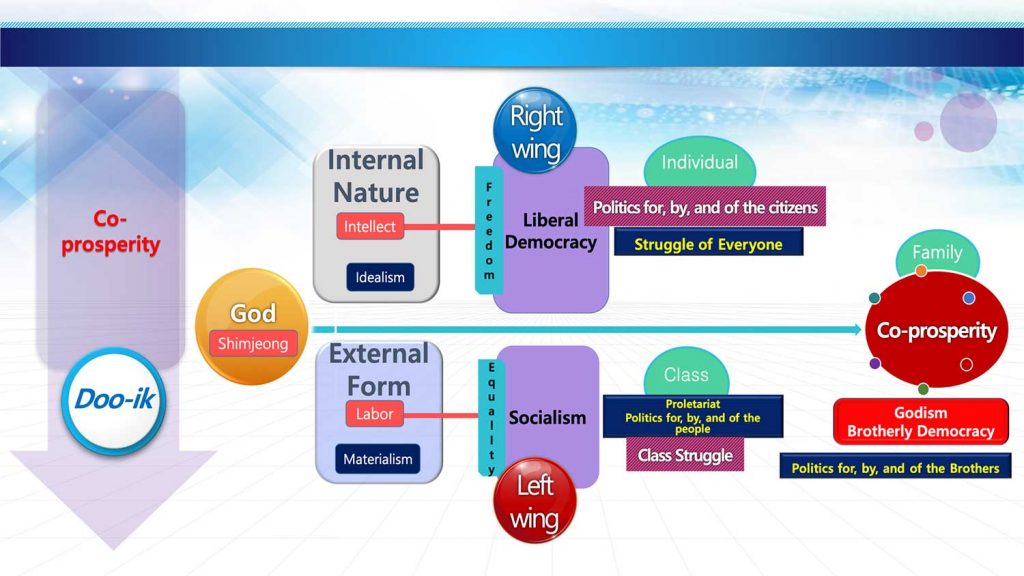
(2:36:30) On the other hand, what is wrong with socialism? Socialism focuses on “class,” leading to great hatred and resentment, because some classes are completely denied and purged. Both sides center on material desire, but in the case of socialism, this is on the class level. Instead we need to focus on shimjeong. Equality and freedom are based on shimjeong. The focus is not just material but shimjeong—heart. We see the same problem in socialism as in capitalism and democracy. (2:37:25)
We must navigate through this process by coexistence, co-prosperity, and co-righteousness. The free liberal democracy in our society has the character of being too focused on individualism and materialism. By being extreme in our individualism or materialism, we are not able to realize our full humanity, and such selfishness causes some people to be alienated. In socialism, you see class exploitation, where one social class exploits another, creating great resentment. We saw this with Kim Il-Sung, Mao Tse-tung, Josef Stalin, and others who became dictators and controlled everyone else, granting no rights to their people. It amounted to the most fundamental violation of human rights. Even socialism boils down to individual selfishness, but on a class level. Whether we speak of capitalism or socialism, both have fallen short. (2:39)
In Godism we have the ideal of co-prosperity. The solution is a family system of values. Don’t focus on material but shimjeong, or handle material through shimjeong. What is the definition of shimjeong? It is a common shared feeling of heart or affection between people for the common purpose. The way to resolve people’s resentment is by centering on shimjeong, the whole purpose or shared purpose, rather than our own personal purpose. Love your neighbors, embrace the whole with a universal embracing heart. (2:39:47)
Let us look again at how we apply the pillars of coexistence, co-prosperity, and co-righteousness in the social sphere. In the democratic election principle, if one candidate wins a 51 percent majority and the other loses with a 49 percent minority, the winner takes all. Then what happens to the minority? Instead we need “brotherism”: a society of the brothers, by the brothers, and for all the brothers together centering on shimjeong. All of these issues can be resolved by a heart of working together. Shimjeong—care, sharing, commonality—resolves many different problems that we see in democracy. But make sure not to go to extremes in either direction. (2:41)
Likewise we apply the pillars of co-prosperity and co-righteousness. Ta-ah ju-iy is living for the sake of others together with God, centered on shimjeong, with a common sense of purpose. The “Three Great Subjects Thought” is expressed through “Other-and-I-ism”, Ta-ah ju-iy. One who lives in this way is the happiest person, even though they go through difficulties and hardships. In Korean we say “our wife” instead of “my wife” as people in the West say. There is a sense that this is a person who is not just mine, but she belongs to our family. We always say “our” instead of “my”. This sense of commonality is expressed in the Korean language. We say, “We have this problem” or “We have this common property.” Going through the long historical process of suffering in Korean history, it is something that we all share as our common legacy. Speaking of the Republic of Korea: This is a country that belongs to God and to us. This is the Korean sense of commonality we’d like to share with all people. (42:30)
The first pillar of the ideal is coexistence. Heavenly Parent, the purpose of the whole, living for the other: My personal goal is fulfilled by fulfilling the whole purpose, not just by pursuing my personal benefit or profit. We must not go to either extreme, but strike a balance with a sense of the whole, of the common benefit. (2:43:25)
Commonality is a commonly shared benefit and identity. When we look to our brothers and sisters, our father and mother, and our children—it is natural to have this sense of sharing and being together. It is not about reason or rationality. God does not primarily emphasize reason, but as a family the shimjeong, loving the neighbors, is a natural instinct. Hyojeong means vertically loving God and horizontally loving people—loving for the sake of others. In everything: money, property, food and everything is shared. We find this same concept in Buddhism, Christianity, Zen, and Confucianism. Everything is shared: living for others, “Do unto others as you would have them do unto you.” (2:44:45)
Finally, we address the problem of ownership in democracy, particularly in the capitalist system. In the socialist system ownership is based on equality: one feels jealous of someone else who has more. The error of communism is that they are seeking this equality while denying individual life, freedom, and value. The issue is the value of the object. We have to uplift the object—their lives are precious. In a more optimum system, we share together. Each person’s life is valuable, with heartistic equality, not just material equality.
Again, with coexistence and co-prosperity we can completely solve the problems in capitalism. Today in our life, by centering on God and loving my neighbor as I love myself, I fulfill my individual purpose together with my neighbors and associates. “Ta-ah ju-iy” means showing concern for the other people. (2:46:30)
Human being’s basic mode of existence is that we receive the value and meaning of our existence through God. We are beings created by God. Descartes expounded, “I think, therefore I am.” Copernicus realized that the celestial spheres did not revolve about the earth but rather it is a heliocentric solar system. This Copernican revolution was a great revolution that we are now realizing through Heavenly Unified Korea. Everything centers not on myself but centers on the whole, not based on reason but through heart. God is not a being up in the sky. Where is God? God is here. God is living among us and is concerned about each of our lives. God is not just transcendental. The Christian concept of God is too spiritualized. Conversely, socialism worships material. How can we bring peace, happiness and freedom through material?
What is important in our life now is not just reason or intellect but shimjeong. Not just centering on myself, not just centering on “I think therefore I am” with Descartes. Worldwide capitalism could not solve the problems, and led to cultural collapse.
The most important core of human existence is that we depend on God for our existence. Starting from the ideology or thought of Abraham, eventually a vertical axis was established, and then a horizontal sense of solidarity and unity among his children. We must go this course; one cannot avoid or escape it.
Think “our wife” rather than “my wife.” This is God’s existence. She doesn’t belong to me; rather, it is through her that we can live and exist together. This is pure love: valuing each person and treating them in that manner. “Ta-ah ju-iy” is living for the sake of others. The ideal pillars are coexistence, co-prosperity, and co-righteousness. (2:49:37)
We human beings can launch a new departure point centering on conscience. That’s why, centering on God and conscience, God can dwell with us as our Heavenly Parent. He is our True Parent, Owner, and Teacher through our conscience. That’s why, through Godism, with the three pillars of coexistence, co-prosperity, and co-righteousness we can bring new life to our Republic of Korea, reunite our country, and solve these problems. (2:50:20)
So today, the democratic society needs to be healed with these three pillars of coexistence, co-prosperity, and co-righteousness. Think of everything as being “ours”—not just mine, and solve these problems by this consciousness. Become the happiest people. Psychologist Erich Fromm said, “What do people want? They want happiness.” There’s nothing else I need. Just as we are beings who belong together as “us” in a community sense of existence, our nation, our ownership—it doesn’t matter whether it is democracy or socialism: the shimjeong can be expressed in both systems. Through the epic of shimjeong, we can solve these.
This concludes my lecture. Thank you! (2:51:40)