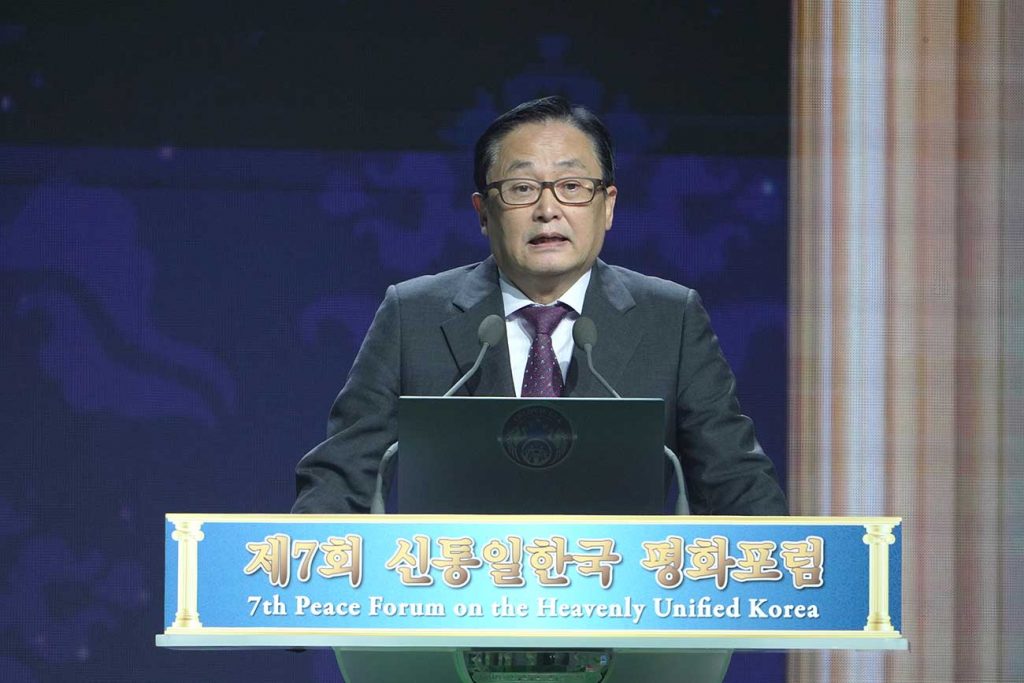
Dr. Jin Sung-Bae gave his seventh lecture on the theory of the heavenly unified Korea during the seventh Peace Forum which was held on November 12, 2021
1. The conflict between North and South Korea’s liberal democracy and Juche socialism is a matter of idealism and materialism, mind versus matter. Therefore, the 38th parallel (DMZ) where the two Koreas face each other is not simply a military confrontation, it is a confrontation line between ideologies that oppose communism and democracy, idealism and materialism, theism and atheism, and a line of good and evil values. These two mental and spiritual sides can be unified into one through true love, that is, the heart or shimjeong. As such, the path to fundamentally resolving the conflict between the two regimes of the two Koreas can only be found in the heart and the heartfelt incident. Heavenly Unified Korea Theory refers to a God-oriented, head-wing reunification movement that seeks to fundamentally unify the South and the North, the left and the right, centering on the axis of the heart. Here, the heart-throbbing epic refers to the life of true love of Rev. Sun Myung Moon and Dr. Hak Ja Han, who have been leading the peace movement throughout their lives. Let’s take a look at one example from the life story of the Moon couple and the heart-felt epic related to the end of communism.
2. On June 16, 2020 last year, North Korea’s bombing of the Inter-Korean Liaison Office at the Kaesong Industrial Complex ended fifty years of peace talks in vain. Peace for the United States means the complete abolition of nuclear weapons by North Korea, and peace for North Korea entails the removal of strategic nuclear weapons and the withdrawal of all US forces from the entire Korean Peninsula. The North Korean peace scenario is a disguised pacifism targeted at communizing the Korean Peninsula, while the peace envisioned by the Moon Jae-in government in South Korea is a relativistic peace that rests on Kim Jong-un’s heart. Korean reunification cannot be predicated on such mutually incompatible peace concepts—disguised peace vs. peaceful relativism. The unification of the Korean Peninsula can only be achieved through peace essentialism. Peace essentialism is clearly evident in the lives of Sun Myung Moon and Dr. Hak Ja Han, who appealed to Gorbachev, the last Secretary-General of the Soviet Union, and to Kim Il-sung, to “accept Godism.” During the Yeltsin Revolution, the young people who stood up in front of the tanks and resisted the military coup were among the 20,000 to 30,000 young people educated by Rev. and Mrs. Moon in the United States. Then who put an end to communism? There are many factors, but above all, I believe that God destroyed communism. And behind him stood the two leaders who led the global Victory Over Communism movement. The event of God intervening in this historical process is the lives of these two individuals, and that is the event of heart. President Moon risked his life to spare Gorbachev, who in an attempt to assassinate him, had dispatched 25 subversive partisans, as identified by the CIA. This story is well detailed in the very readable bestselling author Kim Jin-myung’s novel “The Prophecy”, which I highly recommend.
4. Universally Shared Values (“co-righteousness”) is a universal ethic that takes the orders of the heart of conscience as the three subjects of parents, teachers, and owners. Co-righteousness is a movement that liberates God as the Subject of subjects through conscience. If the ideal of co-righteousness is applied to the reality of the Korean Peninsula, is the subject of the Korean Peninsula a Parent-Leader who advocates the theory of eternal life or the transcendent God of Christianity? It presents as an alternative the one body theory of the True Parents God. Also, does true human emancipation entail a liberal-democratic civil revolution or a socialist proletarian revolution? Addressing the controversy over Freedom or Equality, it proposes the liberation of humanity in terms of freedom and equality centered on shimjeong. Here’s another: is the answer the cultural freedom of capitalism or cultural Marxism? To this, the Absolute Sex revolution and the Character Education movement are presented as alternatives.
5. Co-prosperity refers to a political system based on justice. It suggests peace essentialism as to whether North Korea’s disguised pacifism or the other’s peaceful relativism is taking place on the Korean Peninsula. Is it Juche nationalism in the North or vertical democracy in the South? Presently on the Korean Peninsula, there is Juche nationalism in the North and vertical democracy in the South; the alternative proposal is open nationalism. Then, it deals with the current trends of unification by absorption vs. federal unification; there are alternatives to the inevitable All-Korean General Elections that are bound to happen eventually.
6. Coexistence (Interdependence) points out the contradictions between capitalism and socialism in South and North Korea, addresses the issues of labor versus ownership, existence versus ownership, and freedom versus equality in ownership, and suggests alternatives to economic problems related to the ownership revolution. And the limitations of the mechanistic worldview and the dialectical worldview and the organic worldview and the theory of perpetual peace are dealt with as alternatives.
9. North Korea emphasizes that the masses are the masters of Juche socialism, which is false. This is because the main subject of the masses is the Supreme Leader, and only Parent-Leader is the actual master of North Korea. Originally, the Juche ideology’s view of man is a view of man with autonomy, consciousness, and creativity. This leaps to the masses’ autonomy for class revolution, and the masses’ autonomy becomes social when it establishes a blood relationship with the Father-Leader who lives forever, given political life through the party. At the 6th Party Congress in 1980, North Korea abandoned Marxism nationalism and began to advocate Juche nationalism. The Juche nation, led by Father-Leader, was born. North Korea advocates for the federal system of Goryeo, demanding the withdrawal of US troops from Korea. This was the “national democracy” movement that swept college towns in the ’70s and ’80s, and “Between Our People” led by the NL Jujus, lifting up the Juche idea centering on Great Leader. As such, the Juche ideology has become a civic religion and cannot be escaped with just one injection like drugs. In 1991, Rev. Sun Myung Moon ordered President Kim Il-sung to abandon the Juche ideology and embrace Godism because of the terrifying religious nature of the Juche ideology. ★ North Korea’s nationalism is Juche nationalism with class revolution at the fore, while South Korea sought the origin of Korean nationalism in historical tradition. Nationalism in South Korea entered the modern era, and around 1918, US President Wilson’s principle of national self-determination, the 3.1 Movement’s national self-determination, the provisional government was established as a result of the March 1st Movement, followed by the establishment of the Korean government under the 8.15 liberation and democratic republican system, and the 6.25 Korean War. Although it is difficult to describe Korean nationalism in one word, it has the characteristics of ethnic nationalism that emphasizes lineage, language, and culture. Unlike the concept of class nation, the concept of ethnic nationalism is based on the whole nation, which includes both the ruling class such as kings and feudal lords, and the subject class such as the people. ★ The debate on nationalism between the two Koreas is a matter of which side has national legitimacy. Heavenly Unified Korea Theory overcomes both ethnic nationalism in the south and Juche nationalism in the north and insists on open nationalism as an alternative. The era of exclusive and isolated nationalism in the global era is long over. Moreover, North Korea’s Juche nationalism and Juche socialism based on partisanship only lead to exclusivity and isolation. Nationalism should be open and open to the world and should have the character of universal nationalism. And it must be an ideology with national legitimacy and subjectivity based on the Gyeongcheon ideology. The founding pillars of Heavenly Unified Korea are the ideals of Love Heaven, Love People, and Love Nation, and the founding ideology is coexistence, co-prosperity, and co-righteousness.★ The Godism of Heavenly Unified Korea is a movement to return to the roots of our nation, the Gyeongcheon ideology (Revere Heaven), Hongik ideology (Benefit Humanity), and Gwangmyeong ideology (Resplendent Nation) of Gojoseon established by Dangun. Dangun’s ideology is not nationalistic but universal. The ideology of Aecheon (Love Heaven) in Heavenly Unified Korea corresponds to the ideology of Dangun’s Gyeongcheon (Revere Heaven), and this is the root of Godism. From this Godism, the ideology of Hongik (Love Humanity), and the ideology of Love the Nation, Gwangmyeong (Wonderful Nation). However, Godism is much deeper and more specific than Dangun’s Gyeongcheon Thought. Now let’s take a deeper look at Godism.
10. Godism is an ideology that follows the universal principle of conscience and places the conscience as the subject and God abiding in the conscience as the subject among the subjects. My conscience is a divine subject, different from me, deep in my heart, and is the judge of the inner court. Therefore, the conscience is my subject, and it plays the role of the three major subjects: parents, teachers, and owners. Therefore, God, who is the subject of conscience, is the parent among parents, the teacher among teachers, the owner among owners, and the true parent of mankind. God, who is present in the conscience, delivers Heavenly Parent’s “command of the heart,” which is a universal categorical command. This directive of shimjeong occasions the “high noontide settlement.” ★ Therefore, Godism holds that there is one God, one conscience, and one all-embracing religion. This is because all religions teach the commands of God’s heart through conscience. That is the Golden Rule which appears in the scriptures of all faiths.★ The Golden Rule of all religion is, in a word, “Love the Lord your God with all your heart, mind, and soul, and love your neighbor as yourself.” This is none other than “Hyojeong thought.” Hyojeong comprises vertical hyojeong of loving God and horizontal hyojeong of loving neighbors. Vertical hyojeong liberates the heart of God, and horizontal hyojeong liberates human relationships. The liberation of human relations is the liberation of the conscience. This liberation of shimjeong and liberation of conscience together amount to the ultimate human liberation; this is a fundamental alternative to the human liberation of democracy, under which freedom is destroyed by the abuse of freedom, and the human liberation of socialism, where equality is destroyed. The ethical view of Hyojeong ideology derives from the ontology of “ta-ah juiy”, i.e. the ideal of “other-self.” ★Ex: A typical example of hyojeong can be found in the human victory of Jacob, who received the title of Israel from Yahweh. “Israel” means “victor.” The idea of Hyojeong can be clearly exemplified and verified in Jacob’s victory over humanity. ★ As such, Godism is much deeper and more specific than Dangun’s “Gyeongcheon” Thought. So who are the main actors on the Korean Peninsula? The subject of the Korean peninsula is neither the false Parent-Leader, nor the Christian God saddled with transcendental theology. The subject of the Korean Peninsula is the God of Godism, who succeeded and perfected Dangun’s ideology of Gyeongcheon, that is, God who is the True Parents and Heavenly Parents. Let’s discuss the “one body theory” that was never completed in the past in Korean nationalism. Let’s look into the origins of Korea’s “Han”(韓). This is because the roots of Han of the Republic of Korea and the Han of President Hak Ja Han, are the Han of the Korean people, and thus serve as a basis for acknowledging the national legitimacy of South Korea rather than North Korea.★ Referring to the Golden Rule of religion, Christianity says, “In whatever way you would like others to do to you, do to them also.” (Matthew 7:12); Buddhism says, “They must not kill living lives because they think they are like me.” (Suttanipata 705); Hinduism says, “Do not do to others what is not pleasing to yourself; this is the foundation of all morality.” (Mahabharata Anusasana Parva 113.8); and even traditional African religions say, “Whoever tries to stab a young bird with a pointed stick must first stab himself and feel how painful it is.” All explain the universal principle of conscience.
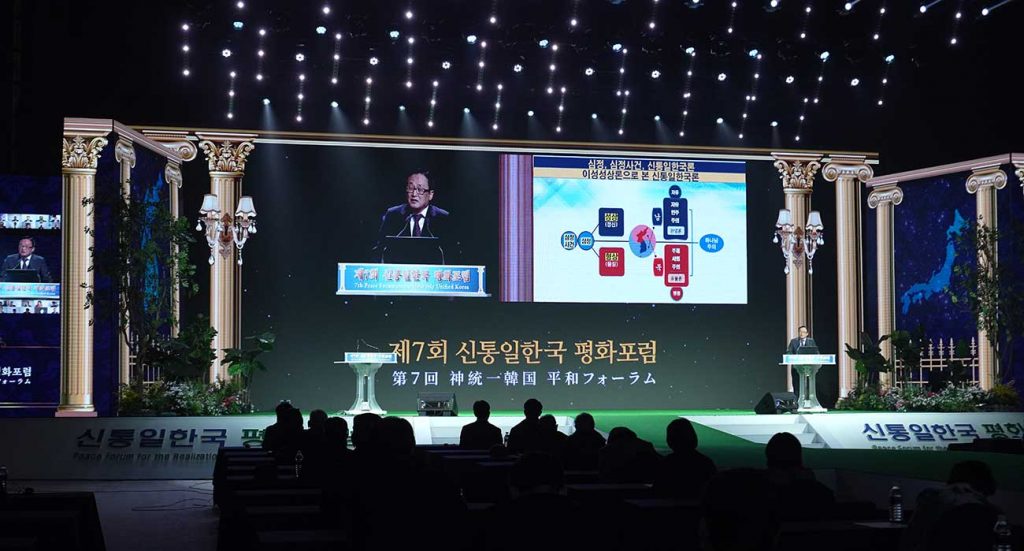
11. The God of Heaven that the Korean people have believed in is the triune Hanin(桓因) Hanung(桓雄) Han-geom(桓儉), who together are the God Hananim who is Three-In-One. Then Han or Hwan, which means bright, is derived from the double-character ‘Hae Ha’, thus ‘Han’ and ‘Hwan’ have the same meaning. ‘Hwan’ or ‘Han’ is the main, original Being of the Trinity (three-in-one) theology. Furthermore, ‘Baedal’ of “Baedal People” and ‘Han’ of “Han Tribe”, origins of the Korean race, both mean ‘Bright’—without darkness or sin. ★ The One (一) and the Three (三) of Heaven, Earth, and Human are also included in this ‘han’, which is called the Three-In-One Principle. Like the Three Great Subjects Thought, the Three-In-One Principle is based on ‘Han’ as its main, Original Being, thus the concept of Parent, Teacher and Owner are all included as One. ‘In’ (因) is the Father and Mother of Creation; ‘Woong’ (雄. 敎化) is the Teacher, and ‘Geom’(儉. 治化) is the Master. ★ These three come from ‘han’, which is the one body or One Original Being, live in the meaning of ‘han’, and then return to ‘han’. ‘In the middle, in the same place, in the corner, in one place’—as we can see from these examples, ‘Han’ means “One embracing the entirety, uniting, becoming One.” Thus ‘Baedal’ and ‘Han’ both mean ‘Bright’, likewise “Love like the red sun,” and “Bright nation radiating like the morning sun.” They mean the world, they mean the essence of love from the essence of shimjeong. It means that from these the ideal world of freedom, equality and peace will be realized. This is the “Main Original Body Theory of Han.” ★From this main body theory of ‘Han’, Dangun’s thought on Gyeongcheon, Hongik, and Gwangmyeong emerged; furthermore, the ideals of the world of Ewha and the ideal world of unity of government (祭政一致) were able to emerge.
12. The God of the Korean people is the triune God, in which the three gods Hanin(桓因), Han Woong(桓雄), and Han Geom(桓儉) become one. The Trinity Principle in which the three gods are united, and the root of the three gods is the ‘Han’ original body theory. The Three-In-One principle is that In(因) is the parent of creation, Ung(雄) is the teacher of education, and the Geom(儉, sword) is the master of Chihwa. This Three-In-One Principle reveals the Three Great Subjects Thought. In other words, it means that conscience is the subject in which the three subjects—parent, teacher, and master are united, and that God is the ultimate three central subjects, namely Parent among parents, Teacher among teachers, and Master among masters. How could the Trinity Principle of the Three-In-One God be so consistent with the Three Great Subjects Thought of Godism? ★ “Ta-ah juiy” (“Others and I thinking”) is an ontology that sees the source of human existence not as the rational self but as the shimjeong (heartistic) other, God. The existence of “I” is not Descartes’ thinking self, but the me through my parents, and furthermore, the me through my Heavenly Parents. God is the Other who gives the prompt of shimjeong through the conscience, and He is the “I Am greater than myself,” so He is the prime “Other and Myself.” Therefore, human beings are not ‘ego’ beings, but ‘other’ beings. From the viewpoint of shimjeong (heart), God is my first other, and my neighbor is my second other. Myself is not a solitary existence thrown out of the universe, but a ‘relational existence’ in which God and neighbor are inseparable and coexisting together. This is the concept of ‘we’, a unique ontology in Korea. The starting point of human existence is not the rational ‘I’ of the West, but the ‘we’ of the heart (shimjeong). In Godism, the ‘we’ ontology is defined as the coexistence of God, the neighbor Other, and I. This ‘we’ ontology is the ontology of ‘Ta-ah juiy‘ (otherism), and Hyojeong thought is the ethical theory of Ta-ah juiy. The triune God and the Trinity principle of the Korean people is a model of our ontology, the coexistence theory that the three gods are One, and that God, our neighbor, and I are one. The beginning of this Three-In-One principle is the country of Korea, Han, and this concept is the most fundamental root of Korean thought.
14. Co-prosperity proposes the family model for resolving the struggles and conflicts that arise from the individual in liberal democracy and the socialist class. This means politics modeled on the family, not the individual or the class. As such, co-prosperity is a politics of brotherly democracy centered on parents, of the brothers, by the brothers and for the brothers. As long as liberal democracy and socialism are based on the material desires and institutions of individuals or classes, the contradictions cannot be overcome. To resolve this, “heart” (shimjeong) is presented as an alternative ideology to co-prosperity (Mutual Prosperity). Co-prosperity proclaims the innate fraternal democracy, which means an ideology that follows the universal normative command of our conscience, that is, the command of our Heavenly Parents. It is a feeling shared with the whole. ★ First of all, co-prosperity proposes an election system including recommendations and a lottery to eliminate excessive competition and realize an election whereby everyone wins. With empathy, it is politics for integration rather than competition. Secondly, the elected representative can become a just and upright representative by following the bidding of the heart based on conscience to counter the “failure of representatives” in the existing representative system. Only brotherly democracy based on the heart is the solution to the “failure of representation.” Unlike the “failure of representation” of liberal democracy, socialism raises the problem of “failure of representation” by class. The problem of “representative failure” in the representative systems of the two Koreas can only be solved by the brotherly democracy of co-prosperity Third, in the case of representatives elected by a close margin of 49 to 51, monopolistic democracy is implemented, where the majority party monopolizes the power. Instead, conservative and progressive parties must overcome their differences in ideology and share power as brotherly parties and do politics for the people.
15 ★ Coexistence (“Interdependence”) refers to the three subjects of ownership. The quality of possession is determined by the three subjects of ownership. In other words, ownership is decided between Heavenly Parent and these three people: me pursuing the individual purpose together with God, and the neighbor (“other”) pursuing the whole purpose. Everything that exists is held jointly by God, the other, and me. Ownership is jointly shared by these three beings. My individual purpose is the basis for capitalism, and my overall purpose serves the ideological foundation of socialism. The starting point of capitalism’s pursuit of profit is myself, but socialism advocates the totality. So which is primary: the individual ambition under capitalism or the whole class necessity under socialism? Godism asserts the unity of the individual and the whole. In the matter of property, Godism insists on the sharing of property between the individual and the whole, rather than the extremes of the individual persons and the whole nation. This is the three subjectivity of possession. Joint possession with God and others is the fundamental sense of possession. Since common ownership revolves about the three subjects of ownership, it determines the quality of ownership and is the key to solving the problem of freedom of ownership in liberal democracy. Since common ownership, which determines the quality of property, entails the unity of property between the capitalist individual and the socialist whole state, it is an alternative to the concept of property in the two extreme systems. Since God is the whole of the whole that encompasses the entirety, the socialist concept of the whole state is included in the concept of God. Therefore, the common ownership by the three subjects of common ownership means the unity of the individual and the whole of possession. These three subjects of possession addresses the problem of ‘being and possession’, which is a fundamental problem for human beings, and it is a problem related to all philosophies and ideas. The co-existence of the three subjects, “us” and “ours” of common ownership, is a perfect alternative to elucidating the philosophical problem of “being and possession”. The ontology of Godism is ta-ah juiy (otherism), and the concept of ownership is coexistence and common ownership. The logical basis of this ontology and the concept of common ownership is ‘shimjeong’ (heart). The ontology based on shimjeong is ta-ah juiy (other-and-I thought), and the theory of possession is common ownership. This is a grand shift from the Western rationalistic ontology and worldview to the ontology of “heartism” (shimjeong) thought and worldview! It is a truly revolutionary thesis (proposition) that sets out to reverse the entire conceptual framework. It is a ‘Copernican revolution’ whereby humans’ rational self-concept is converted to God’s shimjeong-centered others-and-I concept, just like the shift from the theory of celestial spheres to the heliocentric model.
17. ★ Liberal democracy is a political principle combining liberalism and democracy. Liberalism is a system in which freedom is the core value of human rights, and democracy is a system in which the people hold the sovereignty. Liberalism aims to minimize interference by state power, and democracy is “politics of the people, by the people, for the people.” The cause of the failure of liberal democracy is the material character of capital. The structural contradiction of capitalism has resulted in a huge wealth gap, and the people have become economically unequal and poor. The economic inequality of capitalism led to the political inequality of liberal democracy. The almighty material (capital) trend of capitalism based on selfish desire is heavily polluted by the misuse of liberty in liberalism, excessively competitive elections due to partisanship, failure by delegated representatives to represent their constituency, and monopoly democracy based on the principle of majority rule. ★ So then what about socialism? Socialism, on the other hand, is a system of the people, by the people, and for the people based on the class of the proletariat. Whereas liberal democracy results in the struggle of all as a result of the abuse of individual freedom, socialism promotes class struggle and revolution and in so doing amplifies hatred. Socialism is a society in which liberal democracy’s private desires have been translated into class desires. Liberal democracy is a society in which individual citizens struggle, while socialism is a society immersed in class struggle in which the proletarian class exercise dictatorship as the ruling class. The “representative failure” of democracy is individual, while the “representative failure” of socialism is on the class level. Whether it is individual desire or class desire, people’s desire is the same in terms of the desire for material (capital). In that respect, the problem of “failure of representation” in socialism is much more serious than “failure of representation” in liberal democracy. ★ The economic inequality and lack of true freedom under both liberal democracy and socialism lead to political inequality and subservience, resulting in a society in which human rights are deprived. Liberal democracy has been transformed into politics “of Party members, by Party members, for Party members” rather than sovereignty “of the people, by the people, for the people.” Likewise, socialism has degenerated into politics “of the Proletariat, by the Proletariat, for the Proletariat.” No system can guarantee genuine human rights, freedom, and equality. Liberal democracy and socialism, whether individual or class, are fundamentally ideologies of selfish desire and partisanship, capitalism and materialism, and hatred and loathing. Therefore, the only way the contradiction between the two systems of North and South can be resolved is through the ideals of co-prosperity (“Mutual Prosperity”).
20. As much as the South-South conflict, the fundamental problem with regard to international dynamics is the problem between China and the United States related to Asian hegemony. This is the international conflict between China or the United States? The logic of the Korean people in the movement field is very unrealistic in international dynamics, and there is a high possibility that it will be absorbed into North Korea’s Juche nationalism. From our nationalist point of view, the competition for hegemony between China and the United States is a very important issue. ★ The purpose of China’s Northeast Project is to unite its own people with the Chinese ideology, to secure sovereignty over the northeast region of China, and to become a suzerainty country in Asia. In addition, the intention is to prevent territorial return, such as a litigation for the return of Gando, diplomatically, while keeping a unified Korea in check politically. ★ However, the Northeast Project distorted history, was promoted without considering relations with neighboring countries, and had many problems due to excessive intolerance centered on China. ★ In addition, China’s Xi Jinping’s One Belt, One Road is a new Silk Road project to neutralize US pressure and blockade and emerge as a superpower in the global economy. It is a long-term geopolitical strategy over 35 years, 2014–2049. Three inland and two sea routes are being promoted, and more than 100 countries and international organizations are currently participating. ★ However, the Silk Road is geographically very extensive, there is a separatist movement of connected countries, and conflicts between the great powers are inherent, so there are many problems. Recently, participating countries canceled construction projects one after another, and in Pakistan, the largest partner, an armed rebel group opposed to the Belt and Road Initiative attempted a suicide bombing at the Chinese consulate on May 11, 2019. ★ On the other hand, the United States is opening the era of New Space following Star Wars, which collapsed the Soviet Union system. This is the space platform business. In the case of the US government, the National Aeronautics and Space Administration (NASA) “We are going to the Moon to stay” and announced it would advance the lunar exploration program by four years from 2028. In particular, the US space industry has entered a new phase as a “NewSpace Global.” These include Apple’s Internet network construction project by US Apple and Elon Musk Space X’s space Internet “Starlink” project. SpaceX announced that it would launch 4409 satellites in the first phase, and then launch 7518 satellites into low orbit to build a satellite system. Morgan Stanley, a global investment bank, estimated the size of the space internet market in the 2040s to be about 580 trillion won per year. ★ So is it going to be China or the U.S.A.? Following the collapse of the Soviet Union, the second Star Wars are under way! It is in the space platform business that the victory or defeat of all issues such as world economy, industry, politics, diplomacy, culture, and military will be decided. From the standpoint of open nationalism, will our nation be absorbed into the historically repeated continental culture? Or will the Asia-Pacific era be hosted by a unified Korea?
21. Western civilization became astonished by the savagery of human beings during the two world wars, and although there was usefulness in life in the modern industrial society of mass production and mass consumption, a severe distortion of humanity appeared. In other words, in the jungle of the survival of the fittest, they became humans who had to live the struggle of all against all every day. As seen in The Squid Game, they are doomed to live as slaves in front of the fetishism of huge capital and material civilization. ★ Now, the material civilization of the West is already difficult and old to lead and lead the world civilization. This is the crisis of Western civilization. Up till now, the creative power and energy to lead the world civilization have been hidden in the Asian civilization, and from now on, the Asian civilization will begin to bloom. ★In April 1929, the great Indian poet Tagore, who received the first Nobel Prize for Literature as an Asian, extolled Korea under Japanese rule. His poem is titled “The Lamp of the East.” Harvey Cox, a prominent American theologian, argued that the solution to world problems could only be found by a ‘return to the East.’ He predicted, “The oriental view of the cosmos and this world will overcome the limitations of the Western mindset and resolve the conflict and confrontation between the ideologies of the left and right.” Centering on the 1988 Seoul Olympics, the world’s people became completely one, achieving harmony of dialogue as they sang together “Hand in hand… breaking down the walls.” ★ From the point of view of the history of civilization, the ideological confrontation between North and South Korea is between human-centered Hellenism, humanism and God-centered Hebraism, and neo-capitalism. Therefore, we hold that the key to unification of the Korean Peninsula must be found in the third ideology, a new zeitgeist that connects the spiritual veins of Eastern Yu (儒), Buddha (Buddha), and Zen (仙) and subsumes the ideologies of left and right.
22. Now let’s look at the movement of civilization centered on the Korean Peninsula. World civilization started from the continental civilization. Namely, the ancient Egyptian continental civilization was formed for the first time on the rich agricultural soil carried by the huge Nile River. Subsequently, the continental civilization crossed the Mediterranean Sea and moved to the Greek and Roman peninsular civilizations, and then passed to the island nation of England via Europe, forming an island civilization the dominated the world’s maritime sphere. After that, the island civilization crossed the Atlantic to the American continent, bearing fruit in the state-of-the-art science and technology civilization of the United States. In this way, the shift of civilization bore fruit on the Korean Peninsula, and the era of civilization in the Asia-Pacific region was ushered in.
23. On November 10, 1981, the 10th ICUS Conference for the unity of the sciences was held in Seoul. It was here that President Sun Myung Moon proposed the construction of the International Peace Highway that would connect the world as one. “I have one suggestion I would like to make. It is to build a great highway through Asia from China to Japan through Korea and a great highway to the free world.”★ The International Peace Highway proposed by Rev. and Mrs. Moon will have four lanes with a median strip, and will connect China and Russia through North and South Korea, uniting Eastern and Western Europe and the world. When that dream is realized, it will be a “peace highway” connecting the world peacefully. → Set 1 km wide along both sides of the highway as an international neutral zone, → It will introduce visa-free international immigration by setting up immigration offices at each interchange. → No vehicles loaded with weapons will be allowed, and there will be restrictions on the movement of troops. ★ As part of the construction of the International Peace Highway, the Korea-Japan Undersea Tunnel aimed at uniting the East Asian Community was also proposed. → In April 1982, the International Highway Construction Project Group was established in Japan, and in July 1983, investigations of the land and sea areas of Karatsuwa Iki and Tsushima in Saga Prefecture, Kyushu, Japan began. Excavation work began. → In Korea, from 1988 to 1990, drilling was conducted in the areas of Daemado and Geoje Island. ★ The Bering Strait Project ‘World Peace King Bridge and Tunnel’ is another project that connects Eurasia and North America. → President Moon said that he had high expectations that this project would “connect from the Cape of Good Hope in Africa to Santiago in Chile. On this Peace Road, it will be possible to drive from London, England to New York, USA, and it will become the world’s largest highway and unite the world. Thus through this Peace Road, the ideal of One Family under God will also be realized. This is the perfection of open nationalism.
*** END ***