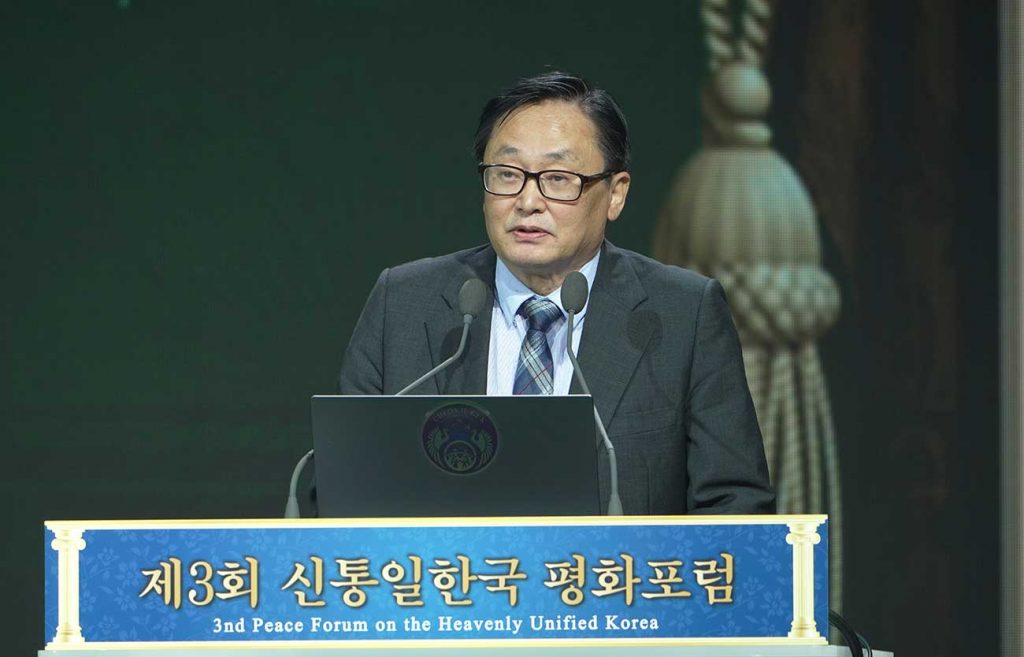
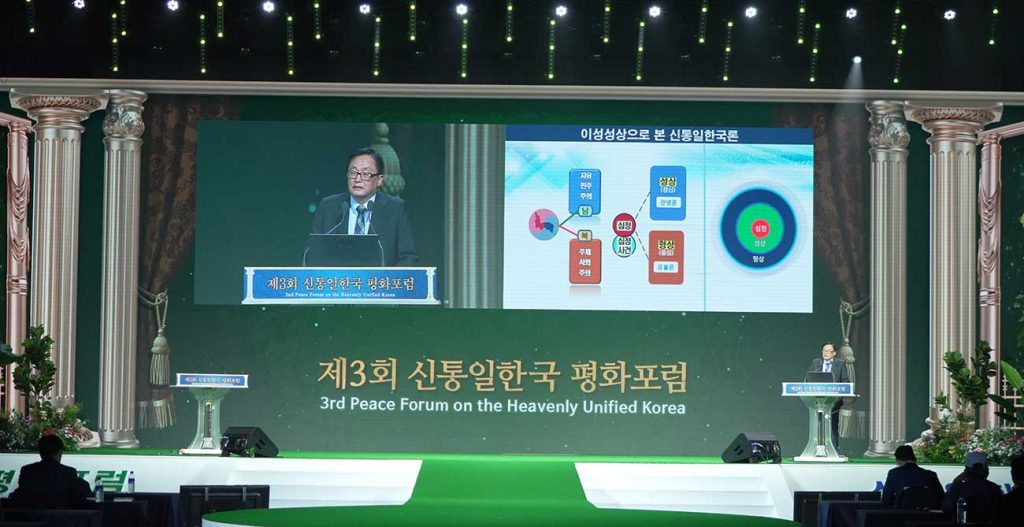
Dr. Jin Sung-Bae gave his third lecture on the theory of the heavenly unified Korea during the third Peace Forum which was held on September 17, 2021
Next, we will deal with the theme of Chapter 8, “The South-South conflict within South Korea and the Cultural Revolution.” The general discussion of the last peace forum was approached from two perspectives: idealism and materialism, which are the ideological roots of the inter-Korean conflict, namely, from the perspective of spirit and material, or sung-sang and hyung-sang.
The rational principles of idealism and materialism are clear and simple. These principles turn out to be the framework upon which we can work out the complex problems between the two Koreas. Then, as was briefly touched upon last week, the fundamental solution to the confrontation between these two systems can be found in the heart and in the matters relating to the heart or shimjeong.
As we discussed earlier, neither side between the two Koreas has the ideology nor the ability to solve the difficulties in any matter related to the fundamental issues of inter-Korean conflict, history, national ideology, human liberation, peace talks, and the inter-Korean conflict.
The root cause of the inter-Korean conflict is a struggle of philosophy vs. philosophy, ideology vs. ideology, and concept and set of values. But what on earth is this thing called “shimjeong” that claims to cover and solve just about all the problems facing the two Koreas? It is because mind can relate to matter and they can unite together only when heart or shimjeong is the center. That principle is an unchanging truth, and practical problems between the two Koreas can only be solved through such a principle. The sentiment expressed here is well expressed in the life of Rev. Sun Myung Moon and Hak-ja Han, who advocate Godism. The life of the two spouses is the life of the heart itself, and the life of the two spouses can be called a ‘matter of the heart.’ As such, the concept of shimjeong and a matter of the heart are one and the same.
Now from here on in, I’ll briefly summarize what we studied last time, and address two additional topics that were not covered last time. The key to resolving the extreme conflict between the idealist philosophy of liberal democracy and the materialist philosophy of socialism can be found nowhere else but in shimjeong and the matters of the heart. You gathered here are listening to the only alternative for the peaceful unification of North and South Korea, which cannot be heard on any other YouTube channel; in that sense you are happy and lucky people to be sure!
After the last inter-Korean summit in Pyeongchang and the first and second North Korea-US talks in Singapore and Hanoi ended in failure, US Secretary of State Pompeo confided that “North Korea’s denuclearization ended with an opponent who was not willing to take even the first step.” Then on June 16th of last year [2020], the North’s bombing of the North-South Joint Liaison Center at the Kaesong Industrial Complex brought the peace talks to a fruitless close. The reason is simple. It is because the concepts of denuclearization on the two sides are completely different. While US denuclearization stipulates North Korea’s complete nuclear disarmament, North Korea expects the U.S. to withdraw all strategic nuclear weapons from the Korean Peninsula. How could the talks be successful? Moreover, while conducting the talks, North Korea was developing nuclear weapons to a level that they now threaten the west coast of the United States. Why are they continuing in this way?
Peace cannot blossom from the communist philosophy of struggle, beating the hammer of alienation of workers and calling for class revolution. Therefore, their version of peace allows no choice but to spread the character of disguised pacifism. On the opposing side we have relativism, namely relative pacifism.
Whereas the peace that originates from God is true peace, namely peace essentialism. This peace comes from the heart of God. A prime example of peace essentialism, engaging the realm of shimjeong, is the peace movement of Rev. Sun Myung Moon and Dr. Hak Ja Han. The story of how this unfolded is well described in Kim Jin-myung’s novel “Prophecy.” Their worldwide peace movement became a decisive factor in the collapse of the communist Soviet Union system, and the story behind it is interesting.
As was later confirmed by the CIA, in November 1987, Gorbachev dispatched 25 Red Army members to the U.S. to assassinate Reverend Moon. However, their plan was thwarted by a fortuitous police checkup, and subsequently the Moon-Gorbi talks were held at the Media Conference in Moscow in April 1990. After accepting Dr. Moon’s proposal, Gorbachev opened religious freedom in the Soviet Union, and in following, over a two-year period, Rev. Moon equipped 20,000 to 30,000 Soviet youth with hope, the ideology and the will to overthrow the Soviet system. Their revolution triggered the collapse of the Soviet Union.
At that time, with President Gorbachev’s full consent, the two leaders agreed to take initiative and educate 3,000 people with the ideas of Reverend Moon. After the collapse of the Soviet Union system, Gorbachev visited Governor Moon’s home in Hannam-dong, and the two Titans embraced each other in a heartwarming reunion.
So who was it who brought communism to its knees? There are of course many factors, such as Reaganomics and the Star Wars Strategic Defense Initiative, but above all, it must be stated that God destroyed communism. At the forefront of that crucial providence, the Moon couple stood tall, and following in their footsteps the global peace essentialism movement was fully mobilized.
The ideology of hyojeong urges that, based on concretely experiencing God’s love, we pursue ethics in our human relationships whereby we love and empathize with all our brothers and sisters of the human race. Hyojeong combines vertical filial piety, loving God, and horizontal filial, piety loving our neighbor. The Bible passage that highlights the hyojeong concept reads, “Love the Lord your God with all your heart, mind, and soul, and love your neighbor as yourself!”
Democracy in its original sense is a system that exalts innate human rights such as individual freedom, equality, life, and property, whereas socialism is a system that holds labor, a material value, as the essence of human beings. But when liberal democracy relinquishes freedom through greed, and socialism breeds endless hatred through violent revolution, neither side can achieve human emancipation.
Only through shimjeong and events that engage the heart can we achieve true human emancipation in the two systems of democracy and communism. This is because true freedom, above all, is freedom of the heart, freedom of conscience, and freedom to manifest one’s character. Freedom based solely on individual desires inevitably leads to indulgence that infringes upon others’ rights and freedoms.
And the same goes for the socialist concept of equality. Equal distribution, the ideal of socialism, is nothing but fiction and illusion. The reason the socialist society that advocated the value of equality has transformed into the most distorted society of inequality is because it distorted the concept of equality into sheerly resultant equality. Equality in its original sense means equality as an object value before God. Accordingly, true equality is equality of heart, equality of personality, and equality of satisfaction. Hyojeong is the only ideology capable of leading liberal democracy and socialism in the right direction.
After liberation and the Korean War, Korea achieved the miracle of the Han River and became a G11 country the envy of the world. However, in the meantime, there have been numerous conflicts, such as the North-North conflict, the labor conflict, and the ideological conflict, and the South-South conflict and the ideological conflict between conservatives and progressives has now reached a dangerous level.
In the year 1980 Marxism-Leninism was removed from the North Korean constitution and the Juche idea was changed to the Leader’s Line Only ideology. As a flag point of the change, the pro-North forces differentiated into the Marxist PD faction and the NK-centered NL faction, and the two sides fought fiercely to gain the upper hand. The struggle ended with an overwhelming victory for the NL Pro-Leader faction. What further ignited their fervor was the cultural revolution of Neomarxism, which caused hot young blood to pound at that time, with such ideological figures as Gramsci, Marcuse, and Habermas. Instead of by a political revolution confronting capitalism, they seek to turn bourgeois democratic society upside-down through cultural revolution. Cultural Marxism raises the banner of sexual liberation and the Eros civilization a la Marcuse.
The shield against their cultural revolution is the Absolute Sex and True Family movement, and also the Shimjeong movement of Godism. What with a perfectly good Anti-Discrimination Law already in place, the progressives want to add the word “inclusive” to the National Assembly law, which means including gays and lesbians as officially sanctioned family forms. In addition to healthy, solid families they want to give sanction to more diverse families. The ghost of Marx is sweeping the Korean Peninsula, trying to destroy the beautiful home of the Korean National tradition.
Life, lineage and sex are one: this is the ultimate truth. Chastity is the standard of public righteousness. Seeing that the image of God is embodied in a single family as a couple, there is nothing more important than understanding gender properly and maintaining the correct order of nature.
Today’s theme is “The Korean People, their Historical Meaning.” This topic addresses the question, “Which side upholds historical orthodoxy” in the showdown between the North and the South. The capitalist system of the South is founded on freedom, i.e. sung-sang (spiritual) values, in contrast to the socialist system of the North based on material equality, i.e. tangible values. This topic addresses the question, “Which side upholds historical orthodoxy” in the showdown between the North and the South. The capitalist system of the South is founded on freedom, i.e. sung-sang (spiritual) values, in contrast to the socialist system of the North based on material equality, i.e. tangible values.
Which side can claim historic authenticity? Communism in the North upholds a class struggle pursuing the material value of labor, while South Korea takes pride in a history of overcoming difficulties, having endured more than 930 crises and survived. The class struggle or historical dialectic is the material view of history finally culminating in the communist revolution, and its error is in its historical determinism.
The 38th Parallel (DMZ) where the North and South face off is not simply a military confrontation, it is a confrontation of good and evil values, and it is a confrontation of communism, democracy, ideology and materialism, theism and atheism. The 38th Parallel (DMZ) where the North and South face off is not simply a military confrontation, it is a confronation of good and evil values, and it is a confrontation of communism, democracy, ideology and materialism, theism and atheism.
The idea that can take on this polarization is heart-centered Godism. Godism is a movement to return to the roots of our nation, the idea of Gyeongcheon—“Revere Heaven.” The God of the Korean people is the god of the three gods in unity: the gods Hwanyin, Hwanung, and Hwangeom; these three emblems are One and stand for One God. Then Dangun is the man who was born of the union of Hwanung of Heaven and Woongnyeo of Earth.
This idea of heavenly harmony is the starting point for not only Gyeongcheon thought, but also Hongik thought and Gwangmyung thought. The ideology of Heavenly Unified Korea is a universal ideology that should be based on national orthodoxy, and it should be an ideology that will lead to the future of a unified Korea. That is the philosophy of love Heaven, love mankind, and love our nation. This founding philosophy not only inherits and develops the Gyeongcheon, Hongik, and Gwangmyung ideas of Dangun; it is a universal ideology that will contribute to world peace. Thus the founding philosophy of the Heavenly Unified Korea is interdependence, mutual prosperity, and universally shared values all centered on God.
In fact, freedom got its start in the French Revolution, where ”Depriving our freedom tantamount to death.” In the Enlightenment, the basis of the revolutionary idea, all human rights, such as freedom, life, and property, of liberal democracy are originally granted by God. Freedom is not granted by the state, but has divine value through natural law. Similarly, the equality of socialism stems from innate object value before God. Freedom can only be true freedom when it is based on shimjeong, and equality can only be true equality when it is based on God-centered heart; therefore, both liberal democracy and socialism can only find their justification when they are based on Godism. Let it be known that if the two systems of the North and South lose the foundation of Godism, the root of the ideas they cling to, they will be shaken from the root.
Next we look at the “The seed of commonality–one God, one religion,” which we did not address last time. This topic raises the same spirit as the outcry of the Samil Independence Movement of our country both north and South. To realize this, the unity of religion and religious people is required, so it will be treated in a single independent chapter.
What is Religion? Religion is a cultural entity that has never departed from human reality; man is no material hillbilly living from hand to mouth, stuck on productivity and the means of production. From birth to death human beings are surrounded by religious offerings and rituals. The history of the world has seen 21 religious civilizations coalesce into 4 major religious groups now. The world religions are classified into monotheistic religions such as Judaism, Christianity, and Islam, and religions that refer to the fundamental principles of the universe called Brahman (the abiding Godhead), the law of Ri (propriety), or do (the Way) in Buddhism, Confucianism, and Taoism. The history of formal religion runs from the 9th century BC to the 2nd century BC, when the higher religions such as Judaism, Hinduism, Buddhism, and Taoism appeared, and Islam appeared in the 6th century. Today there are 2.3 billion Christians, 31.2% of the world’s total population, 1.8 billion Muslims, 24.1% Hindus, 1.1 billion Buddhists, 6.9% 500 million, and 16% atheists, minus 1.2 billion, so the absolute majority are religious. According to the modern secularization trend, Marx’s prophecy was wrong, and Toynbee’s prophecy was correct.
So there are positive aspects of religion, but there are also negative aspects. We are speaking of the violence all too often associated with religion. The eighth Crusade to recapture Jerusalem lasting 200 years from 1096 was the most brutal war in the history of the world. The Roman Catholic Pope Urbanus II issued a Holy Edict: “Not I command you, but the Lord Jesus Christ, to fight the Heathen. Even if you lose your life, your sins will be fully forgiven.”
The Northern Ireland conflict between British Protestants and Irish Catholics, the 80-year French Huguenot War of Dutch Independence, the 30-year War of Germany, the four recent “powder kegs in the Middle East” between Israel and Palestine, the Bosnian and Serb, Pakistan and Indian Kashmir conflict, the ethnic wars following the breakup of Yugoslavia, the Islamic Sunni and Shia war, the bloodshed in Central and South America during more than 300 years of Spanish conquest, the collusion of Catholicism and Marxism with Liberation Theology… – the religion brought on horseback has become religion of despair. All this violence, in short, came from the aggrandizement of orthodox doctrine and proselytism.
Jesus was executed in the name of the law of Judaism, the Scribes and Pharisees, and the orthodox doctrine. The same with Muhammad, who was persecuted as a collaborator and driven out of the east of the Quresh, and of Sakyamuni Buddha, who was reviled, ridiculed, and proscribed. So to what degree of infernality will religious anger and hatred go?
Kant wrote that the history of Christianity spiritualized the category of God, and locked the Palestinian religion into the epistemological god of Yahweh and the god of philosophy. The living God is imprisoned in the jail of doctrine, the prison of religion.
Thus, there is no other way but to return to the nature of religion, to recover the original spirit of all religions, to go back to the scriptural spirit of each of the great faiths. Human history began with religious offerings and religious experiences. Birth itself has always been associated with religious rites appealing to God. No matter how much people deny God, they cannot deny the sense of relying on some absolute thing.
Marx’s atheistic ideas also refer to religion as an opium, yet they themselves have a fundamentally religious character. Berdyaev holds that Marxism should be viewed as an atheistic religious phenomenon. Marxism has a schematic analogous to the fall, consummation, last days, and salvation like Christianity. His theory follows the schematic of alienation, apocalyptic revolution, judgment and salvation. Nietzsche’s proclamation of the death of God likewise leads to a messianic long-awaited “superhuman” and a religion called ” spiritual regression.”
Descartes wondered, “Why can’t humans leave religion behind and just live? All I need is to think.” Thus, the proposition that I shall be a strictly material being, along with Newton’s scientific reason, abdicated the medieval God and opened the age of Man. Is man just a material bumpkin?
I do know that I have a material aspect, like the animals, but I also know there is something deeper I long for. Reason, sensibility, and will are a stream of rivers and winds that flow through our consciousness. Our consciousness is a consciousness that has a bundle of orientations regarding what we perceive and constantly striving towards the essential. The source of that consciousness is “longing of the heart.” And the final terminus of the human flow of mind, its orientation, is ‘the ultimate being, the God. Human emotional motivation has an ultimate interest towards ultimate existence. That is the conscious orientation of man, and when he fulfills his purpose, he feels joy and happiness. In this way, man is a countryman who constantly thinks, feels, and desires, and the ultimate destination of his interest is to become the ultimate countryman or “True Man.” Therefore, man is essentially a religious human being, as we have seen before, God is the true parent of mankind, and He is one God.
God is not a particular religious or doctrinal god, but the ultimate cause, the ultimate reality, guiding people through the conscience of mankind. And it is a centripetal point that can unite all mankind beyond borders, races, and religions. And because God is one, Religion is one. Some religions claim a personable God, others a nonpersonal truth, but the ultimate reality that all religions seek is one—one Heavenly Parent. This is because the starting point of all religions comes from one God. The purpose of religion is for all mankind under one God to become a family, as brothers and sisters. That is why religion must naturally be one.
In the next chapter 6, we will look at “Conflict and Overcoming North and South ideology.”
In fact, human rights such as freedom, life, and property rights in liberal democracy are originally granted by God. Similarly, the equality advocated by socialism stems from the natural value of the object before God. And freedom can only be true freedom when it is based on heart (shimjeong), and equality can only be true equality when it is based on shimjeong. Therefore, democracy, which sets forth freedom, and socialism, which sets forth equality, can find their justification when they are both based on the idea of Gyeongcheon (revering Heaven), or Godism.
We should know that when liberal democracy and socialism lose the ideological basis of Godism, they falter from their root. First, democracy is a system “for the people, by the people, of the people’, and socialism is a system for the people, by the people, and of the people. If liberal democracy results in a struggle of all who come from the abuse of personal freedom, socialism emphasizes class warfare and revolution and foments hatred.
The most basic of democracy is the electoral system and the democratic caucus system. However, these rational systems were tainted by excessive competitive elections, the failure of delegated representatives to represent, and the monopoly of power by the majority party.
As an alternative, the concept of mutual prosperity centered on God aims to exclude excessive competition and realize elective and integrative politics in which everyone wins, the legitimate allocation of power of the fraternal party, and, further, an organic unity politics in which parliament, government, and citizens are united as a family. The ideal of interdependence and mutual prosperity presents the model for solving the conflicts and conflicts that is linked to both the individual of liberal democracy and the class of socialism. As such, coexistence, coprosperity, and co-righteousness centering on God is the politics of brotherhood democracy, centering on parents, by the brothers, and for the brothers.