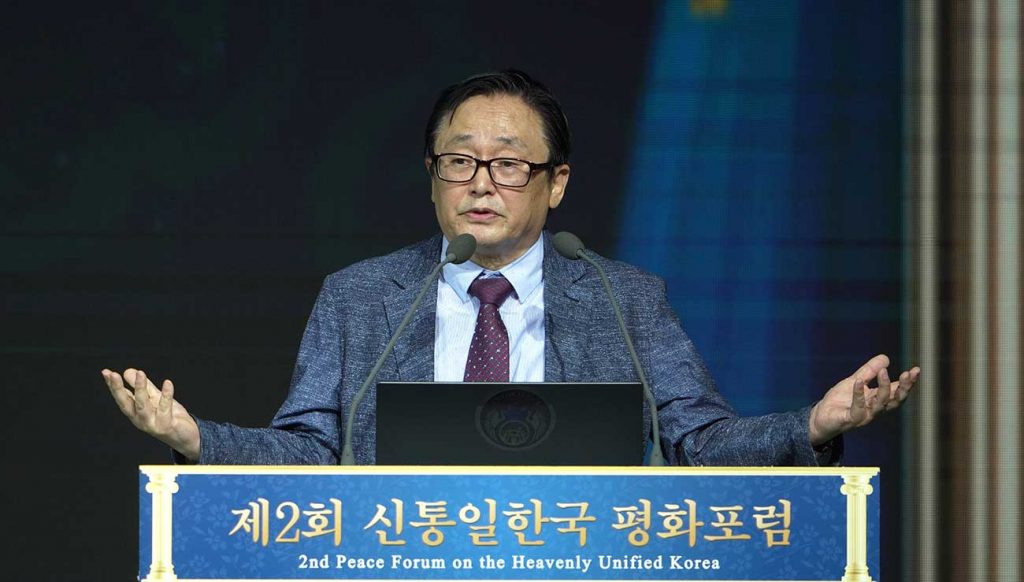
Dr. Jin Sung-Bae gave his second lecture on the theory of the heavenly unified Korea during the second Peace Forum which was held on September 3, 2021
A general overview of Theory of Heavenly Unified Korea from the point of view of the Dual Essentialities
1 This second general discussion on Heavenly Unified Korea has the same meaning as the 1st Peace Forum, but is a different type of lecture. It was selected by our Hoon Dok Hae instructor. The nature of this material is the work of reconstructing it centered on rational theory, the core of True Parents’ thought. By doing so, the content of the first forum is the same, but the general discussion is made in a different color.
The principle of rationality is unchanging logic from chapters 1 to 10 of our lecture. Reason is a criterion for diagnosing liberal democracy and socialism, and the key to resolve the ideological confrontation between the two Koreas. The principle of rationality is clear and simple: In short, “All beings are composed of images and forms, mind and matter. God, the cause of all existence, is the neutral being of sung-sang and hyung-sang.” Sung-sang and hyung-sang relate to each other through the essence of heart. I will construct the themes of the Theory of Heavenly Unified Korea centered on the principle of rationality.
__________________________
2 Ch. 5: “The Essence of Peace: Absorption Reunification or Federal Reunification?”
__________________________
3 South and North Korea are arguing over unification by absorption vs. federal unification: there is a great difference in their positions on peace. Peace of others is peace based on rational values, which is only relative peace. In contrast, peace for North Korea means peace based on dialectical struggle; yet can peace be based on struggle?
__________________________
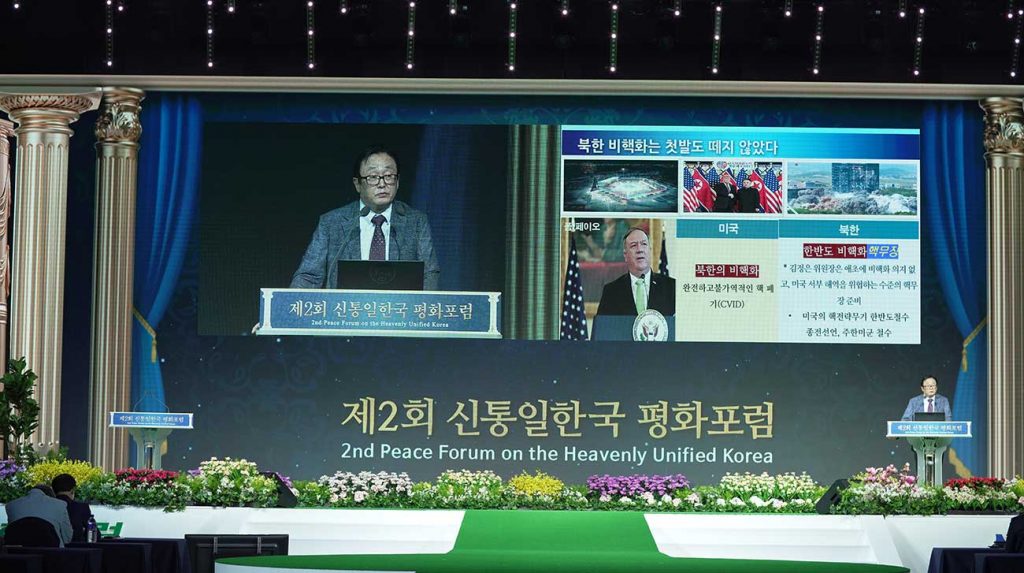
4 The Inter-Korean talks in 1972 concluded with the 7.4 Joint Statement, but it all finally came to naught on June 16, 2020, fifty years later, when North Korea exploded the Inter-Korean Liaison Office at Kaesong Industrial Complex. It was termed “Buddha’s All-Consuming Fire.” After inter-Korean summit in Pyeongchang and the first and second US-NK talks in Singapore and Hanoi failed, U.S. Secretary of State Pompeo summed it up: “Denuclearization of North Korea ended without even taking the first step.” Decades of inter-Korean talks ended in vain. The reason is simple: it is because the concepts of denuclearization on the two sides was different. Denuclearization to the U.S. means the complete disarmament and denuclearization of North Korea; What denuclearization means to North Korea means denuclearization of the Korean peninsula and withdrawing U.S. nuclear weapons from Korea. During the talks, North Korea was developing nuclear missiles able to threaten the West Coast. North Korea constantly demands that the U.S. remove nuclear weapons from Korea, declare the end of the war, and U.S. forces leave Korea. The two sides have different concepts of denuclearization and peace; this is the reason why the summit talks have not succeeded.
__________________________
5 Why are peace talks always futile? Let’s ask a more fundamental question. Can a genuine peace concept come from materialist communism, advocating alienation and revolution? It is absurd that a peace concept should come from materialism emphasizing struggle. It can only be a disguised peace.
6 For example, after the 1972 peace talks, concluding in the Joint Declaration of July 7, 1972, Kim Il-sung reminded his People’s Congress: “Do not for a moment forget that we cannot have peace until we liberate South Korea and reunify the country.” The North is conducting peace talks only for show; in truth it is a terrifying disguised peace, calling for the liberation of South Korea. Communists always disguise peace because materialist philosophy destroys peace, amplifies hatred. No peace concept can come from such ideas, material and figurative values.
__________________________
7 Then how about the classical peace of the past liberal democracy based on spiritual values? The liberal democratic parties to the peace talks think that chaotic peace, or the absence of war, is real peace. The fact is, President Moon Jae-in’s denuclearization and peace depend on Kim Jong-un’s heart. We call this “pacifist relativism.” Is the essence of peace the freedom of South Korea or the labor of North Korea? Are we homing in on the sung-sang or hyung-sang, the essence or the outward form? Resolving the nature of peace in relation to sung-sang and hyung-sang is the key to realizing inter-Korean peace.
__________________________
8 Ch. 8: “South-South Conflict and Cultural Revolution”
9 After the Korean War, with the “miracle of the Han River,” the Republic of Korea became a G11 country, the envy of the world. However there have been serious conflicts, involving North Korea, labor–management disputes, and ideological battles. The South-South conflict between conservatives and progressives has reached a dangerous level. The biggest problem in the South vs. South conflict is ideology: behind it is the debate among the pro-North Korean classical Marxist vs. Juche factions. In debate of South vs. South, between conservatives and progressives is ideological battle between the values pursued by South Korea and North Korea: sung-sang vs. hyung-sang. Sadly neither conservatives nor progressives can resolve the South vs. South conflict and lead the future Unified Korea. Conservative or liberal?
__________________________
10 From 1980, the Communists divided into factions—the classical Marxist PD (People’s Democracy Party) vs. the pro-Juche NL (National Liberation) faction; both sides fought. The PD faction counts on proletarian revolution from below; the NL factions advocate a consciousness revolution centering on the North Korean Party leader. These struggles culminated in the victory of the Juche NL. The Cultural revolution of Neo-Marxism fueled it, made hearts of young people throb (some outstanding ideologues were Gramsci, Marcuse, Althüsser, and Habermas).
__________________________
11 Neo-Marxism is Marxism that has re-emerged in capitalism after communism has almost collapsed. The ghost of Marx has been revived in the cloak of youth culture. Unlike classic Marxism, Neo-Marxism transformed political revolution into cultural revolution in the heart of capitalism. Goal: overturn capitalist society through cultural revolution, not political revolution. Cultural Marxism reaches the climax with the Eros Revolution of Marcuse, promoting liberation of Freud’s sexual instinct.
__________________________
12 Ch. 4: “Who is the subject of the Korean peninsula?” In this unit we deal with theories of human nature.
__________________________
13 Ch. 7: Human Liberation Theory: Freedom or Class Liberation?
__________________________
14 The problem of human nature is that sung-sang vs. hyung-sang in human beings oppose each other. Liberal democracy in South Korea is preoccupied with human rights and freedom; North Korean socialism is preoccupied with hyung-sang values: labor and material. Democracy began with the French Revolution: “Give me freedom or death!” bore fruit in the American spirit of independence, respecting natural rights (individual freedom, equality, life, property). But in democracy, overemphasizing the individual leads to excessive desire, reckless freedom leads to self-indulgence and infringes on the rights and freedoms of others. Hobbes: democracy corrupted people, leading to a struggle of all against all. Thus freedom has been lost.
15 Socialism is biased toward the materialist view of the human being: labor is viewed as the human essence. Socialism advocated liberation of workers, class liberation. They liberated anger and hatred of the working class, but could not liberate the bourgeoisie purged in the revolution. How can the screams and resentment of the slaughtered and purged capitalists and bourgeoisie be liberated by class emancipation? A philosophy of hate only breeds hatred. History shows how socialist revolution legalized class struggle, justifying slaughter and destruction. It is the worst crime of mankind that cannot be undone. Human emancipation was not realized through revolution, but rather it turned out to be a hell of slaughter and destruction.
__________________________
16 The same is true of Juche. Article 3 of the North Korean Constitution states that the DPRK espouses a people-centered worldview and Juche is a revolutionary ideology for realizing the independence of the masses. The view of man in Juche advocates the ideal man with independence, consciousness, creativity (for class revolution). So it is not correct to refer to Juche as communism with a human face. This is because the view of man in Juche itself is a fabricated view of man that advocates humanism.
17 Juche philosophy is fabricated social history: man is the master of all, the masses are the subject of history, and Parental Leader is the subject of subjects.
18 Juche is the only ideology and religion of North Korean authorities. From a social scientific point of view, Juche is far more religious than Stalinism or Maoism, and is now in the top ten world religions with 20 million followers. Juche has become an atheistic civic religion. Are humans spiritual beings based on freedom or material beings based on work? Are we entities of sung-sang or hyung-sang? Human emancipation is the issue of legitimacy of the North Korean and South Korean governments related to human rights, the issue which the South and North must solve realistically.
____________________
2 Ch.1 is “The Historical Meaning of the Korean People.”
3 Which side has legitimacy in the Korean confrontation? The capitalist system of South is based on freedom, a symbolic value. The socialist system of North is based on material equality, an image value. In this showdown, which side do you think is legitimate? While the Republic of Korea strives to deal with suffering of Korean people, communism in North Korea upholds class struggle, material value of labor. The two historical views are opposite: good vs. evil, spirit vs. material, sung-sang vs. hyung-sang values.
4 Let’s look at historical examples. The Republic of Korea adopted liberal democracy and market economy, risen to G11 status as an advanced country. Korea has a history of overcoming hardships, having suffered more than 930 invasions. No history of class struggle exists among Koreans. But People’s Republic of North Korea has history of class struggle. The history of class struggle leads to communist revolution and historical determinism.
5 In the history of the Korean peninsula, the 38th parallel (DMZ) is not only a military confrontation border, but a line dividing good and evil values, communism vs. democracy, idealism vs. materialism, theism vs. atheism. The Korean confrontation is battlefield of conflicting ideology, philosophy, values. No resolution can be found in democracy or communism, in extreme confrontation: Exclusive ideologies and systems. An idea to unify them can only be in a third zone. This is Godism. No historical view of the two Koreas suggests a future unified Korea.
6 Ch. 2: “Open Nationalism”
7 Ch. 3: “Why Godism?” Ch. 3 deals with the nature of God: mind or matter?
8 There are two “theologies”: in Christianity God is spirit, while in the materialist/atheist “theologies” God is material. How can there be an atheist priest? Historian Toynbee called communism “the illegitimate child of Christianity.” Communism overturned Christian view, advocated atheism/materialism, shaking the world and taking over the world. So is God sung-sang or hyung-sang?
9 Christianity defines God as spiritual reality, Sung-Sang, Absolute Other, self-existent, transcending sinful material world. Hegel: The idea of Absolute Spirit applied the Christian spiritual view to philosophy. Marx’s dialectical materialism overturned Hegel. Christianity, Hegel, Marx theories are intertwined. The pattern of these three is similar to the schema of Christian creation and salvation: humanity started from an original state and ultimately returns to the original state. The three-fold Christian creation/fall/salvation schema is analogous to Hegel’s and Marx’s three-fold dialectic.
10 Starting in 1980, the pro-North Korean forces were divided between the classical Marxist PD (People’s Democracy Party) and the pro-Juche NL (National Liberation) faction, and both sides fought fiercely for the ascendancy. Namely, the PD faction expected revolution stirred up from below by the proletarian class, while the NL faction pushed for a consciousness revolution spearheaded by the leadership from above. This struggle has ended with an overwhelming victory for the pro-North NL Juche faction.
11 Neo-Marxism is Marxism that has re-emerged in capitalism after communism has almost collapsed. It is a new form of Marxism that has emerged from within. The cultural revolution of Neo-Marxism fueled it, making young hearts throb (some outstanding ideologues were Gramsci, Marcuse, Althüsser, and Habermas). The ghost of Marx has been revived in the cloak of youth culture. Unlike classical Marxism, Neo-Marxism has transformed Marx’s political revolution into a cultural revolution in the midst of capitalism. Their goal is to overturn capitalist society through a cultural revolution, not a political revolution. In the end, cultural Marxism reached its climax in the Eros Revolution of Marcuse, who advocated the liberation of Freud’s sexual instincts.
As we have seen above, in a state of fundamental confrontation such as the history between North and South, national ideology, human liberation, and the conflict between political factions within Korea, neither side of the two Koreas is capable of resolving the difficulties. The root cause of the inter-Korean conflict is a battle between philosophy and philosophy, ideology and ideology, and ideas and values. The conflict is, in a word, an ideological conflict between the sung-sang (essentialism) and hyung-sang (outward form). Where can we find a way to resolve the conflict between the two Koreas based on the values of these two pillars, essence and form? Where can we find the answer? The answer is none other than the heart. Sung-sang and hyung-sang (inner essence and outward form) can relate to each other only when they give-and-take action centered on shimjeong. This principle is an immutable truth, and practical problems between the two Koreas can only be solved by this principle.
28 Can the immediate problems of the two Koreas, centered on their feelings, be resolved? Can the unification of sung-sang and hyung-sang centering on the heart truly be the key to solving the inter-Korean problem? Shimjeong refers to the original essence of love, and the essence of love is a primordial impulse of heart (affection that cannot be suppressed even if one tries to suppress it. That impulse of shimjeong is the motive of creation that originally burst forth at the moment of creation of the universe: it refers to the heart of God. Godism is the thought system founded upon this shimjeong. The sentiment is particularly well expressed in the life of the couple Rev. Sun Myung Moon and Dr. Hak Ja Han, who have been promoting Godism. The life of the two spouses exemplifies the life of the heart itself, and the life of the two spouses can be called a “story of shimjeong.” This is because the concept of shimjeong itself is derived from the events of the heart, accrued in the life of the exemplary couple.
29 In this way, the concept of shimjeong and the shimjeong event are one. At the same time, the life of both spouses takes precedence over the concept of heart. This is because, without the life and teachings of this pioneer couple with the mission to establish the model family, the concept of the heart of God could not even have appeared on Earth. Modern Christian neo-orthodoxy understands Jesus as the “story of the Word,” whereas, in contrast, the life of the Holy Couple is not a series of episodes of the Word, but a story of shimjeong. Only when we turn to shimjeong as the medium can we solve all the practical issues, from conflicts between our bodies and minds to inter-Korean conflicts and world peace. These events unfolded like a miracle that no one had anticipated. It is indeed through shimjeong as the magic key, that all the ideological problems can resolved at once. If it had not been for the teachings on the heart by these two great figures, and without the life and heartistic episodes along their path, the real world as is would have turned dark as pitch. As discussed above, the inter-Korean conflict has been divided into the sung-sang (internal) values of liberal democracy and the hyung-sang (external) values of socialism.
30 Then what remedy could we offer to the problems raised in Chapter 1, “The Korean Peninsula and Its Historical Significance”?
31 The British historian Edward Carr described history as a “ongoing dialogue between the past and the present.” This would mean that history is not only the recording of events in serial, but moreover involves the resolving of historical issues. There are various types of interpretation of history, such as the providential perspective, the view of progress, the cultural perspective, and the view of historical materialism, to name a few. The theory of Heavenly Unified Korea regards the history of Korea as the struggle between good and evil, interpreted through the history of providential restoration. “He who follows the Way of Heaven will see his seed continue long; he who spurns the Way of Heaven will perish.” Behind this adage some transcendental law is at work. It is no exaggeration to say that the confrontation between democracy and communism is a battle of legitimacy over their respective views of history. The struggle manifest in history is not a class struggle, but a struggle for good and evil, and the goal of history is to build a national community as on family under God.
32 As such, the 3.8 line, where democracy and communism are opposed to each other, is the line of confrontation between good and evil values, democracy and communism, idealism, and materialism. The ideology that can unify these two extremes is the Godism centered on the heart (shimjeong).
33 Godism is a movement to return to the roots of our nation and people—the Gyeongcheon ideology. The God that the Korean people have served from ancient days is the God of the Trinity, in which the three gods Hwanin, Hwanung, and Hwangeom are united as one. This ideology of harmony between heaven and earth becomes the starting point of not only Gyeongcheon ideology, but also Hongik ideology and Gwangmyeong ideology. The ideology of Heavenly Unified Korea should be based on national legitimacy and should be a universal ideology that can encompass both South and North Korea. And this vision must map out the future coordinates of a unified Korea, that is, an ideology bearing with it a long-awaited consciousness. The pillars of love Heaven, love human, and love your country serve as the founding ideology of this Heavenly Unified Korea. This founding ideal constitutes an ideology that can succeed and develop Dangun’s core ideological pillars of Gyeongcheon (revere Heaven), Hongik-ingan (benefit humanity), and Gwangmyeong (resplendent nation), and is thus a universal ideology that can contribute to world peace.
34 In fact, human rights such as freedom, life, and property rights in liberal democracy are inherently endowed by God. Likewise, the vaunted equality in socialism is derived from the inherent object value in the sight of God. And freedom can be true freedom only when based on the heart, and equality can be true equality only when it is based on the heart. Thus democracy championing freedom and socialism advocating equality can attain legitimacy only when based on the ideological pillar of Gyeongcheon (revere Heaven), which in contemporary terms is Godism. We must know that when liberal democracy and socialism shun the ideological foundation of Godism, their fundamental roots are very shaky.
35 As such, the founding ideals of Heavenly Unified Korea are the pillars of love heaven, love humanity, and love the nation; the ideology for implementing the foundation for the nation is Interdependence, Mutual Prosperity, and Universally Shared Values centering on God. The vision of a unified Korea can only be realized with these two ideologies as the foundation
36 Next in Ch. 3, let us look into the question of “Why Godism?”
37 In this chapter the topic of Ontology, the theory of the original nature of God, is dealt with. The question arises as to whether God is mind or matter. The orthodox view of Christianity, Hegel, and Marx’s materialistic view of Hegel “turned on his head” are in the position of opposing theologies. From the point of view of Godism, mind and matter are only attributes of God—they are not God himself. Therefore, the spiritualized view of Christianity has been in error, and Hegel’s starting point, the Absolute Spirit, was erroneous right from the outset. The spirit, namely the “image”, is not God himself, but an attribute of God.
38 The essence of God is shimjeong, and God is the God of shimjeong, which is “heart” but in a deeper realm. Genesis 1:28 states that God created man in his own image, male and female, which means that the intangible God appeared in the form of the tangible Adam and Eve. That is why, originally, God was to be the intangible True Parents indwelling Adam and Eve, and Adam and Eve were to become the tangible True Parents, as the ancestors of humankind. Thus, the main theory of God is God the True Parent, or Heavenly Parent. In terms of his attributes, God is a God of the dual essentialities of sung-sang (inward nature) and hyung-sang (outward form), while, viewed in terms of his essence which is shimjeong (heart), God is the True Parent, namely the Heavenly Parent.
39 Marx’s atheism and Nietzsche’s proclamation of the “Death of God” were all occurrences due to the errors in orthodox Christian doctrine. Orthodox (traditional mainline) Christianity is not properly based on the biblical God, but has lost the living God of the Bible because it is trapped in Christian philosophy and doctrine. In this sense, the views of the Christian church with its many denominations are severely distorted. It has imprisoned the living God of the Bible in formal philosophical and theological dogmas. Where else could there be such historical happenings and historical comedy? The God of the Bible is neither the spiritualized God of orthodox Christianity nor the materialist God of Marx. The God who created the universe is the God of the heart, God the True Parents, and our Heavenly Parent.
40 The next topic to be dealt with is the human problem, that is, the problem of human nature. These two views of the original human nature, that is, the sung-sang view of the human being and the hyung-sang view of the human, are opposed to each other. The chapters addressing this issue are Chapter 4, “Who Is the subject of the Korean Peninsula?” and Chapter 7, “Theory of Human Liberation: Freedom or Class Liberation?” The human-centered perspective of the two Koreas, as discussed above, cannot secure the future of a unified Korea. In this way, let’s take a look at the man-centered view, and the Hyojeong of the Heavenly Unified Korea theory suggested as an alternative to this, going beyond the limits of the views dividing North and South Korea.
41 First, Hyojeong thought is an ethical value system that human beings should take to heart and assimilate. Hyojeong ideology is derived from the ideal of “Ae in” (Love Human), and earlier on from the vision of “Hongik” (Benefit Humankind), together forming the founding ideology of Heavenly Unified Korea. Hyojeong ideology, embodying the pillar of Ae in, goes beyond the vague Hongik ideology of benefiting people widely. Hyojeong thought promotes a concrete human relationship ethic that emphasizes viscerally experiencing the love of God abiding in the conscience and loving humanity broadly as brothers and sisters. Vertical hyojeong is loving God and horizontal hyojeong is loving those around. The Bible passage “Love the Lord your God with all your heart, mind, and soul, and love your neighbor as yourself, love!” exemplifies hyojeong.
42 Second, hyojeong refers to a life of following the universal principle of conscience. My conscience is a divine subject different from me deep in my heart, serving as the judge of the inner court. Therefore, conscience is my subject—the most central and personal subject through which I can exist. Then if conscience is my personal subject, God is the Subject among all subjects. God abides through our conscience and delivers the universal Heavenly Parent’s “command of the heart.”
43 All told, the source of conscience is not “reason” as Kant said, but “heart” (shimjeong). This is the heart of Heavenly Parent. Living according to the heart’s bidding is not a Kantian ethic of duty, but an ethic of happiness and joy according to the heart. In this way, the life of hyojeong that follows conscience precedes filial piety toward our physical parents. This is because filial piety toward Heavenly Parent who is present in our conscience is first and foremost. Such is the life of hyojeong.
44 The topic to be dealt with in relation to hyojeong in Ch. 7 is “Human Liberation Theory: Freedom or Class Liberation?” Specifically, the social-political realm is divided between liberal democracy after the sung-sang aspect of humans, valuing human rights and freedoms, and socialism pursuing the hyung-sang side of human existence, valuing labor and material things. No clue can be found to resolve the inter-Korean conflict either of these human-centered views at their two extremes.
45 Originally, democracy is a system that respects the values of innate human rights such as individual freedom, equality, life, and property, while socialism is a system that poses labor, a materialistic value, as the essence of human life. Therefore, democracy was born through the human liberation movement to win freedom, and socialism was born through the class liberation movement to liberate labor. So should we choose freedom or equality? The dream of a future unified Korea cannot be nurtured from either of these extreme views of human being. The dichotomy of democracy and socialism can be overcome only by establishing a human view based on shimjeong. The value of freedom can be rightly esteemed only when it is based on values of the heart. This is because freedom is freedom of heart, freedom of conscience, and freedom of character. Therefore, freedom based on individual desires inevitably leads to indulgence and infringing on the freedom of others.
46 The same is true of the socialist concept of equality. Equal distribution, the vaunted ideal of socialism, is a fiction. The reason the socialist society that advocated the value of equality has transformed into the most distorted society of inequality is because it distorted the concept of equality into resultant equality. Can we say that all fingers are of different lengths and consequently are not equal? The different lengths of the fingers might appear to be inequality, but it is in fact functional equality. In this way, equality must be evaluated in terms of the object value before God. Therefore, true equality is equality of heart (shimjeong), equality of personality, and equality of satisfaction.
47 In this way, the freedom of liberal democracy and the equality of socialism can only recover their original meaning through shimjeong. Freedom looks at the relation between subject and object in terms of sung-sang, and equality evaluates the hyung-sang aspect. Thus, liberal democracy upholds the sung-sang view of human existence, whereas socialism emphasizes the hyung-sang side of life. These two poles can only be mediated and reconciled by the original view of human being centered on shimjeong. The shimjeong-centered view of man is the view of man according to the ideal of co-righteousness based on the hyojeong ideology.
48 The Hyojeong ideology is a human liberation movement that stems the tide of unbridled freedom from the wellspring of democracy but goes on to realize fundamental freedom. At the same time, it is a human liberation movement that realizes fundamental equality by correcting and reforming the distorted concept of equality in socialism. In conclusion, hyojeong thought is the ideology of human liberation that solves at once the crisis of liberal democracy that lost freedom through greed and the crisis of socialism that produces endless hatred through violent revolution. Furthermore, hyojeong ideology is the ultimate human liberation ideology that realizes the liberation of the heart (shimjeong) vertically, the liberation of conscience horizontally, and the liberation of ownership.
49 Let us consider the alternatives to Chapter 4, “Who Is the Subject of the Korean Peninsula?”
50 Juche ideology is North Korea’s home-baked view of human being that complements socialism. The human view that can overcome this North Korean Juche ideology is Hyojeong ideology. Originally, Godism proposed the “Three Great Subjects Thought” as an alternative to North Korea’s Juche ideology. When used in the everyday sense of God’s view of man, it is Hyojeong ideology, and when used in the sense of a critique and counterproposal to Juche ideology, it becomes the Three Great Subjects Thought.
51 In Juche thought, human life is divided into the physical life and the socio-political life. The physical life ceases, but the socio-political life is eternal. “Socio-political life” refers to the autonomy to live as the master of destiny, and this independence can endure forever when it establishes a blood-related relationship with the Leader through the Party. The life eternal theory of Juche thought displays the culmination of civic religion. The slogan hanging on banners all across North Korea is “Father, Comrade Kim Il-sung, will be with us forever.” Kim Il-sung is already dead.
52 In North Korea’s civic religion, the Parent Leader is the giver of eternal life, the forerunner of the nation, the divine being and the savior. The process is in full swing and the Father Kim Il-sung has been elevated to the God of North Korea.
53 In that sense, the declaration of Sun Myung Moon and Hak Ja Han during an interview with Kim Il-sung at the Presidential Mansion in Hamheung on December 6, 1991, “If you do not abandon the Juche idea, North Korea will perish. Accept Godism!” was a historic event that brought down a mace on Kim Il-sungism.
54 Then what is God’s view of man in response to Juche thought? The human-centered view of justice is that the heartistic aspect, lawful aspect, and creative aspects correspond to independence, consciousness, and creativity in Juche thought. While the view of human in Juche thought is the view of man for socialist revolution, the view of the human being in God-centered co-righteousness is the original view of man in creation. In Juche ideology, the subject of history is the masses of the people, and the subject of Juche, which is the subject of the masses, is the Leader, whereas in co-righteousness (“Universally Shared Values”), the subject of history is conscientious figures, and the Subject of subjects is God. In Juche ideology, the fact that the socio-political life of the Leader grants eternal life clearly shows the form of false religion. Eternal life is bestowed by God, the parent of mankind. God the True Parent is the parent of mankind who bestows love and life through conscience, and is the true subject of eternal life.
55 So who is the god and who is the subject in the Korean peninsula? The answer to that question is clear. The subject of subjects is not Kim Il-sung, but the Heavenly Parents, the parents of mankind. On the Korean peninsula, Kim Il-sung is a false subject and a fabricated god. Godism and co-righteousness (“Universally Shared Values” centered on God) accuse Kim Il-sung, the false subject, and accuse Juche ideology so that it can no longer be propagated on earth. In conclusion, the only alternative to Juche thought is the Three Great Subjects Thought and the Hyojeong ideology.
56 In the next chapter 5, “Will unification be achieved by absorption or federal unification?” we examine the position of peace essentialism.
57 The essence of peace cannot be realized under socialism based on the value of labor and disguised pacifism. Neither can liberal democracy, which pursues relativistic peace, preserve peace only with the value of reason. The reason that peace in liberal democracy and socialism cannot achieve true peace is because the essence of peace comes from the heart of God. Peace that originates from God is realized through the individual person as the first stage of peace. Peace begins with peace of mind and body, united around the heart, and only when this peace spreads to society, the country, and the world will the essence of peace be realized. This means that the source of peace is the heart of God (“shimjeong”) and the human conscience. Just as God is the source of peace, the principle of coexistence, co-prosperity and co-righteousness (“Interdependence, Mutual Prosperity, Universally Shared Values”) based on Godism is also a movement to realize peace essentialism.
58 A prime example of peace essentialism is the peace movement of Rev. Sun Myung Moon and President Hak Ja Han. I believe that this worldwide peace movement was the decisive moment for the collapse of the communist system under the Soviet Union. As the fact was later confirmed by the CIA, in November 1987, at that time, Gorbachev of the USSR had dispatched 25 members of the Red Army to the U.S. and instigated a plan to assassinate President Moon. However, by the grace of God, the plot was fortuitously thwarted by a police checkup at a rest stop along the turnpike. Later on, President Gorbachev, who was reunited with Rev. Moon at the Moscow Congress, allowed religious freedom in the Soviet Union and decided to have 3,000 Soviet youths educated with the ideas of Reverend Moon.
59 Rev. Moon received a total of 20,000 to 30,000 Soviet youths handpicked by Gorbachev and university rectors, welcomed them at training workshops in the U.S., Baltics, and the Black Sea for 40 days, and then sent them back to the Soviet Union. Those young men who received ideological education in the United States were among those who overthrew the military coup d’état during the Yeltsin Revolution by setting up barricades and laying down in front of Soviet tanks.
60 After the collapse of the Soviet Empire, Gorbachev, who had wanted to kill Reverend Moon, visited the home of President Moon in Hannam-dong, Seoul, and the two giants embraced each other in a thrilling reunion. Who brought down communism? There are many factors, such as Reaganomics and SDI Strategic Defense Initiative, but above all, it must be said that God destroyed communism. At the forefront of that providence, the figures of Rev. and Mrs. Moon stood tall, and behind them were the heroes and heroines of the global peace essentialism movement. Historians are morally and factually obliged to record these facts in history. As Korea’s President Moon Jae-in has demonstrated, peace essentialism is not a movement to kill the enemy, but a movement of saving the enemy by laying one’s own life on the line.
61 Next, we discuss alternatives to the scenarios laid out in Chapter 8: “South-South Conflict and Cultural Revolution.”
62 Cultural Marxism is embedded in the (R.O.K.) Comprehensive Anti-Discrimination Act, the Basic Act on Family Policy, and the Amendment to the Basic Act on Healthy Family, recently promoted by some political circles. There is already a satisfactory anti-discrimination law in effect; the reason for adding the word “inclusive” is to include various unions such as gay and lesbian cohabitation as recognized family forms. A more diverse family rather than a healthy one is their slogan. It is the ultimate truth that life, sex, and lineage are one and inseparable. The pure and chaste sexual union is the most essential standard of co-righteousness (Universally Shared Values). In that the image of God is finally realized in a family where a married couple becomes one, there is nothing more important than understanding sexuality and correcting our character especially with this issue in mind. Cultural Marxism is embedded in the (R.O.K.) Comprehensive Anti-Discrimination Act, the Basic Act on Family Policy, and the Amendment to the Basic Act on Healthy Family, recently promoted by some political circles. There is already a satisfactory anti-discrimination law in effect; the reason for adding the word “inclusive” is to include various unions such as gay and lesbian cohabitation as recognized family forms. A more diverse family rather than a healthy one is their slogan. The movement for Absolute Sex and True Family offers an alternative to such manifestations of cultural Marxism. This True Family movement is also a movement to lift up the shimjeong of God our Heavenly Parent.
63 Next, we delve into Chapter 9: “The Seed of Unification, One God, One Religion.”
64 God is the True Parent of humankind, and that God is One. Some religions insist on a personal God and other religions claim impersonal truth, but the ultimate reality that all religions seek is one God, our Heavenly Parent. This is the central point that can unite all mankind, transcending borders, races, and religions. And because God is one, there is ultimately one religion reuniting mankind with our Heavenly Parent.
On May 8, 2020, President Hak Ja Han proclaimed Heavenly Parents Holy Community. The Holy Community of Heavenly Parent is to realize the ideal world of one extended family of all humanity under one God. In other words, under the big umbrella of Heavenly Parents Holy Community, the world’s religions will become one, and all organizations such as politicians, academics, journalists, religious people, business people, and artists will come together to realize the ideal world.
65 Chapter 6, “Inter-Korean Ideological Conflict and Overcoming it,” will be examined.
66 First of all, democracy is a system “Of the people, by the people, for the people,” and socialism is a system of the masses, by the masses, and for the masses. Whereas liberal democracy leads to the struggle of all against all stemming from abuse of individual freedom, socialism emphasizes class struggle and revolution and ends up amplifying hatred. The most basic pillars of democracy are the electoral system and representative government. However, these rational institutions were corrupted by excessively competitive elections, the failure of delegated representatives to represent their constituency, and the monopoly of power by the majority party. As an alternative to this, co-prosperity eliminates excessive competition and realizes elections and unified politics in which everyone wins, and the fair distribution of power between the brotherly parties, furthermore, it is oriented toward organically unified politics in which the parliament, government, and citizens come together as one family. Co-prosperity proposes the family as the model for resolving the struggles and conflicts that arise from the individual in liberal democracy and the socialist class. As such, co-prosperity is the politics of brotherly democracy centered on parents, by brothers, by brothers, and for brothers.
67 The ideology of capitalism based on individual private property and socialism where the means of production are held in common raises the question of whether the individual or the state takes priority. In the ideological confrontation between the two Koreas, where one affirms the individual and the other adamantly insists on the whole, the ideal of coexistence presents the family as the workable model. Concerning the property issue, the only model capable of securing the purposes of both the individual and the whole is the family. To take a domestic example, the refrigerator is a utility shared by my parents, my brothers and sisters, and me. Only through the common ownership model of the family can private ownership under capitalism and state ownership in socialism be harmoniously integrated.
68 Furthermore, in the ideal of coexistence, the amount of possession is determined by appropriate possession regulated by each person’s conscience. Adequate ownership is measured by an individual’s psychological satisfaction according to the effect-value theory. The question of proper ownership raised here is the key to solving the problem of socialist equality. What we call “equality” is originally equality as an object value before God. Therefore, equality is equality of love, equality of freedom and personality, and equality of satisfaction. The five fingers are equal, not because they are the same length, but because of the equality of functions in which the fingers perform the multiple functions they are called to perform. In this way, common ownership in the ideal of co-existence (“Interdependence”) solves the freedom problem of capitalism, and appropriate quantity of ownership becomes the key to solve the equality problem in socialism.
69 Finally, Chapter 10, “North-South Unification and World Peace,” will be omitted.
~ END OF LECTURE ! ~