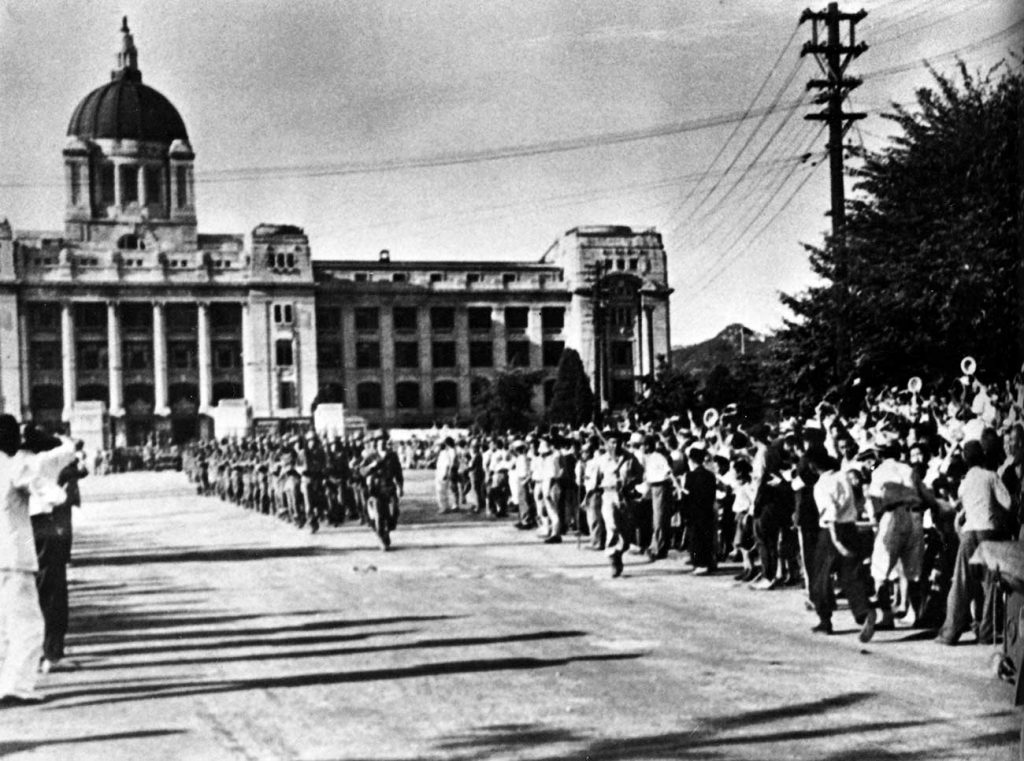
Based on extracts from his speeches throughout his life
Part 27
Earlier installments are available for reading.
Spiritual Battle to Prepare the Way for True Parents
Completing the internal preparations for the public mission
I grew up during the period of colonial rule and oppression. In those days, even if we had many hopes and dreams, we could not express our internal heart. Even if we had different ideas and wanted to express them, we had to remain silent, observing our surroundings. It was very difficult to speak about a particular ideology or philosophy, even if it was great. Under those circumstances, I had to struggle, unknown to anyone, to prepare for the course of restoration we have learned about in the Divine Principle.
I prepared the Divine Principle that I teach today while I was in my twenties. Look at the situation now! What I spoke about fifty years ago has been fully realized. This is not something I am saying for the first time. In those days, the nation we now call Korea did not exist. How sad the situation was then!
Korea’s liberation foretold
Mrs. Heo predicted that Japan would surrender in 1945 on August 15 (the seventh day of the seventh month of the lunar calendar). She often spoke out in public about what she had heard from Heaven, so she was arrested. She had already received a revelation about when the announcement of the surrender would be broadcast.
Everything she received from Heaven came true, so people could not help following her. Thus, they knew the day of Korea’s liberation. To them was also revealed that “When Japan collapses, you will be able to meet the Lord.” At the time of their release from prison, they danced with joy, but as before, they continued to be persecuted by mainline churches.
This God-inspired work began at the formation-level with Mrs. Kim Seong-do. Mrs. Pak No-pa inherited this work from her through Mrs. Heo Ho-bin.
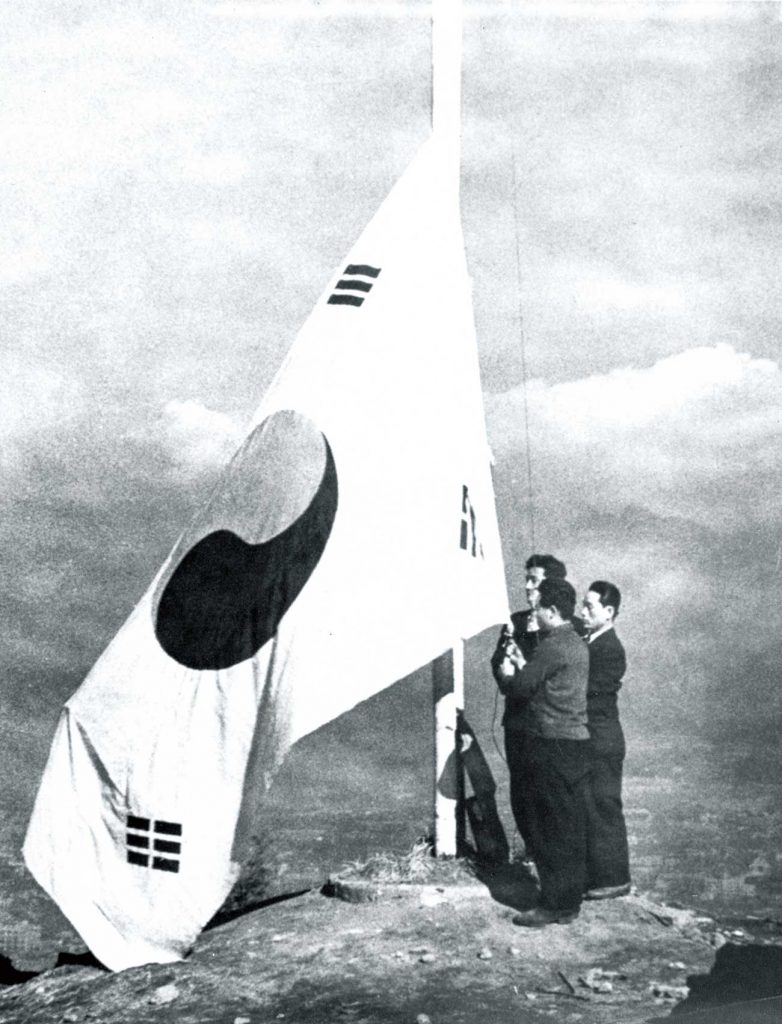
Day of liberation (August 15, 1945)
On that day, Koreans could rise out of their desperate, hopeless situations and become a people who could meet a day of new hope; the hopes of families and individuals were renewed. If you merge the hope of a nation, the hope of families and the hope of individuals into one, it makes a foundation for national-level victory. This was the day of hope, in which we could recover the country; it paralleled Jesus’ time, in which the opportunity to gain a country was lost. The day of Korean liberation in 1945 was the day of hope for recovering the lost race and the lost family.
After liberation, patriots who had spread out all over the world returned to Korea; groups arrived from Japan, China, America and Russia. As you know, fighting broke out among the communist Kim Il Sung faction, the Kim Ku faction, Dr. Rhee’s[1] faction and the China faction,[2] and a time of confusion ensued. At that time, I couldn’t shout “Mansei.” Everyone else was so happy because they had been liberated, but even though I wanted to raise my hands with them, my hands just wouldn’t go up. Everyone else was dancing joyously on August 15, but I was in a tiny room praying in tears.
I was tortured a lot by the Japanese, but when the war ended, I gathered all those of my friends who were planning to take revenge on the special police agents who had tortured them and said, “The Japanese have lost the war and are really in a wretched state. God will punish those who beat people; they have lost sovereignty over Korea and are begging on bended knee for forgiveness.” I also quietly called some Japanese who was being pursued in Korea and helped them pack their bags saying, “Go home quickly, before you are tortured.” Nineteen forty-five was a very happy year for the Koreans, but it wasn’t for the Japanese, who had lost the war; for them it was a sad year. We need a day on which all the people of the world can rejoice together.
The seven years following Korea’s liberation
The military ruled Korea immediately after liberation.[3] It took three years, until 1948, to establish a [Korean] government. The three years immediately after the liberation was a buffer period.
The second Israel had to be established on the foundation of the first Israel. America, the representative nation of Christianity, the second Israel, facilitated Korea’s independence. Based on this independence, which came via the second Israel, the problems of the first and second Israels had to be solved and Korean independence had to stand on the resulting foundation. That was the situation at that time.
What would have happened if Christianity and Korea had welcomed me? I could have absorbed Protestant America over the course of seven years. And if I had begun working on the world level after the seven-year course finished in 1952, I would have mobilized all the world’s statesmen by the time I was forty years old, leading them in one direction, toward the goal of making the kingdom of heaven on earth. That was the original providential plan. Christianity has made a unified, global territory after four thousand years of Judeo-Christian history. If Christianity had followed me, a unified physical and spiritual world would have come about.
US military government and the Christian cultural sphere miss their chance
The occupying forces’ military governor of southern Korea, General Arnold,[4] took over all the Korean government offices. The translators the American military government used were all former Christian ministers or other people who had studied theology. They worked for the government as translators but ignored God’s will, though it was by God’s will that the historical foundation to make an Abel-realm political party had been prepared. They became one centered on the country but not centered on God’s will.
Through mistakes within the Christian cultural sphere (the Korean Christian church, Korean leaders, American leaders and missionaries) the platform for the returning Lord’s ideal—the achievement of which would have brought about Heaven’s blessing and the holding of a glorious banquet, and developed into the victory of the kingdom of heaven—began to crumble. The United States was in the position of the eldest son but did not fulfill the responsibility to be an offering that would have been able to restore the foundation of the father and mother of Korea.
Korea’s demarcation and Christian disbelief
God knew that Christians might oppose His will. He therefore prepared, internally and spiritually, a large number of Spirit-led groups. But no matter how many internally prepared groups there were, Christianity externally already had the form of a nation, so it was a matter of course that on the day they began to oppose us, we returned to the same situation as when Judaism and the nation of Israel opposed Jesus. AT that point in time, the same destiny was unfolding.
I was one of five people who formed the Liberal Party. I was fully aware that things wouldn’t work without creating a foundation centered on a political organization. At that time, as a young man of twenty-five or twenty-six, I was about to start joining hands with high-level Koreans. I intended to start with a broad base, centered on the Defense Minister at that time, Shin Seong-mo,[5] but the plan did not work out. I was going to start on the highest level and go out to the world…. If only Dr. Rhee and a few members of his party—between three and twelve of them—had supported me, the United States, the Cain leader of the democratic world, would surely have been connected with this nation and I would have been able to move in that direction.
I had received God’s permission to start from the highest position but everything was blocked because of two Christian ministers. I was cut off by a very senior minister, so I had no choice but to start the course of restoration again from a lower position. At that time, one person who had formed a close bond with me and was working in the forefront was the famous minister of an established church. Nevertheless, he betrayed me because he wanted to have more power for himself.
Spiritual groups divide, established churches grow in power
The person who was to become the president of Korea should have represented Abel. In Abel’s position, he should not have used Christian ministers who had had an easy life. He should have excluded all those church ministers and chosen instead those Abel-type people who had been in prison or who had suffered in the underground liberation movement. Then he should have reeducated those people in order to establish the country in the right way. If only this had happened then!
At that time, I knew all the people at the ministerial level. I had met all the well-known people in the Korean underground. They also knew who I was. If that had happened, centering on the Abel group, which focused on national independence, we could have automatically started out in a new direction and advocated a new way for the world. The country could only have been saved if the underground churches and the churches that were being re-created[6] had united and representing the Abel realm had become one with the Cain realm’s established churches.
And the Old Testament Age spiritual group bent on the restoration of Eden should have followed the New Testament Age group that had a similar focus, but it didn’t realize this. It thought it was the best group. Because a center is needed to carry out any activities, in the East or West, if the center doesn’t appear, everything collides. North and South collide; East and West collide. I brought these people together.
To be continued next week.
[1] Syngman Rhee, first president of the Republic of Korea (1948–1960)
[2] The Korean Provisional Government (KPG) had been based in Shanghai; Kim Ku had led the KPG but also had his own following.
[3] Father is referring to the United States Military Government in Korea (1945–1948)
[4] Archibald V. Arnold (1889–1973) was commander of the U.S. Army’s 7th Division when it landed in Korea on September 8, 1945. Four days later, Lieutenant General John R. Hodge appointed Arnold acting military governor, a post he held until that December.
[5] Shin Seong-mo (1891–1960), Republic of Korea Defense Minister (March 20, 1949–May 5, 1951)
[6] This appears to be a reference to the churches that had been banned under the Japanese and were reestablishing themselves.