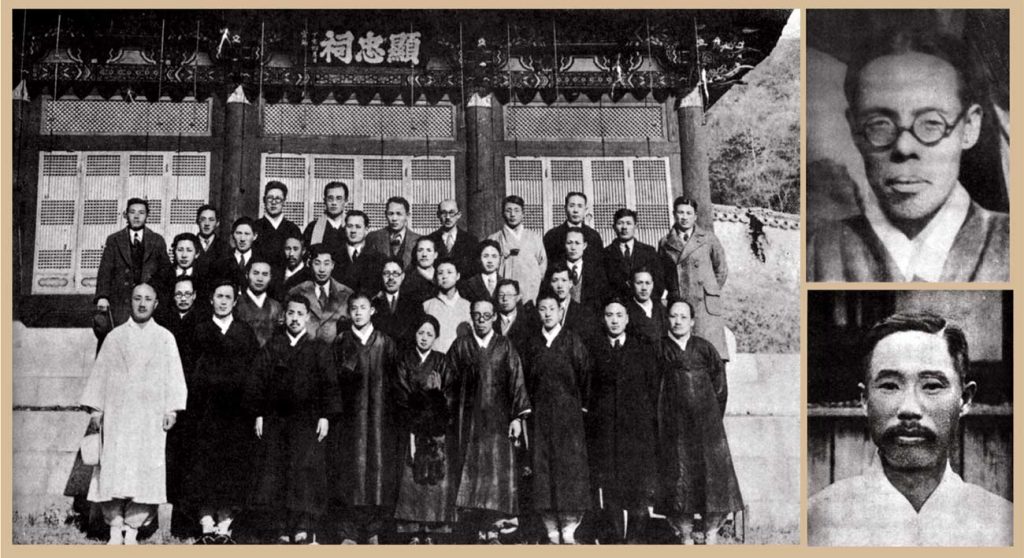
After the March 1919 independence uprising, Japan replaced its governor-general of Korea with Baron Saito Makoto, who quietly initiated a great upsurge in police presence, better intelligence-gathering and stricter control of the independence movement. Simultaneously, he conspicuously built more schools, allowed a great increase in civic groups and relaxed restrictions on non-threatening activities, such as Korean-language newspapers. Pictured above are some members of the Korean Language Society, formed as a result of that policy in December 1921. The Society published a journal, assisted needy scholars and produced a dictionary. Policies later changed, however. In late 1942, dozens of Korean Language Society members were arrested. Among them, lexicographer Lee Yun-jae (top right) and journalist Han Jin (bottom right) died in prison before Korea’s liberation in 1945.
This portion of Father’s life story opens with him speaking about his incarceration in a Gyeong-gi Province provincial jail during the time of Japan’s colonial rule of Korea.
Based on extracts from his speeches throughout his life
Part 23
Earlier installments are available for reading.
Endurance and Forgiveness
Internal preparation
During a forty-year period, Japan tried to rid Korea of all her cultural traditions, even her language. I was imprisoned by the Japanese during that time. The government also imprisoned and oppressed many other Koreans. To be called by God, you had to become a patriot, a devoted son or daughter, and a citizen devoted to society. Patriots are people who have resolved to offer themselves to the nation. Such people are needed for God’s providence. When God establishes the foundation for the providence and expands it, Satan always opposes Him. Thus, as a young man I prepared myself for the public life to come.
From the 1920s onward, God was already prepared. That is when I was born. I have struggled to resolve life’s hitherto unsolved problems, to reveal the heavenly way and to deal with all the problems related to religion and to love. I worked in this way until the time of Korea’s liberation. How old was I at that time? I was twenty-six then.[1] I couldn’t say anything about the Principle you are now studying. This was partly because God had told me not to and partly because I had promised God that I would begin my work immediately after Korea was liberated. One person alone cannot accomplish God’s will; there have to be partners to work with.
Forgiving and blessing one’s enemy
Even though they may lock me up in prison, they can’t do the same to my mind or my philosophy. “Hit me. If you beat me, you are striking the foundation God laid for me and the course I have walked along the road God has paved. Let’s see how strong my heart is when it comes to loving my enemies. Hit me if you want to hit me. Do you think I will hate you?” I’ve been severely beaten, vomiting blood. I was beaten in place of the human race with its bitterness accumulated through history. They would whip me, and then I would forget it. How wonderful it is for someone to go through such a thing and be able to say, “God, please forgive them.” We should go through that; to do so, we have to practice self-abnegation. Then it becomes simple.
In the days when Korea was under Japanese control, there was a man named Kumahata, a name I’ve never forgotten. Though we were taught to love our enemies, I would have kicked him without hesitation when he was stamping on me and hitting me. Then I thought, “Hey, you! Fine. Do as you want. I will endure this even though it may push me to the point of death.” I didn’t treat him as my enemy. Since it was my responsibility to pray for blessings for others, I looked for something in them that could make them worthy to receive blessing. In my prison cell, that was what I studied. Since men have a conscience, in the morning when everyone else had gone out, the torturers would apologize. That is a human quality. When we see that, we can see that people everywhere are the same. They can’t deceive their consciences.
A mother’s tears
They gathered the little money they had and sent me abroad to study, but I ended up in jail there.
My mother came to the prison and wept. She might have said, “If you had thought of your mother, you would not have gotten involved in that kind of movement.” But she never said anything. I had not done anything wrong my mother’s son. As one born into the Moon family, I never shamed the family name. Centering on the traditional and unique philosophy of Korea, they could see that my conscience was clean. Even though I was in prison, I did not want a mother who pitied her son and cried. I needed a mother who would give advice and encouragement and who would tell me to carry on with hope for tomorrow.
It was impiety. There is no greater lack of filial piety¡¦. Soon after I returned from Japan, the police summoned me, because they were afraid. It wasn’t as if I got into fights with them. When my parents came to the police station in tears, I would shout like a thunderbolt descending on them from the clear blue sky. I said, “Your son is not a petty little boy. The tears in my eyes are to relieve the world’s sadness and God’s. These tears are not for you.” That is what I told my mother about why I was walking this path.
Leaving prison
When you leave prison, you have to be kind to the people there. When you go through harsh torture for about six hours and pass out on the floor, the torturer sympathizes with you. The prejudice at that time was real but a torturer later wonders what has become of his victims. This explanation can never make sense at all to anyone who just chase after enjoyment.
When I was about your age, I was tortured a lot. Nevertheless, I didn’t die though I was beaten and my body swelled to bursting through the water torture. I recovered in about two weeks. I ate well for two weeks and returned to normal. So, suffering is not something you want to experience when you are old, but before you have your family.
I have been incarcerated many times, but I was not destroyed by it. No one knows that I wept on the banks of the Han River, but I know….
There were times when I went high into the mountains near Seoul and wept bitterly. Where will this nation go? Where is she going, away from the heart of God, the great supervisor of the universe? Before the liberation, I traveled everywhere, starting with Mt. Bugak.[2] I bowed my head and prayed, “O Korea! Don’t be sorrowful. Even though the world may be lost, you won’t be. So long as I exist, Korea will not be lost.” Our ancestors and God carry much bitter sorrow.
Staying in Seoul reminds me of the day I prayed while hiking to Mt. Samgak[3] and walking around that area. Have you done that kind of thing? Though the world is unaware, we have to build the road of love. We have to build an altar to love. Though I long to tell of my serious suffering and prayers offered to God for the world’s sake, there is something very heartbreaking about it, so I cannot speak.
When I started forging this road, I had already met and seen through all the famous Christian ministers in Korea. I had already evaluated them. They didn’t know about me. From outer appearances, I was nothing but a bachelor and an unkempt passerby, but I looked inside them and wrote down what I saw in a report to Heaven. After making my report to God, I began my work.
I went to the underground churches first. Three years before the liberation, or from the time I was twenty-two, I began traveling to the underground churches. Because people had been tainted from bowing to the Japanese Emperor, genuine religious organizations all went underground. Though I was young then, I was well aware of religious organizations doing underground activities and other states of affairs in Korea.
Foresight and liberation
This man they call Reverend Moon is a clever person. [Laughter] I am not a fool. I am canny and see far into the future. Already, in my teens, I knew what would happen to Korea. Yesterday, my younger cousin told me, “What you said about Japan and Germany—that in 1945 Germany would be out of it in April and Japan in August—all happened.” He said, “I thought a person had to graduate from a university to be well informed about the world and see the future.”
To be continued next week.
[1] Father was twenty-five by Western reckoning
[2] A peak in northern Seoul, behind the presidential palace
[3] Samgak means “three horns” and refers to a set of three peaks in the mountains on Seoul’s northern perimeter.