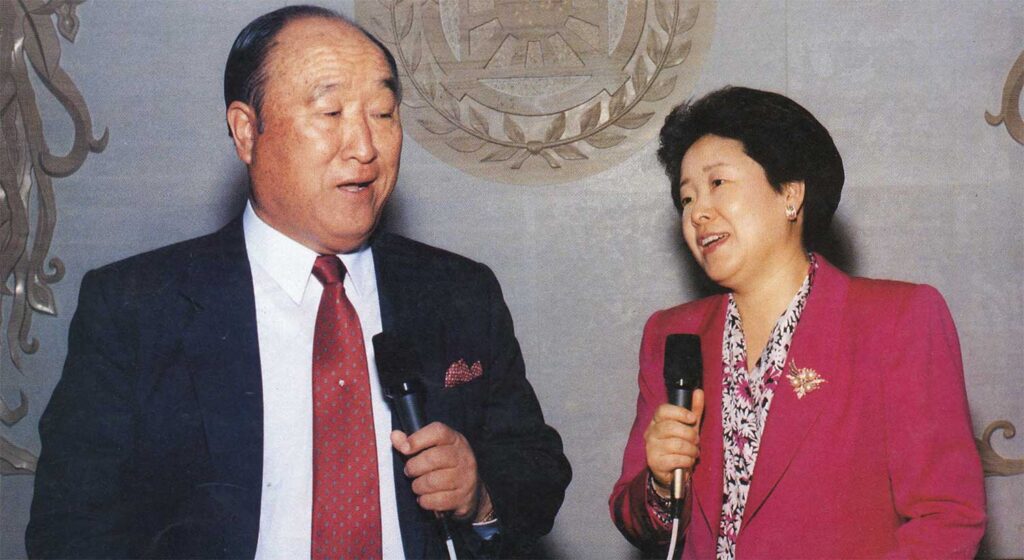
Father’s speech on March 22, 1989 in Washington DC
Distinguished Chairman,
Esteemed Guests, Ladies and Gentlemen:
It is my great pleasure to welcome all of you to the 10th World Media Conference in Washington DC.
It was reported to me that the participants this year, as well as the speaker selection, are by far the most distinguished in the history of the conference. I am delighted to meet you all, many of you for the first time. I hope you are as happy to see me as I am to see you.
As you all know, I am primarily a religious leader. And yet my work has not been limited to the field of religion. I have a tremendous interest in the media. Since 1975, I have created many newspapers and publishing enterprises in different parts of the world. I established a daily newspaper, Sekai Nippo, in Tokyo. In 1976, I founded the New York City Tribune, in New York. I have started Spanish language dailies, called Noticias de/ Mundo, in several major cities of the United States. In 1981, I began the daily Ultimas Noticias in Montevideo, Uruguay. In the Middle East, I started the Middle East Times.
But I am most well-known as the person who provided the alternative voice in Washington, D.C., the nation’s capital. After the demise of the 128yearold Washington Star, the city was left with only one newspaper.
Most Quoted Newspaper
The Washington Times, in less than 7 years, has become a respected newspaper and won many awards for design and editorial content. It is recognized by the Associated Press as one of the three most quoted newspapers in the United States. The Washington Times Corporation also publishes a weekly news magazine, Insight, and a monthly academic journal, The World & I. Furthermore, I have just returned from Korea, where we launched a new major daily newspaper, the Segye Times, which has achieved a circulation in excess of one million in less than two months. In addition to these publications, in 1978 I founded the World Media Association to explore issues related to media ethics and responsibility.
The question arises, why should a religious leader expend so much effort and resources in media enterprises? My reason is quite simple. It is because I recognize the power of the media. The latter half of the Twentieth Century is an age dominated by communication. The electronic and print media are the most powerful and influential means of communication the world has ever known.
In a world of conflict and differing ideologies, the media plays a large role in determining whether we live in peace or war. My ultimate goal and desire is to achieve lasting world peace, a peace based upon a system of true values. The achievement of this goal is far more likely to be determined by the work of the media than by military might. So perhaps it is accurate to say that this room contains the most powerful people on the face of the earth those who have the power to shape, for better or worse, the future of mankind.
In spite of the media’s great power, in contrast to the great majority of professions in the world, most free nations have very few laws governing the conduct of the media. Given this situation, when one considers the tremendous power wielded by the free press, it is clear that media professionals must continuously exercise their own powers of self-examination. The World Media Association was created as a forum for that self-examination. Our purpose is to promote the free press wherever freedom of expression does not exist and to promote responsible use of the media where the free press is already established.
The Gift of Freedom
Freedom is one of the most precious gifts from God to man. Man is created to be free, and also to be responsible for how he uses his freedom. To use freedom properly requires self-discipline and self-control, based on a fundamental understanding of right and wrong. When asked to define right and wrong, the answer is often given that anything is acceptable as long as it causes no one any harm. But clearly, even to determine what “harm” is requires an absolute standard, a standard which must derive from the purpose of life itself.
God, being the Creator, has already determined the purpose of human life. Man’s spiritual wellbeing is realized as he accomplishes his life’s purpose in accordance with the moral laws established by God. When he violates these principles, he invites self-destruction, just as he does when he violates the laws of nature. I say this because, before one is a journalist, or a scholar, or a clergyman, or even a husband or wife each person is a child of God. We are the sons and daughters of our Creator. This is where our sacred nature and unique human dignity originate. The first responsibility of a human being is to exercise freedom to preserve our God-given value. In order to do this, we must live in accord with basic moral principles given by God.
America is a nation which has put a high value on individual liberties. Americans, and anyone living in America, may worship as they wish, assemble at will and may print or speak just about anything. At the same time, the American founding fathers stressed the concept of self-government. In America today, we find an abundance of freedom, but a shortage of self-government.
Certainly the media must be free, and must be self-governing. And a self-governing media must also be a moral media. What do we mean by a moral media? A moral media uses its freedom to protect, preserve and promote God-given human rights and dignity. The preservation of human rights and human dignity must be the standard of all ethics and morality.
Therefore, the media must stand at the very forefront in the defense of human dignity and freedom and the crusade against all forms of injustice. Doing this is the best possible way to ensure world peace. The media must lead the fight against all forms of oppression. Furthermore, in the service of morality, the media must oppose corruption and racism and vindicate the unjustly accused. A moral media must lead the fight against drug abuse, pornography and many other destructive vices of our society. Thus, the media must become the conscience of society.
At this year’s conference, for the first time, we have a delegation of journalists from the Soviet Union and also from the People’s Republic of China. We are very pleased to welcome you. The communist world is rapidly changing. I encourage the new policies of “glasnost” and “perestroika” in the Soviet Union, and the reforms being enacted in China. The media
of both countries is playing a leading role in these changes. The World Media Association, in its commitment to free and open discussion, is happy to serve as a forum for your participation.
The Search for Solutions
Both the democratic and communist worlds are searching for solutions to the problems of corruption, greed and exploitation. And both worlds are still far from achieving the ideal. As I see it, there are fundamental problems with both societies. They are both excluding God from their search for solutions. God has been forgotten.
The forsaking of God is the most serious problem of this century. When you forsake God, either in the name of totalitarianism or atheistic secularism, the result will be the same: self-destruction. Both East and West are struggling with this fundamental question.
As I said, I founded the World Media Association to promote free expression in the media wherever it is oppressed, and to encourage a responsible media wherever freedom of the press already exists. Furthermore, I founded this important organization to promote the spirit of truth so that all media professionals can become uncompromising champions of truth. We have held this conference almost annually and have organized numerous fact-finding tours with media professionals all over the world, including the Soviet Union, China, South Africa, Mozambique, Angola, Cambodia and Central America.
These tours are searches for truth, giving journalists an opportunity to experience the world firsthand. As a very good old saying goes, “seeing is believing.” Journalists must always have their hands on the pulse of the world in order to report accurately. The work which we will undertake in these next few days is important an examination of the performance of free and moral media.
Finally, I am sure you have seen many stories about me on television and in your own newspapers. You might even agree that some of the more exciting stories about Reverend Moon have helped sell more newspapers or bring a bigger audience to your newscasts. So, since I have helped you all these years, I would now like to ask you for one favor: find out what I am teaching and what kind of life I am living. Conduct your own open-minded and thorough investigation, and draw your own conclusions. This conference is a good place to begin.
I hope you will enjoy your stay in Washington and will enjoy the conference. Thank you for coming and may God bless you.